Artwork
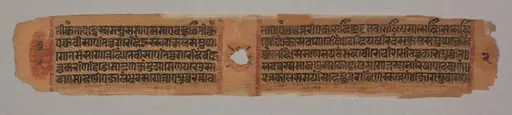
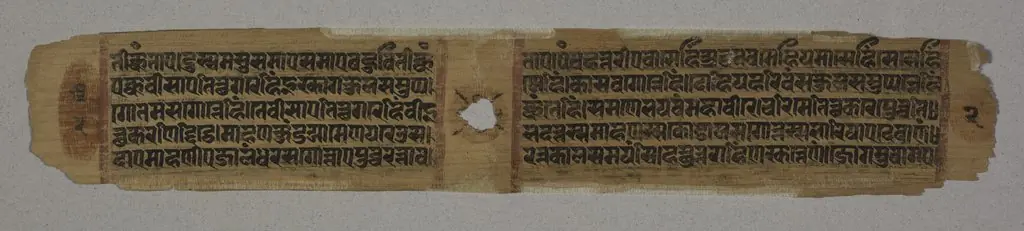
Folio (recto) from a Kalpa-sutra and Story of Kalakacharya of Devachandra: Text

Folio (recto) from a Kalpa-sutra and Story of Kalakacharya of Devachandra: Text is an unspecified painting by the Mughal Painting artist Devachandra. It dates from 1279 and is held in the collection of the Cleveland Museum of Art.
About this work
Overview
The physical condition reflects centuries of use, with brittle edges and surface cracking characteristic of aged parchment in religious contexts.
This folio, dated 1279, originates from a Jain manuscript compiled by the scribe Devachandra. Crafted on fragile, yellowed paper, it contains dense black ink script arranged in tightly spaced lines. Faint red ink borders frame the text, while a small tear near the center suggests prolonged handling. The physical condition reflects centuries of use, with brittle edges and surface cracking characteristic of aged parchment in religious contexts.
Subject & Meaning
The text records passages from the Kalpa-sutra and the narrative of Kalakacharya, central to Śvetāmbara Jain tradition. These writings detail monastic lineages, doctrinal rules, and the legendary life of Kalakacharya, a monk whose actions shaped Jain community structure. The folio served as a devotional and instructional object, preserved for ritual recitation and transmission of sacred knowledge across generations.
Technique & Style
The script is a precise form of Prakrit written in a regional Jain calligraphic hand, notable for its uniformity and angular clarity. Ink was applied with a reed pen, and red lines were likely drawn with a ruler to guide composition. No illustrations accompany the text, emphasizing the primacy of the written word in this tradition. The paper’s texture and wear reveal hand-made production methods common in medieval western India.
History & Provenance
Created in 1279, the folio was likely part of a larger manuscript produced in a Jain scribal workshop, possibly in Gujarat or Rajasthan. It remained in religious or monastic use for centuries before entering private collections. Acquired by The Cleveland Museum of Art in the 20th century, its survival is attributed to careful storage and limited exposure to environmental damage.
Context
In the 13th century, Jain communities in western India maintained a strong scribal culture, producing manuscripts for temple libraries and monastic study. These texts were not merely religious but also acted as cultural anchors, preserving language, law, and history. The absence of imagery aligns with Jain ascetic values that prioritized textual authority over visual representation in sacred contexts.
Legacy
This folio stands as a tangible link to a centuries-old tradition of Jain manuscript production. Its survival offers insight into the material practices of pre-modern religious scholarship and the endurance of textual devotion. Today, it contributes to scholarly understanding of Jain liturgy, paleography, and the material culture of medieval Indian religious communities.
Artist & collection
Artist
Devachandra made delicate drawings on palm-leaf manuscripts in 13th-century India.

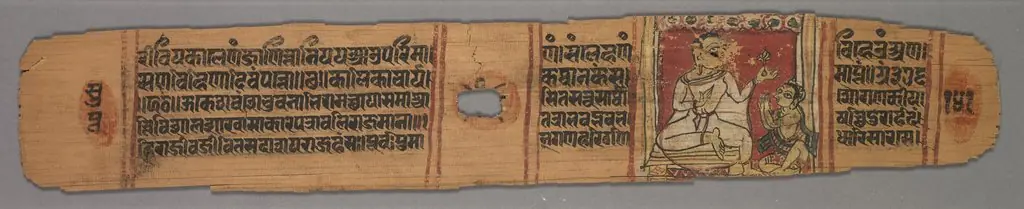 Leaf from a Jain Manuscript: The Story of Kalakacharya: Colophon Page, Text (recto)
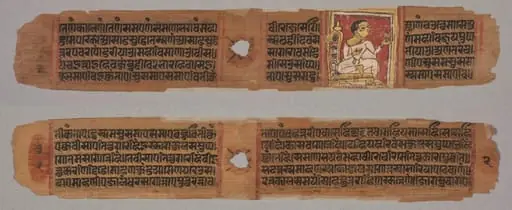
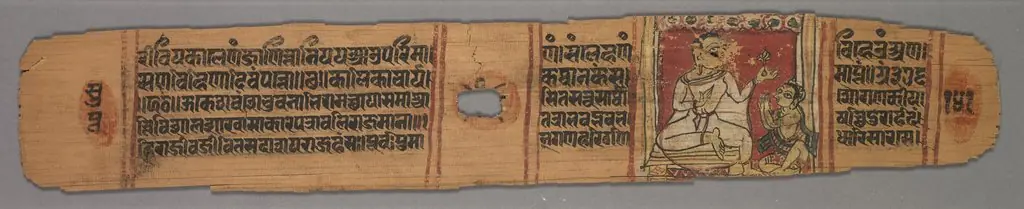 Jain Monk Holding a Flower Venerated by a Royal Follower, colophon page from a Story of the Religious Teacher Kalaka (Kalakacharya-katha, verso)
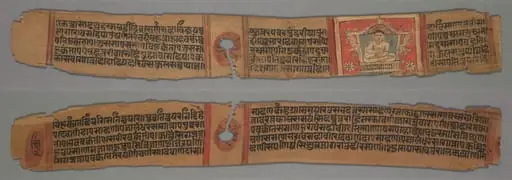
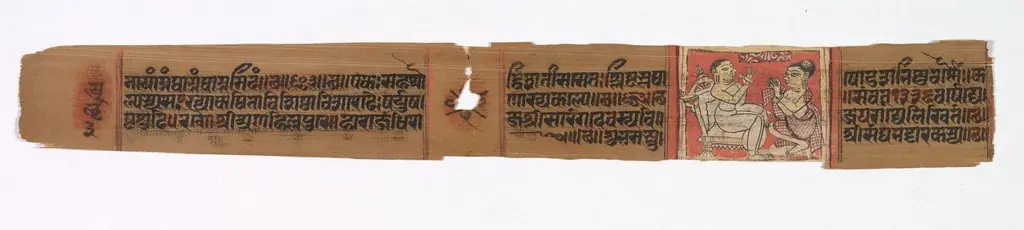 Leaf from a Jain Manuscript: Colophon page, Kalpa-sutra and The Story of Kalakacharya of Devachandra: Monk Teaching Lay Disciple (recto)
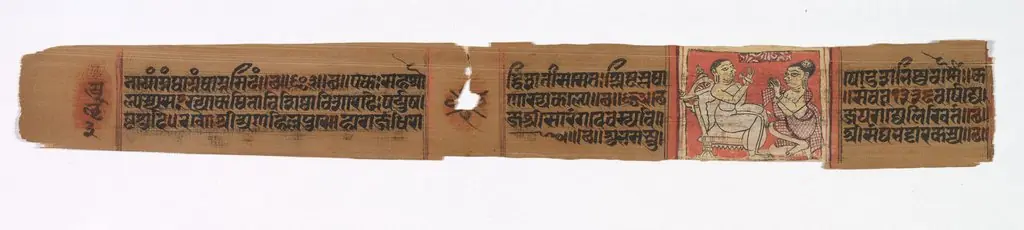 Leaf from a Jain Manuscript: Colophon page, Kalpa-sutra and The Story of Kalakacharya of Devachandra: Monk Teaching Lay Disciple
 Leaf from a Jain Manuscript: Colophon page, Kalpa-sutra and The Story of Kalakacharya of Devachandra: Monk Teaching Lay Disciple (verso)
 Leaf from a Jain Manuscript: The Story of Kalakacharya of Devachandra: Text (recto)
 Leaf from a Jain Manuscript: Kalpa-sutra: Text (verso)
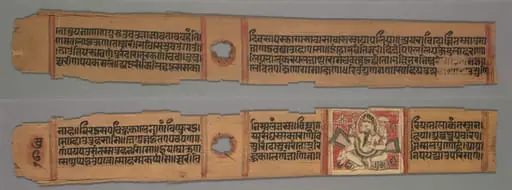
 Leaf from a Jain Manuscript: The Story of Kalakacharya of Devachandra: Brahmanshanti Yaksha (verso)
 Folio 2 (verso), from a Kalpa-sutra and Story of Kalakacharya
 Brahmanshanti Yaksha: Folio (verso), from a Kalpa-sutra and Story of Kalaka of Devachandra
 Folio 2, from a Kalpa-sutra and Story of Kalakacharya: Monk Holding a Flower (recto); text (verso)
 Folio 2, from a Kalpa-sutra and Story of Kalakacharya of Devachandra: Enthroned Monk Gautama (recto); Text (verso)
 Folio from a Kalpa-sutra and Story of Kalakacharya of Devachandra: Text (recto); Brahmanshanti Yaksha (verso)
 Folio 2 (verso), from a Kalpa-sutra and Story of Kalakacharya
 Folio 2 (verso), from a Kalpa-sutra and Story of Kalakacharya of Devachandra