Artwork
Folio 2 (verso), from a Kalpa-sutra and Story of Kalakacharya of Devachandra

Folio 2 (verso), from a Kalpa-sutra and Story of Kalakacharya of Devachandra is an unspecified painting by the Mughal Painting artist Unknown. It dates from 1279 and is held in the collection of the Cleveland Museum of Art. This miniature, painted on paper, depicts a monk in a vivid red robe seated beneath a tree, addressing two listeners.
About this work
Look up more paintings from western india, gujarat, patan (anahillapura) to see how artists there kept telling stories this way.
You see a small, bright painting on paper: a monk in a red robe sits under a tree, teaching two listeners.
This is from a Jain manuscript made in 1279 in Gujarat. The artist used bold colors and flat shapes—no shadows—to tell a sacred story. The tree’s leaves are tiny green dots, almost like confetti.
Look up more paintings from western india, gujarat, patan (anahillapura) to see how artists there kept telling stories this way.
Overview
This miniature, painted on paper, depicts a monk in a vivid red robe seated beneath a tree, addressing two listeners. The composition is compact, with the figures rendered in flat, bold hues and the foliage suggested by numerous tiny green specks that resemble scattered confetti.
Subject & Meaning
The scene illustrates a teaching moment from a Jain narrative, likely drawn from the Kalpa‑sutra or the story of Kalakacharya as recounted by Devachandra. The monk’s role as a spiritual guide is emphasized by his calm posture and the attentive disciples, underscoring the transmission of doctrinal knowledge.
Technique & Style
Executed in 1279, the work employs a palette of saturated colors applied without gradation, creating a two‑dimensional effect typical of western Indian manuscript illumination. The artist’s handling of line and color favors clarity over realism, using flat planes and repetitive motifs such as the dotted foliage to convey narrative quickly.
History & Provenance
The painting originates from a Jain manuscript produced in Gujarat during the late thirteenth century, a period when the region’s artistic centers, especially Patan (also known as Anahilapura), were renowned for their manuscript workshops. The piece remains a representative example of the period’s devotional art.
Context
In the broader visual culture of medieval Gujarat, miniature paintings served as illustrated companions to religious texts, allowing lay readers to visualize complex theological stories. This work aligns with other regional examples that prioritize symbolic color and stylized figures to communicate sacred themes efficiently.
Artist & collection

 Domestic Scene
 Giacomo and Cardinal Marco, investing Andrea, Abbot of San Zeno, with his Benefice
 The Nymph of Fontainebleau
 Portrait of a Woman
 Madonna and Child with Saints in the Enclosed Garden
 Venus and Minerva
 Family Group of Four on Sofa
 Wall painting from Room H of the Villa of P. Fannius Synistor at Boscoreale
 Folio (recto) from a Kalpa-sutra and Story of Kalakacharya of Devachandra: Text
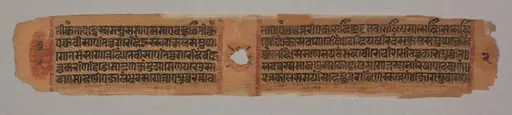 Folio 2 (verso), from a Kalpa-sutra and Story of Kalakacharya
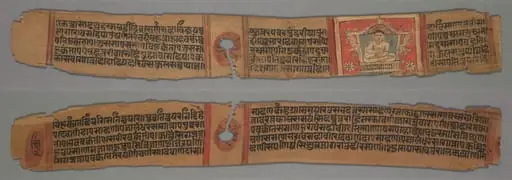 Folio 2, from a Kalpa-sutra and Story of Kalakacharya of Devachandra: Enthroned Monk Gautama (recto); Text (verso)
 Text: Folio 2 (verso), from a Kalpa-sutra
 Brahmanshanti Yaksha: Folio (verso), from a Kalpa-sutra and Story of Kalaka of Devachandra
 Folio 2 (verso), from a Great Poem about Twos (Dvyashraya Mahakavya) of Hemachandra with Commentary by Abhayatilaka