Artwork
Lithographic Workshop
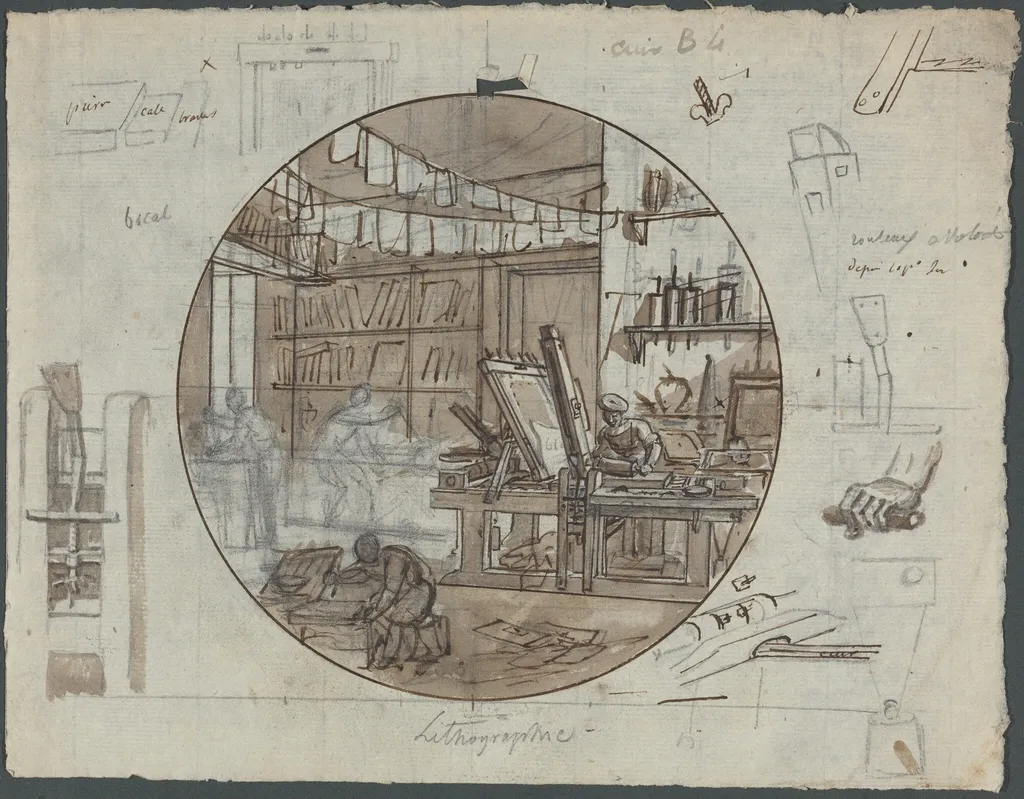
Lithographic Workshop is an ink drawing by the Romanticist artist Jean Charles Develly. It dates from 1826 and is held in the collection of the National Gallery of Art.
About this work
Overview
Lithographic Workshop is a drawing executed in pen, brown ink, graphite and a brown wash, later highlighted with white gouache on laid paper. Attributed to Jean‑Charles Develly and dated to around 1826, the work records an interior scene of a printing studio, rendered in a rapid, sketch‑like manner that emphasizes the bustling atmosphere of early lithographic production.
Subject & Meaning
Shelves laden with tools and paper line the walls, and a small bird perches on a beam, adding a touch of everyday life to the industrial setting.
The composition depicts a cramped workshop where two figures are engaged in the preparation of prints: one crouches at a table, seemingly carving or drawing, while the other stands beside a wooden press. Shelves laden with tools and paper line the walls, and a small bird perches on a beam, adding a touch of everyday life to the industrial setting. The inscription “Lithographie” at the bottom identifies the activity being illustrated.
Technique & Style
Develly employs a combination of pen work and brown ink washes to establish form, while graphite provides tonal variation. Cross‑hatching creates depth and shadow, and selective application of white gouache accentuates highlights, especially in the lighter areas of the paper. The use of laid paper contributes a subtle texture, reinforcing the work’s preliminary, documentary quality.
History & Provenance
Created circa 1826, the drawing belongs to the early period when lithography was emerging as a commercial printing method in France. Though specific ownership records are scarce, the piece has been catalogued as a study of a lithographic workshop, offering insight into the practical environment of printmakers during the first decades of the nineteenth‑century.
Artist & collection

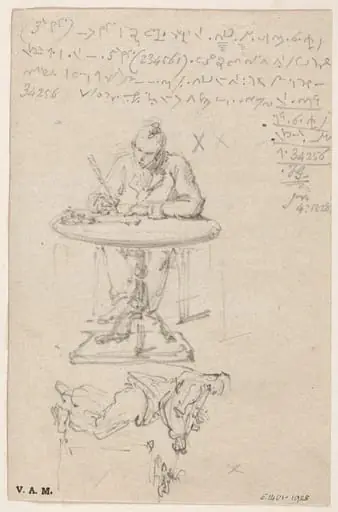 Sketches of a figure writing at a pedestal table, and a figure lighting a pipe
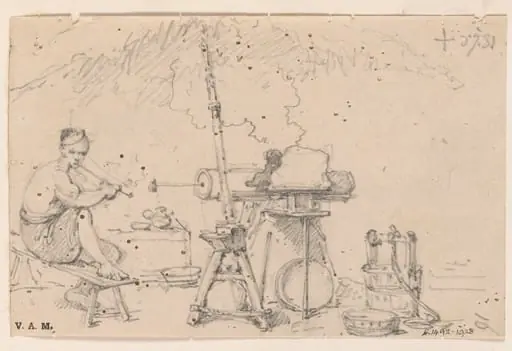 A Chinese blacksmith at his forge
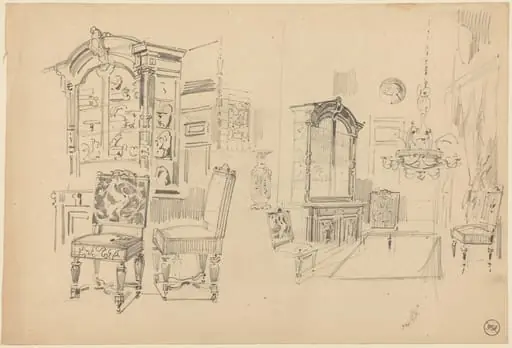 Two Studies of an Interior with Furniture
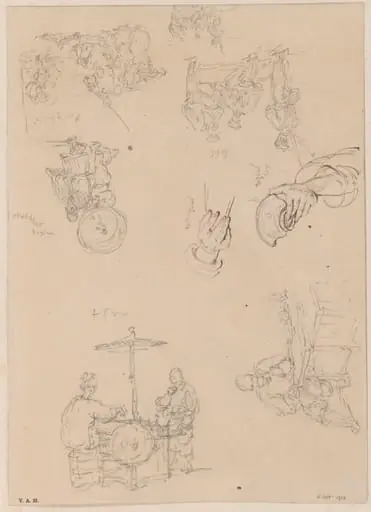 Chinese figures, soldiers, and details of hands
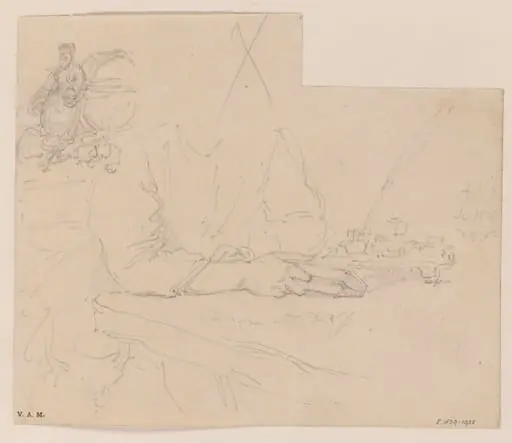 A Western woman seated at a table
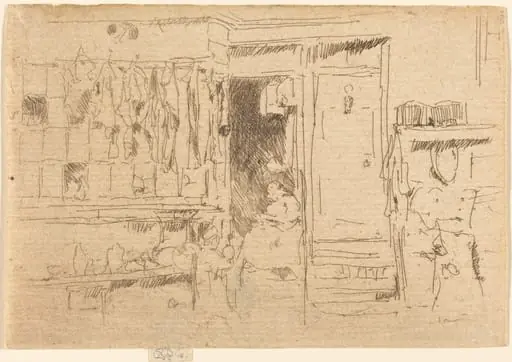 Old-Clothes Shop, No.I
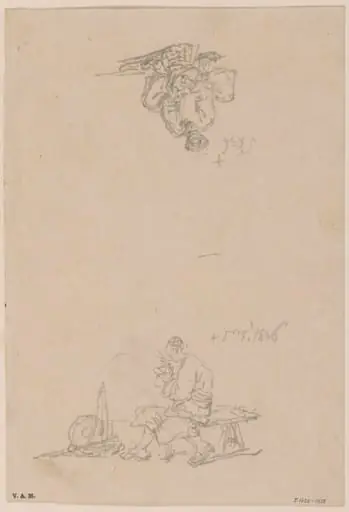 Two drawings of Chinese figures
 Two figures seated at a stall, and a pig
 A figure seated beside a portrait, and other sketches
 Interior of a Barn Built on Ancient Ruins