Artwork
Apollo in the Forge of Vulcan
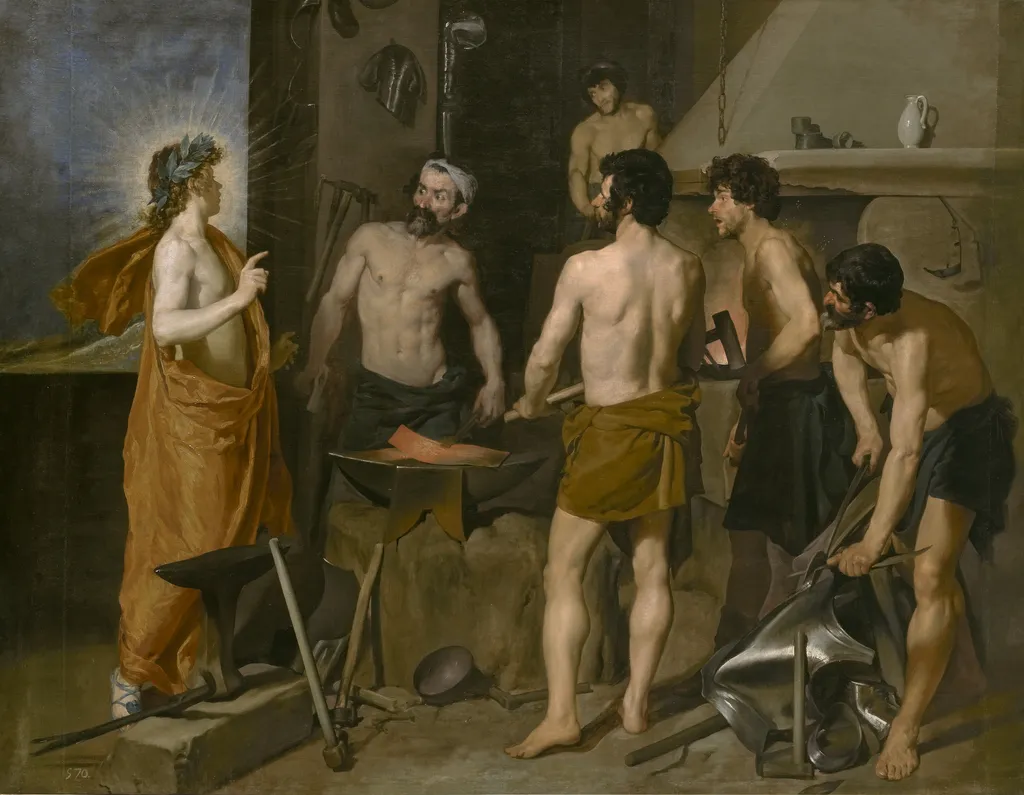
Apollo in the Forge of Vulcan is an oil painting by the Early Baroque Italian artist Diego Velázquez. It dates from 1630 and is held in the collection of the Museo del Prado.
About this work
Overview
Diego de Velázquez’s oil painting titled *Apollo in the Forge of Vulcan* was executed around 1630, shortly after his first journey to Italy in 1629. The work, often linked with his contemporaneous piece *Joseph’s Tunic*, demonstrates a mature handling of narrative composition and entered the Spanish royal collection before being transferred to the Museo del Prado in 1819.
Subject & Meaning
The canvas depicts a mythological scene in which a female figure, dressed in an orange mantle, gestures toward a group of nude craftsmen laboring at an anvil within a dimly lit workshop. The men, representing Vulcan’s smiths, are surrounded by tools, shields and helmets, while the goddess—identified as Apollo—appears to observe or direct the forge’s activity, suggesting a dialogue between divine patronage and mortal labor.
Technique & Style
Velázquez employs a pronounced chiaroscuro, casting deep shadows across the interior while allowing shafts of light to illuminate the workers’ musculature and metallic implements. This contrast heightens the tactile sense of the forge’s heat and texture, and the unified arrangement of figures creates a natural interaction that has been praised for its compositional cohesion.
History & Provenance
Although neither *Apollo in the Forge of Vulcan* nor its companion piece were commissioned by the Spanish monarch, both quickly entered the royal collection in the early 1630s. The painting remained in the royal holdings until it was assigned to the Museo del Prado in Madrid in 1819, where it has been displayed as part of the museum’s Spanish Baroque holdings.
Context
Created during Velázquez’s first Italian sojourn, the work reflects the artist’s exposure to the dramatic lighting and classical themes prevalent in Roman and Bolognese painting. It stands as a significant example of how the Spanish court painter integrated Italian influences into his own evolving style, contributing to the development of Spanish Baroque narrative art.
Own this work as a print
Artist & collection

Artist
Diego Rodríguez de Silva y Velázquez was a Spanish Baroque painter, the leading artist in the court of King Philip IV of Spain and Portugal, and of the Spanish Golden Age.