Artwork
Portrait of Marguerite Gauthier-Lathuille
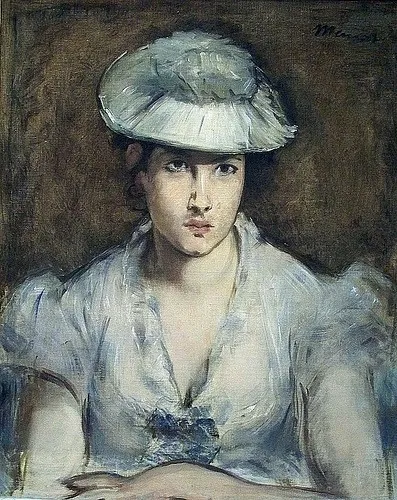
Portrait of Marguerite Gauthier-Lathuille is an oil painting by the Impressionist artist Edouard Manet. It is held in the collection of the Museum of Fine Arts of Lyon. Painted around 1878, this half-length portrait by Édouard Manet depicts Marguerite Gauthier-Lathuille in white attire.
About this work
Portrait of Marguerite Gauthier‑Lathuille is a half‑length oil painting by French artist Édouard Manet, dated around 1878.
Portrait of Marguerite Gauthier‑Lathuille is a half‑length oil painting by French artist Édouard Manet, dated around 1878. The work is an oil on canvas and now belongs to the Museum of Fine Arts of Lyon, which bought it in 1902.
Manet never had the sitter sit for the final picture; he worked from his own sketches. He created the portrait as a gift for her father, so it carries a personal note beyond the usual commission.
If you’re curious about more of his work, check out the artist: Édouard Manet.
Overview
Painted around 1878, this half-length portrait by Édouard Manet depicts Marguerite Gauthier-Lathuille in white attire. Executed in oil on canvas, the work was not painted from direct sittings but derived from preliminary sketches. It was commissioned as a private gift for the sitter’s father, distinguishing it from typical portrait commissions of the period. The painting entered the collection of the Musée des Beaux-Arts de Lyon in 1902, where it remains today.
Subject & Meaning
Marguerite Gauthier-Lathuille, a young woman from a Parisian family, is portrayed with quiet composure, her gaze directed slightly away from the viewer. The absence of formal posing suggests a more intimate, remembered presence rather than a staged representation. Created as a personal gift, the portrait carries emotional weight beyond social convention, reflecting Manet’s sensitivity to familial relationships and private gestures.
Technique & Style
Manet employed loose, deliberate brushwork to render the white dress and soft contours of the sitter’s form, emphasizing texture over detail. The background remains muted and indistinct, focusing attention on the figure’s silhouette and the play of light on fabric. His approach blends observational precision with a sense of immediacy, characteristic of his mature style—rejecting academic polish in favor of atmospheric clarity and restrained elegance.
History & Provenance
The painting was completed without the sitter’s presence, relying solely on sketches Manet made earlier. It was given to her father as a personal token, not intended for public exhibition. The work remained in private hands until 1902, when the Musée des Beaux-Arts de Lyon acquired it. Its transition from domestic gift to public collection underscores its quiet significance within Manet’s oeuvre and the museum’s growing interest in modern French painting.
Context
In the late 1870s, Manet was increasingly focused on portraiture, often exploring psychological subtlety over social display. This work aligns with his interest in informal, intimate depictions of individuals, distinct from the grand historical or mythological themes favored by the Academy. The portrait reflects a broader shift in French art toward personal expression and the everyday, even within commissioned works.
Legacy
Though not among Manet’s most widely known portraits, this painting exemplifies his ability to convey quiet dignity through understated means. Its survival in a public collection ensures continued study of his approach to private commissions and the emotional resonance he could achieve without theatricality. The work remains a quiet testament to the artist’s capacity to transform personal gestures into enduring visual records.
Artist & collection

Artist
Édouard Manet didn’t have much time to make his mark—he died at 51—but he used every year.