Artwork
The Execution of Emperor Maximilian
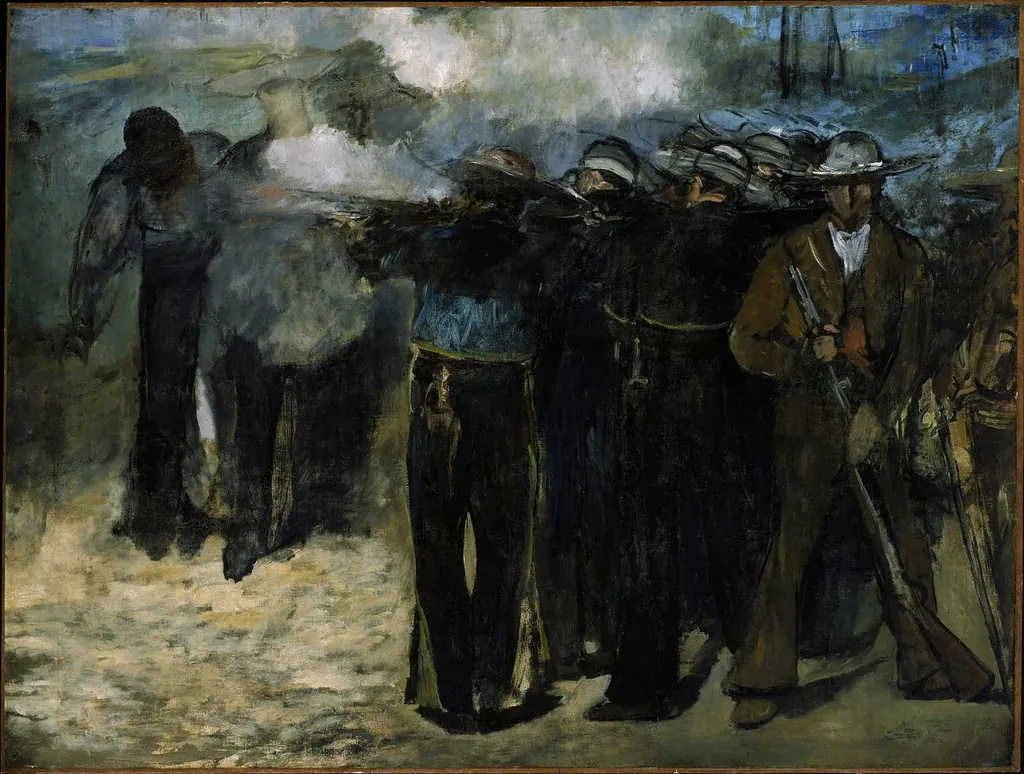
The Execution of Emperor Maximilian is an oil painting by the Realist artist Edouard Manet. It dates from 1867 and is held in the collection of the Museum of Fine Arts Boston.
About this work
Overview
The work was created in response to the political scandal surrounding the French withdrawal from Mexico and the subsequent execution of Maximilian in 1867.
Édouard Manet's The Execution of Emperor Maximilian (1867) depicts the immediate moment before the firing squad executes the Austrian Archduke Maximilian, who had been installed as Emperor of Mexico by French forces. The composition arranges the figures in a frieze-like manner against a rough wall, emphasizing the mechanical nature of the violence. Maximilian, distinguished by his light-colored coat and white hat, stands centrally between two Mexican generals, while the firing squad, clad in dark uniforms and hats, aims their rifles directly at the victims. Manet omits the blood and the aftermath, focusing instead on the psychological tension and the stark contrast between the executioners and the condemned. The work was created in response to the political scandal surrounding the French withdrawal from Mexico and the subsequent execution of Maximilian in 1867. Although Manet produced three versions of this subject, the 1867 oil painting is the most complete and famous iteration. It marks a significant departure from traditional history painting, rejecting heroic narrative in favor of a cold, journalistic realism that anticipates modernist approaches to contemporary events. The painting reflects Manet's critical stance toward the Second Empire's foreign policy and his interest in the intersection of politics and art.
Subject & Meaning
The composition suggests an execution scene, with the figures arranged in a linear formation that directs the eye toward a central, lighter‑clad individual. The muted palette and obscured expressions convey the weight of political violence surrounding the fate of Emperor Maximilian.
Technique & Style
Manet employs a stark chiaroscuro, contrasting deep shadows with illuminated areas to model the figures and give them a three‑dimensional presence. The limited color range and loose brushwork are typical of his approach to history painting, emphasizing mood over detailed narrative.
History & Provenance
Painted shortly after the 1867 execution of Maximilian I of Mexico, the canvas reflects contemporary European interest in the event. It entered the Museum of Fine Arts, Boston, where it remains on display as part of the museum’s 19th‑century European painting holdings.
Artist & collection

Artist
Édouard Manet didn’t have much time to make his mark—he died at 51—but he used every year.