Artwork
Haute Égypte. Grand Temple de Denderah, Sculptures de la façade postérieure
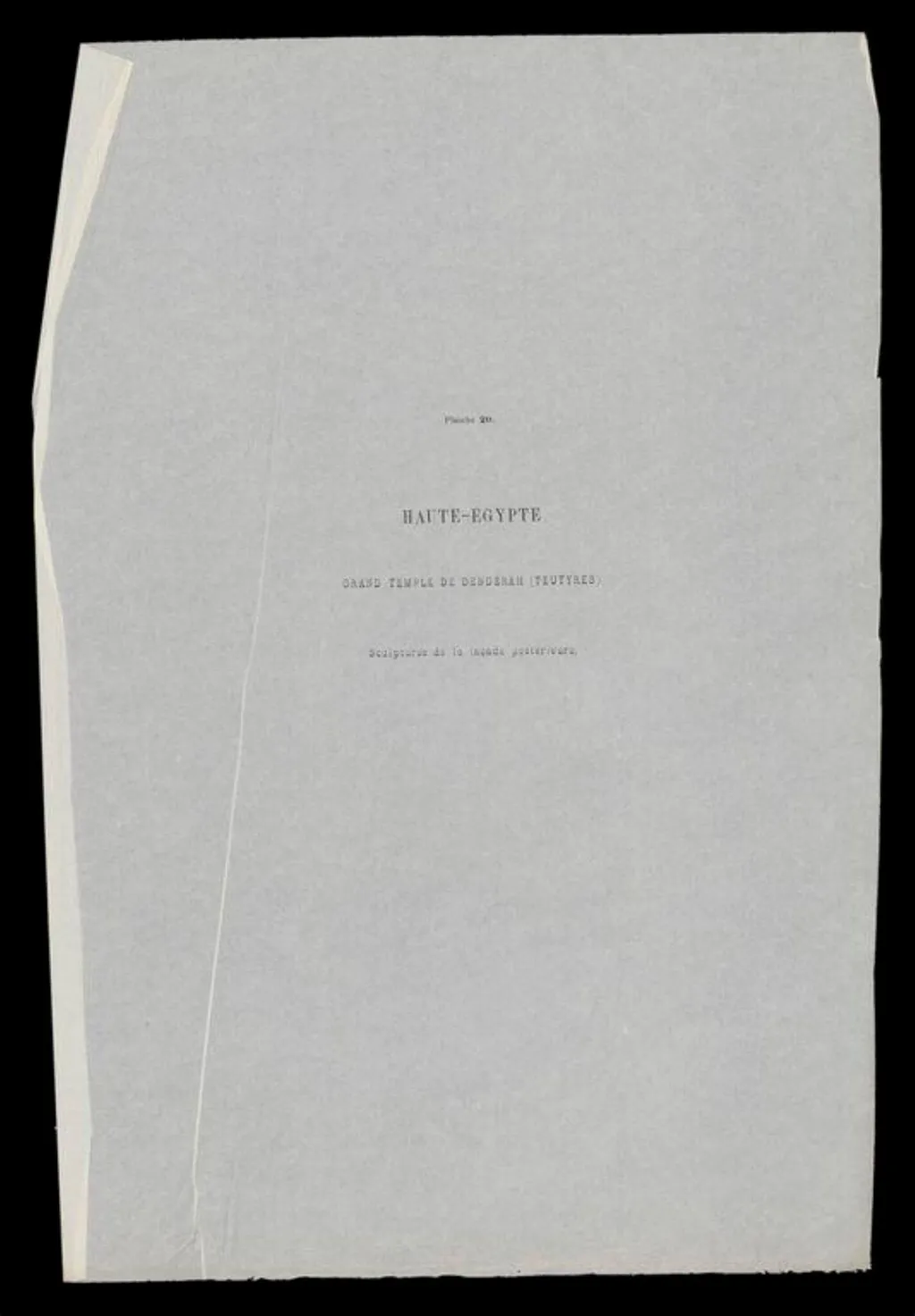
Haute Égypte. Grand Temple de Denderah, Sculptures de la façade postérieure is a photographic photography by the Impressionist artist Maxime Du Camp. It dates from 1852 and is held in the collection of the Victoria and Albert Museum. This object is a letterpress-printed tissue paper interleaf from a serialized photographic publication issued in 1852 by Gide et J.
About this work
Overview
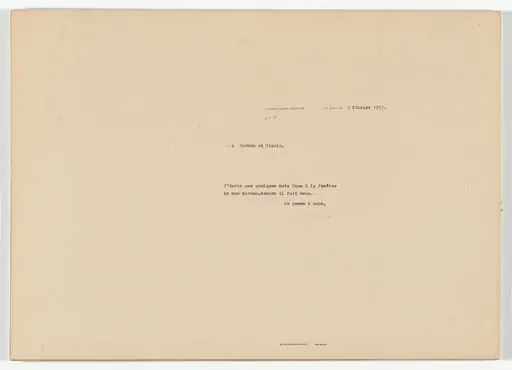
The tissue bears no image, only printed text identifying its intended subject: the rear façade sculptures of the Great Temple of Denderah.
This object is a letterpress-printed tissue paper interleaf from a serialized photographic publication issued in 1852 by Gide et J. Baudry. It was designed to protect one of twenty-four photographic plates in a set of 125, documenting Egyptian monuments. The tissue bears no image, only printed text identifying its intended subject: the rear façade sculptures of the Great Temple of Denderah. Its blank surface suggests it was meant to precede an unbound photograph that may have been lost or omitted.
Subject & Meaning
The text on the tissue specifies the rear façade sculptures of the Temple of Denderah, a Ptolemaic-era religious site in Upper Egypt. These carvings typically depict ritual scenes, deities, and royal offerings, central to the temple’s function as a center of worship for Hathor. The labeling implies the publisher intended to systematically record architectural details, aligning with mid-19th century European efforts to document ancient Egyptian heritage through visual archives.
Technique & Style
The tissue is printed in letterpress with faded black ink, using a simple, typographic layout centered on the page. The typography is uniform and restrained, typical of scholarly publications of the period. The edges show minor fraying, consistent with handling and storage in a bound volume. No photographic emulsion or illustration is present, indicating this was a textual guide rather than an image, reflecting the logistical constraints of early photographic reproduction.
History & Provenance
Produced in 1852 by Gide et J. Baudry, this item belongs to a subscription-based series of 25 parts, each containing five plates. The series was part of a broader initiative to compile visual records of Egyptian antiquities following Napoleon’s campaigns. The tissue’s survival suggests it was once part of a complete, though now fragmented, set. Its current state—text only, no accompanying image—hints at the fragility and incomplete preservation of early photographic collections.
Context
In the 1850s, European publishers sought to capitalize on growing interest in Egyptology by producing illustrated volumes of ancient sites. Photographs were still costly and technically challenging to reproduce, so printed text often served as placeholders or guides. This tissue reflects the transitional phase between illustrated travelogues and photographic documentation, where textual labels anticipated images that were not yet reliably reproducible or included.
Legacy
Though devoid of imagery, this tissue remains a material artifact of early photographic publishing practices in Egyptology. It illustrates how textual metadata functioned as a structural component in visual archives before standardized image reproduction. Its existence underscores the efforts of 19th-century scholars and publishers to systematize the documentation of ancient monuments, even when technical limitations prevented full realization.
Artist & collection