Artwork
The Rialto, Venice
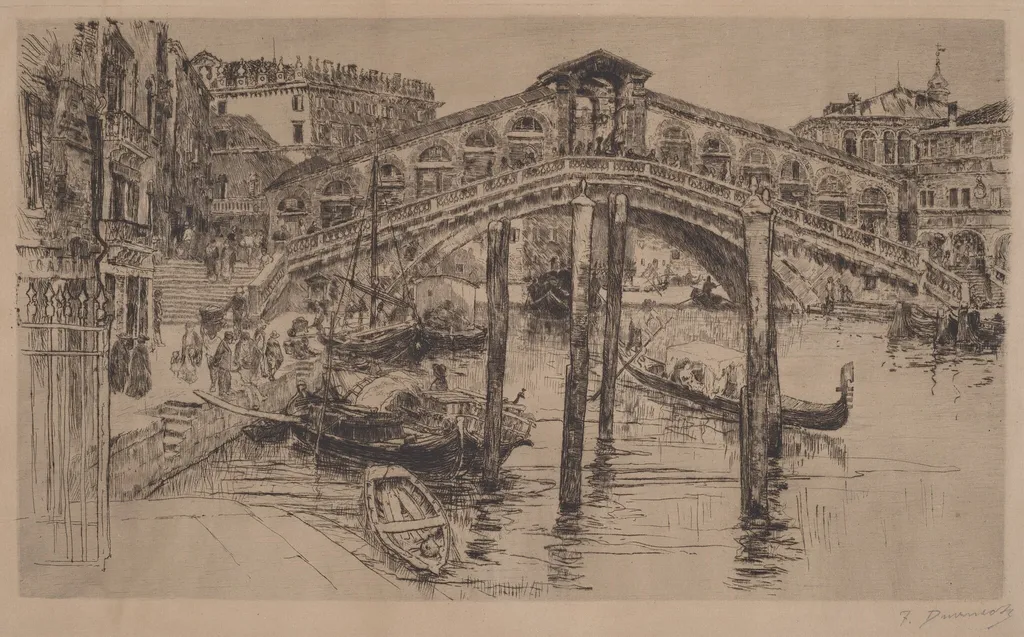
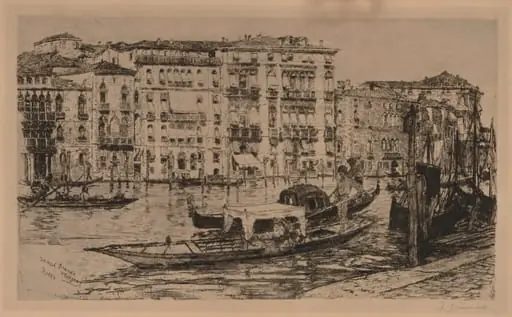
The Rialto, Venice is an ink print by the Impressionist artist Frank Duveneck. It dates from 1883 and is held in the collection of the National Gallery of Art.
About this work
Overview
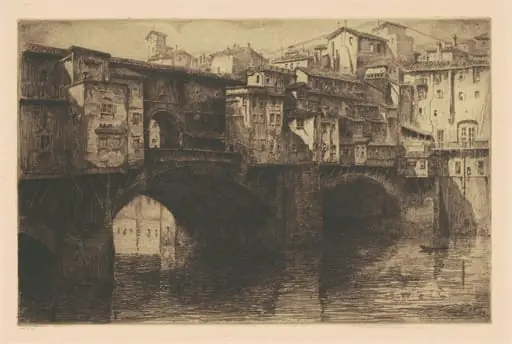
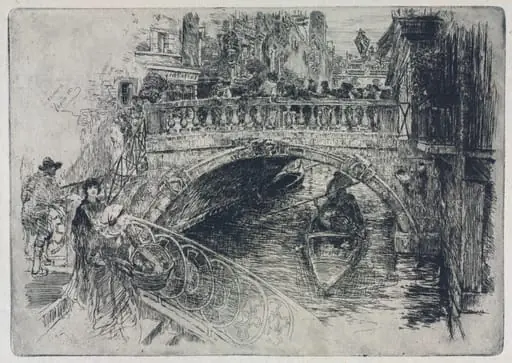
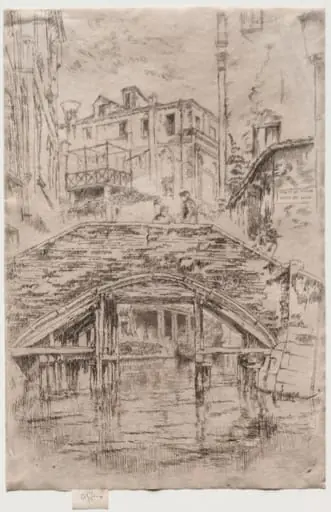
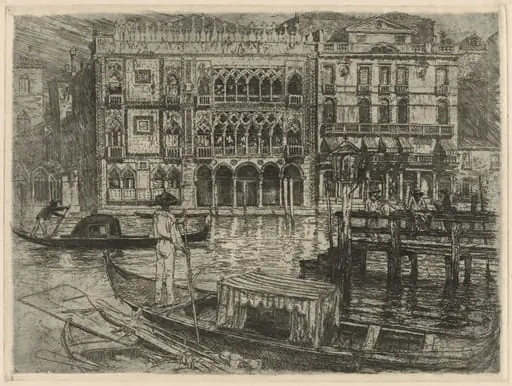
Created in 1883, The Rialto, Venice is an etching by American artist Frank Duveneck, rendered in black ink on laid paper. It captures a bustling scene along Venice’s Grand Canal near the Rialto Bridge, emphasizing motion and urban density. Unlike finished paintings, the work retains the immediacy of a sketch, using loose, energetic lines to convey the rhythm of daily life in the city.
Subject & Meaning
The scene centers on the Rialto Bridge, a key crossing point, with crowds moving across it and boats clustered along the water’s edge.
The scene centers on the Rialto Bridge, a key crossing point, with crowds moving across it and boats clustered along the water’s edge. Tall, closely packed buildings rise on either side, their windows and balconies suggesting dense habitation. The composition reflects Venice’s layered social and commercial activity, portraying the canal not as a picturesque postcard but as a working artery of the city.
Technique & Style
Duveneck employed etching to achieve rapid, expressive marks, allowing the plate’s bitten lines to mimic the spontaneity of a drawn sketch. The water is suggested by jagged, irregular strokes, while architectural details are rendered with minimal yet decisive contours. The absence of fine detail and tonal refinement enhances the sense of fleeting observation, aligning the work with the aesthetic of direct visual recording.
History & Provenance
Duveneck made this print during a period of travel in Italy, where he studied Venetian architecture and urban life. The etching was likely produced in his studio in Venice or shortly after his return to the United States. It was part of a series of Italian scenes he created in the early 1880s, reflecting his interest in capturing authentic, unidealized views of European cities.
Context
In the 1880s, American artists increasingly traveled to Europe to study and sketch, often favoring candid urban scenes over grand historical subjects. Duveneck’s work aligned with this trend, embracing the sketch-like quality favored by realist and impressionist practitioners. His focus on ordinary moments in Venice contrasted with the more romanticized depictions common in earlier travel art.
Legacy
The Rialto, Venice exemplifies Duveneck’s commitment to direct observation and his influence on American printmaking. Though not widely exhibited in his lifetime, the work contributed to a broader shift toward informal, atmospheric etchings in late 19th-century American art. It remains a testament to the value placed on immediacy and truthful representation over polished finish.
Own this work as a print
Artist & collection