Artwork
Mary Cassatt at the Louvre: The Etruscan Gallery
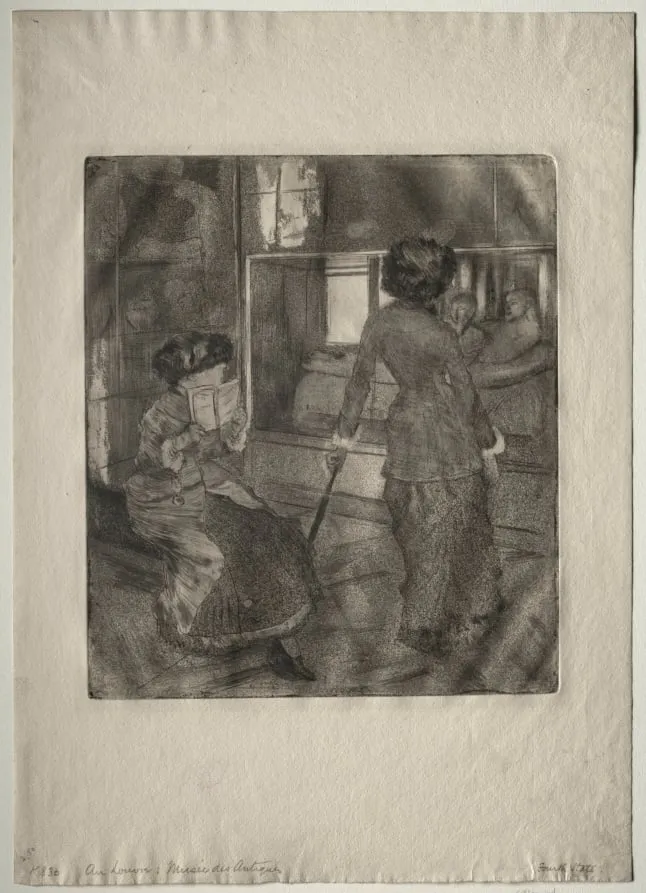
Mary Cassatt at the Louvre: The Etruscan Gallery is a print by the Impressionist artist Edgar Degas. It dates from 1880 and is held in the collection of the Cleveland Museum of Art.
About this work
Overview
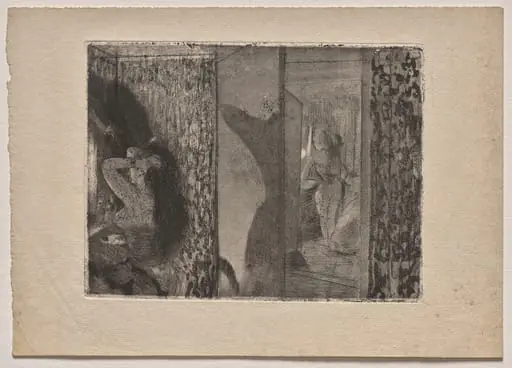
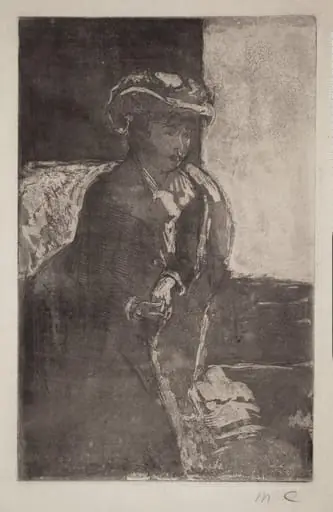
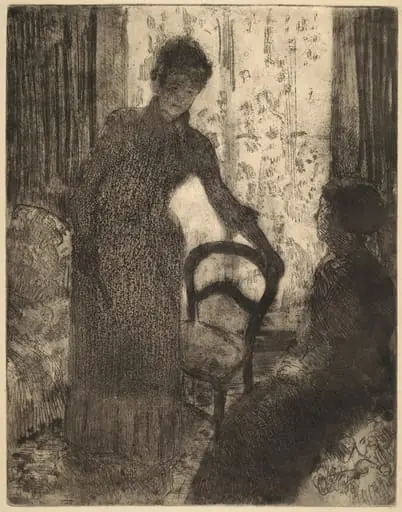
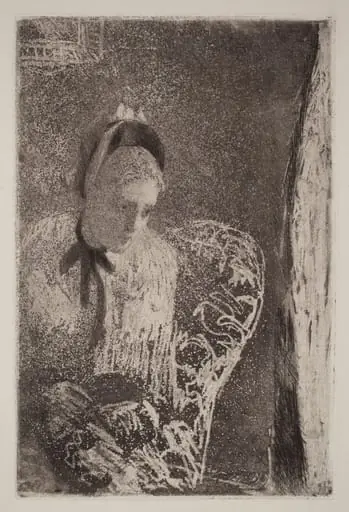
This drypoint print by Edgar Degas captures Mary Cassatt and her sister Lydia in the Etruscan Gallery of the Louvre.
This drypoint print by Edgar Degas captures Mary Cassatt and her sister Lydia in the Etruscan Gallery of the Louvre. Created around 1879–1880, it is one of two known works by Degas depicting Cassatt at the museum. The scene is intimate and observational, focusing on the quiet engagement of two women with ancient art. The print is held by the Cleveland Museum of Art and reflects Degas’s interest in depicting artists at work, not as subjects but as active participants in cultural inquiry.
Subject & Meaning
Mary Cassatt is shown from behind, absorbed in studying an Etruscan sarcophagus from Cerveteri, dated to approximately 500 BCE. Her sister Lydia sits nearby, consulting a guidebook. The carved figures on the tomb—a smiling couple reclining together—gaze outward, creating a silent dialogue between ancient and modern observers. The composition suggests a shared reverence for historical art, positioning Cassatt not as a passive visitor but as a serious student of visual culture, engaged in the same intellectual pursuit as the artists of antiquity.
Technique & Style
Degas employed drypoint to create rich, velvety lines and subtle tonal contrasts, emphasizing texture and atmosphere. The figures are rendered with loose, suggestive strokes, while the sarcophagus and glass case are defined with sharper, more precise contours. The use of negative space and cropped composition reflects Degas’s interest in candid, snapshot-like moments. The print’s quiet intimacy and attention to posture and gaze reveal his commitment to portraying psychological presence over narrative drama.
History & Provenance
Executed during a period of close artistic collaboration between Degas and Cassatt, the print was likely made for their private circle rather than public exhibition. It remained in Degas’s possession until his death, later entering the collection of the Cleveland Museum of Art through a gift from the Hanna family in 1957. Its preservation reflects its significance as a personal document of artistic camaraderie and mutual respect between two major figures of Impressionism.
Context
In late 19th-century Paris, the Louvre served as both a public museum and a training ground for artists. Cassatt, an American expatriate, regularly studied Old Master and ancient works there to inform her own practice. Degas, equally devoted to historical art, often visited the museum with fellow artists. This print documents a common but rarely depicted ritual: the act of looking closely at antiquities as part of artistic education, reflecting broader 19th-century European engagement with classical and non-Western heritage.
Legacy
The print endures as a quiet testament to the intellectual lives of women artists in a male-dominated art world. By portraying Cassatt in deep concentration, Degas affirmed her status as a peer, not a muse. The work also bridges ancient and modern visual traditions, highlighting how historical artifacts continued to shape contemporary artistic practice. Today, it remains a key example of how printmaking could convey nuanced observation and mutual artistic respect.
Artist & collection
Artist
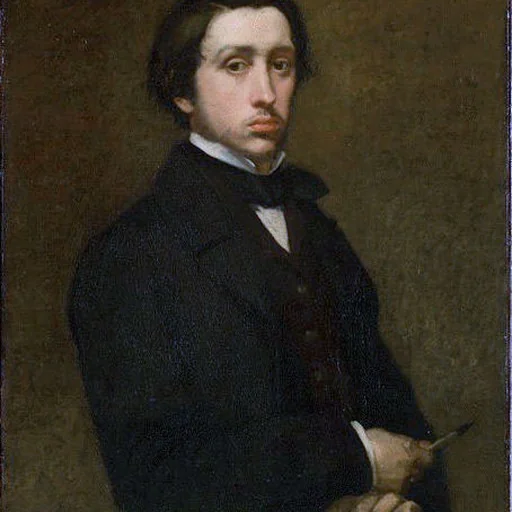
Born Hilaire-Germain-Edgar De Gas on 19 July 1834 in Paris, Edgar Degas came from an affluent banking family with aristocratic roots and spent his childhood among the cultivated circles of the French capital.