Artwork
Racehorses at Longchamp
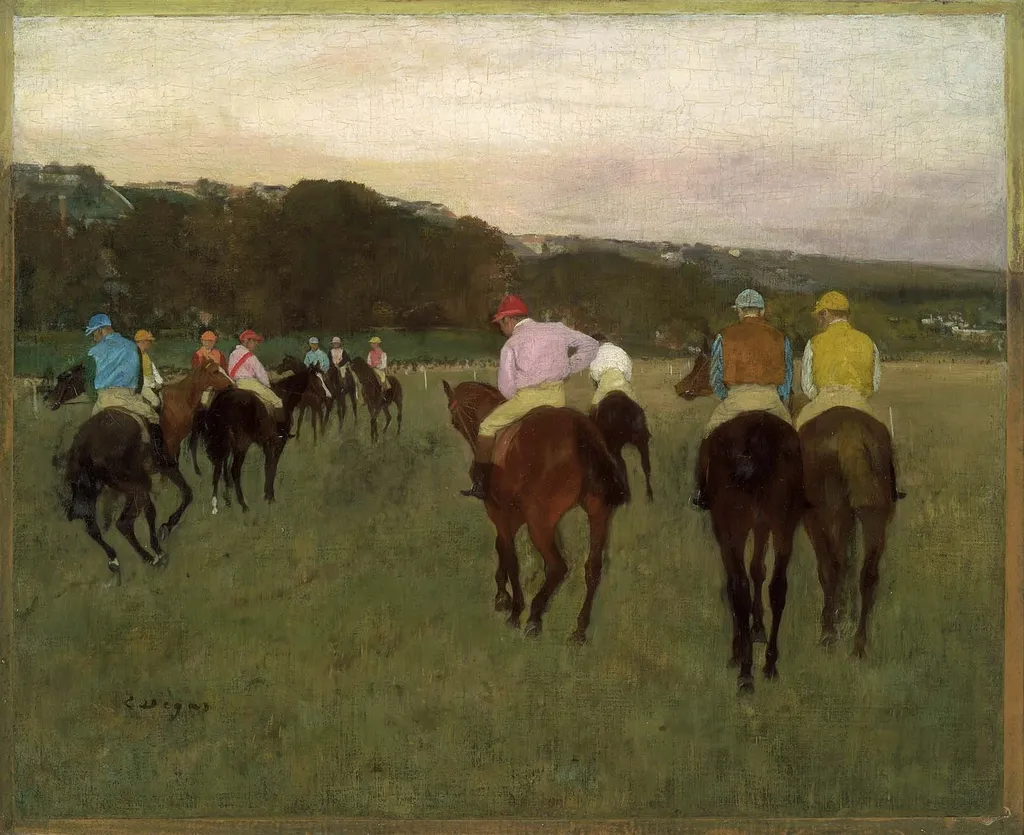
Racehorses at Longchamp is an oil painting by the Impressionist artist Edgar Degas. It dates from 1874 and is held in the collection of the Museum of Fine Arts Boston.
About this work
Overview
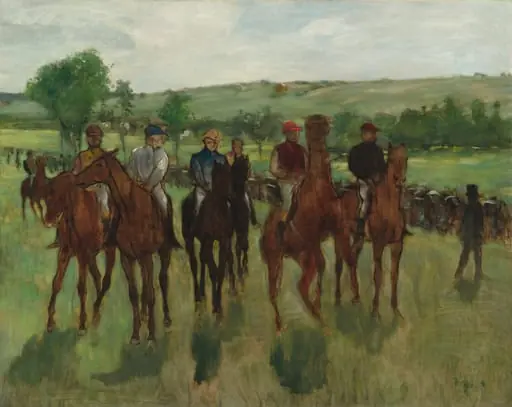
Painted in 1874, Racehorses at Longchamp is an oil on canvas work by Edgar Degas that captures a moment during a race at the Longchamp racecourse near Paris. The composition centers on a group of jockeys and horses moving across a grassy expanse, their forms rendered with energetic brushwork that suggests motion. The painting is part of the permanent collection at the Museum of Fine Arts, Boston.
Subject & Meaning
The painting portrays a fleeting instant in a horse race, with riders and mounts advancing away from the viewer, their bodies partially obscured by motion. Degas avoids romanticizing the scene, instead emphasizing the physicality and rhythm of the sport. The absence of a clear focal point or dramatic climax reflects his interest in candid, unposed moments rather than idealized narratives.
Technique & Style
The palette is restrained—soft sky tones contrast with the vivid jackets of the riders—drawing attention to the figures without overwhelming them.
Degas employs loose, rapid brushstrokes to convey speed and movement, particularly in the horses’ legs and tails, which are softly blurred. The palette is restrained—soft sky tones contrast with the vivid jackets of the riders—drawing attention to the figures without overwhelming them. The background is deliberately muted, reinforcing the immediacy of the action and the artist’s focus on dynamic form over detailed setting.
History & Provenance
Created in 1874, the painting was likely made during a period when Degas frequently visited the Longchamp racecourse, sketching and studying equine motion. It entered the Museum of Fine Arts, Boston’s collection in 1919 through the bequest of Mrs. Mary B. Jackson, a noted collector of French art. Its acquisition helped solidify the museum’s holdings of Impressionist-era works.
Context
In the 1870s, horse racing was a fashionable pastime among Paris’s upper classes, and Degas was drawn to its blend of spectacle and routine. Unlike contemporaries who idealized rural life, Degas focused on modern urban leisure, capturing the energy and structure of contemporary entertainment. His interest in movement and composition aligned with broader shifts in artistic representation during the rise of Impressionism.
Legacy
Racehorses at Longchamp exemplifies Degas’s contribution to modern painting through his innovative treatment of motion and everyday subjects. While not as widely known as his ballet scenes, this work influenced later artists exploring dynamism and transient moments. Its presence in a major American collection helped introduce European modernism to broader audiences in the early 20th century.
Own this work as a print
Artist & collection
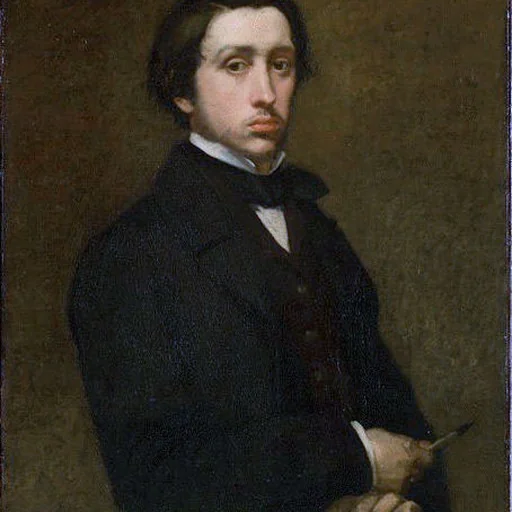
Artist
Born Hilaire-Germain-Edgar De Gas on 19 July 1834 in Paris, Edgar Degas came from an affluent banking family with aristocratic roots and spent his childhood among the cultivated circles of the French capital.