Artwork
Addoldy-y-Bedyddwyr, Glyndyfrdwy, Merionethshire
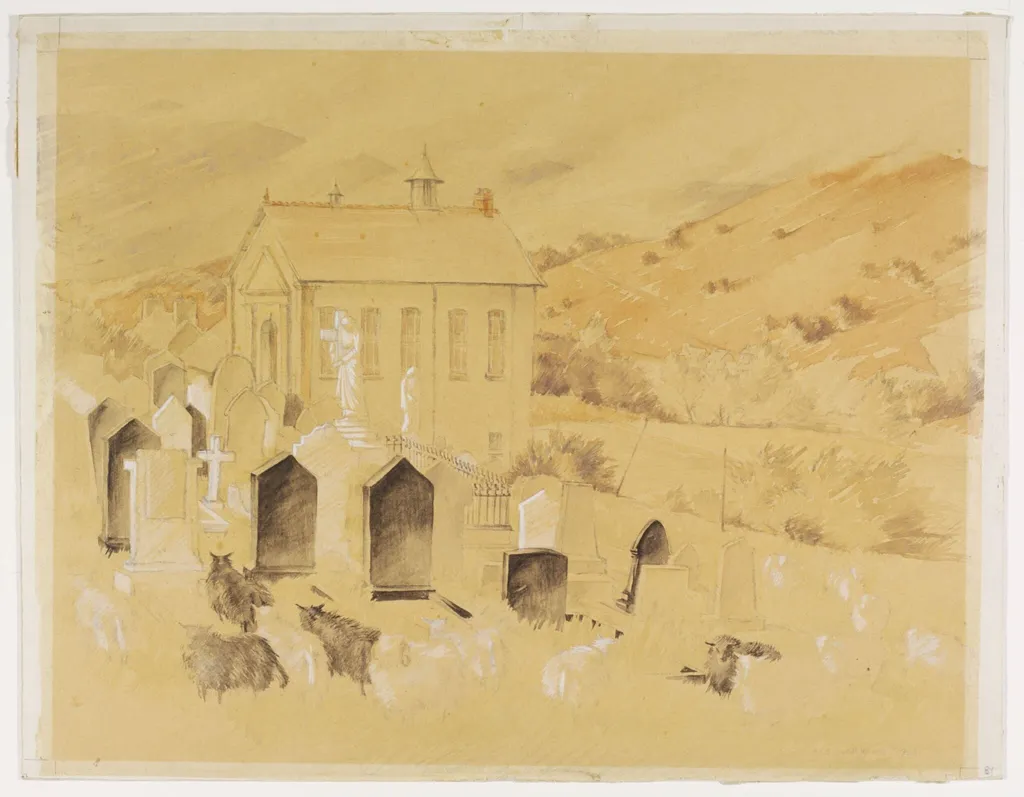
Addoldy-y-Bedyddwyr, Glyndyfrdwy, Merionethshire is a watercolor work on paper by Mildred E. Eldridge. It dates from 1943 and is held in the collection of the Victoria and Albert Museum. Mildred E.
About this work
Overview
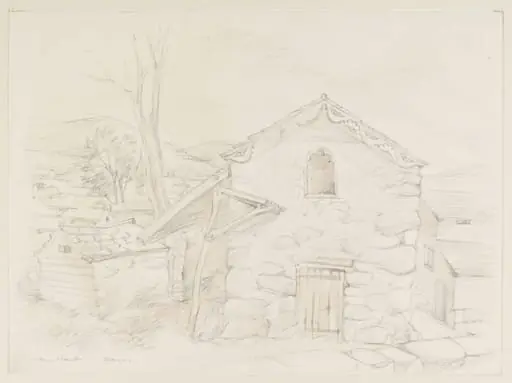
Mildred E. Eldridge’s 1943 watercolour portrays the Baptist chapel of Addoldy‑y‑Bedyddwyr in Glyndyfrdwy, set on a gentle hillside. In the foreground, weathered gravestones share the ground with a small flock of sheep, while the modest white chapel and its simple steeple rise against a pale sky. The composition balances the quiet of the burial ground with the broader landscape beyond.
Subject & Meaning
The painting captures a moment of rural spirituality, juxtaposing the permanence of stone memorials with the transience of grazing sheep. The chapel, modest and unadorned, underscores the modesty of the local Baptist congregation, while the surrounding hills suggest a landscape that frames and sustains community life.
Technique & Style
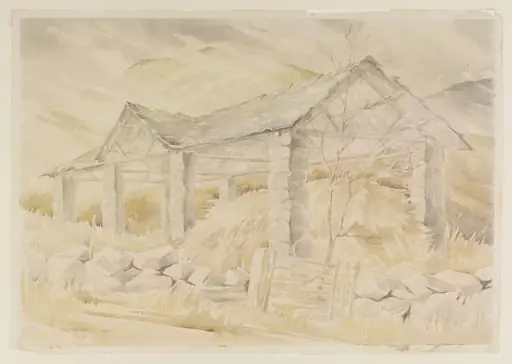
Eldridge employs loose, sketch‑like lines to suggest form rather than delineate detail, allowing light and shadow to emerge through soft washes of muted, warm colour. The watercolour medium lends a hazy, atmospheric quality, with the pale sky and subdued tones reinforcing a sense of stillness and gentle reverie.
History & Provenance
Created under the Recording Britain scheme, the work was commissioned between 1940 and 1943 to document threatened sites across the United Kingdom. Funded by the Pilgrim Trust and supervised by Sir Kenneth Clark, the project aimed to preserve visual records of locations vulnerable to wartime damage or post‑war development. Eldridge’s piece entered the scheme’s archive upon completion.
Context
The Recording Britain initiative focused heavily on rural and religious architecture in Wales, reflecting concerns about cultural loss during the Second World War. Eldridge’s depiction of a modest chapel and its surrounding graveyard contributes to a broader visual narrative of a nation confronting both physical danger and rapid social change, preserving a snapshot of Welsh identity in the early 1940s.
Artist & collection
Artist
Mildred E. Eldridge painted the hills and barns of 1940s Wales in watercolours. She left us five small scenes of rural life, each titled by the place it shows: a stone barn in Llanrhaeadr, peat cutters near Cefn Coch,…