Artwork
China - Aleea Împăraților
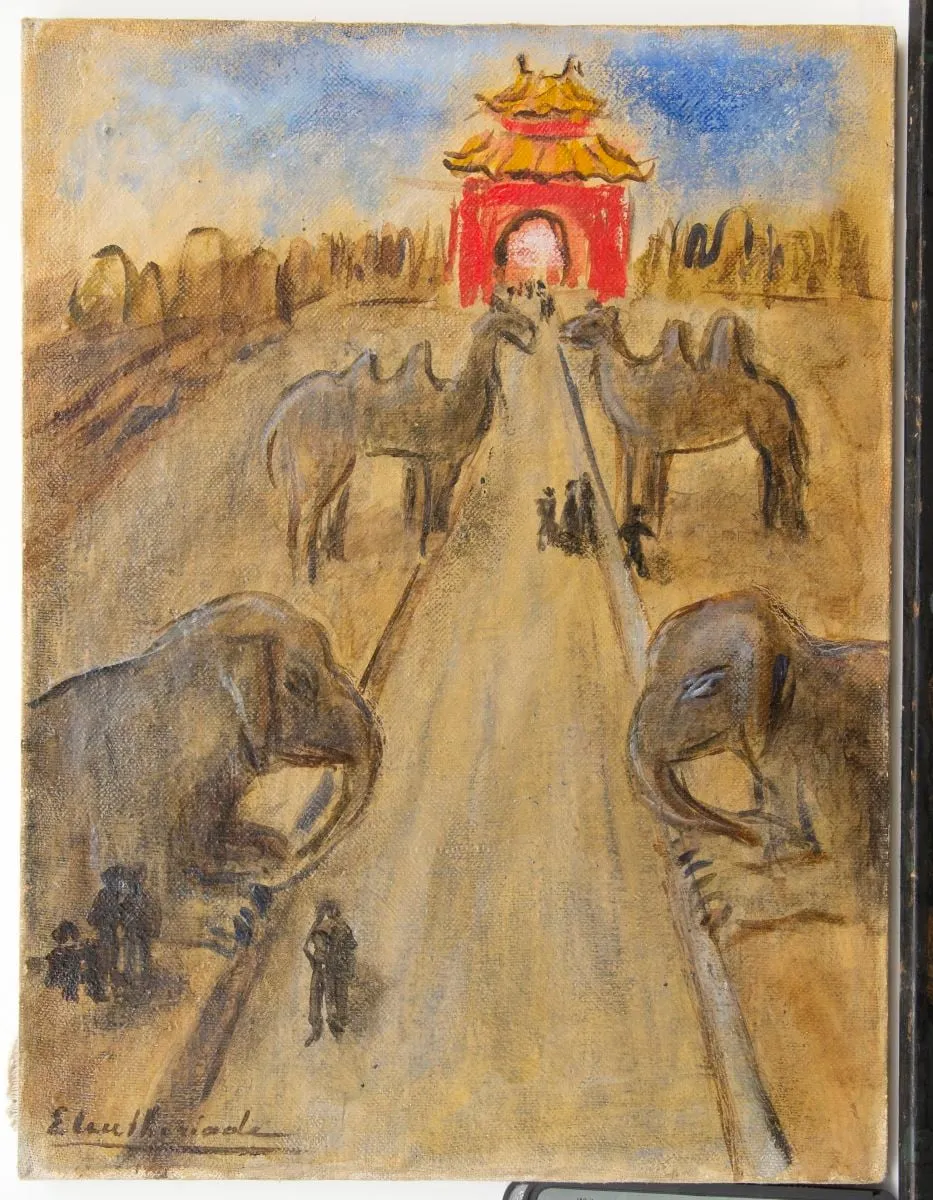
China - Aleea Împăraților is a print by Micaela Eleutheriade. It dates from 1973 and is held in the collection of the National Museum of Art of Romania.
About this work
Overview
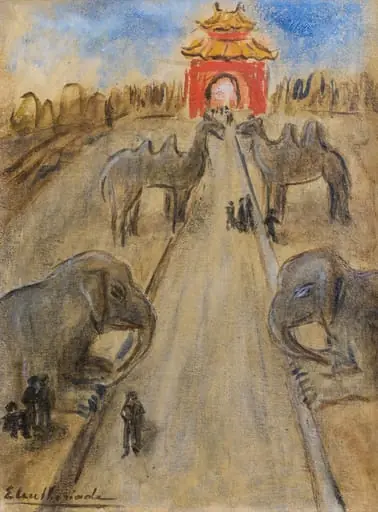
Created around 1973, “China – Aleea Împăraților” is a sketch by Micaela Eleutheriade. The composition depicts a dusty thoroughfare in a Chinese setting, dominated by a vivid red gate with a yellow‑tiled roof that suggests a temple entrance. Small figures and three camels move toward the gate, while rounded structures recede in the background.
Subject & Meaning
The work captures a moment of travel and transition, with the camels and their handlers progressing toward a symbolic threshold. The red gate, highlighted against the muted earth tones, may represent a portal to a sacred or communal space, emphasizing the interplay between movement and place in a bustling street scene.
Technique & Style
Eleutheriade employs rapid, loose brushwork that gives the drawing an immediacy and vitality. The palette relies on warm, earthy hues, allowing the bright red gate to dominate the visual field. Light and shadow are suggested through subtle tonal contrasts, creating a sense of depth without detailed modeling.
History & Provenance
The sketch dates to the early 1970s, a period when the artist explored Asian motifs and travel narratives. It remains part of Eleutheriade’s body of work from that decade, though specific exhibition or collection details have not been widely documented.
Context
During the 1970s, Western artists often turned to Eastern subjects, reflecting broader cultural curiosity and exchange. Eleutheriade’s depiction aligns with this trend, presenting an imagined Chinese street that blends observational detail with a stylized, sketch‑like approach.
Artist & collection

Artist
Micaela Eleutheriade (1900–1982) was a noted Romanian painter and engraver. She was a descendant, through her mother, of the painter Gheorghe Tattarescu, the pioneer of neoclassicism in Romania.