Artwork
Călărețul roșu
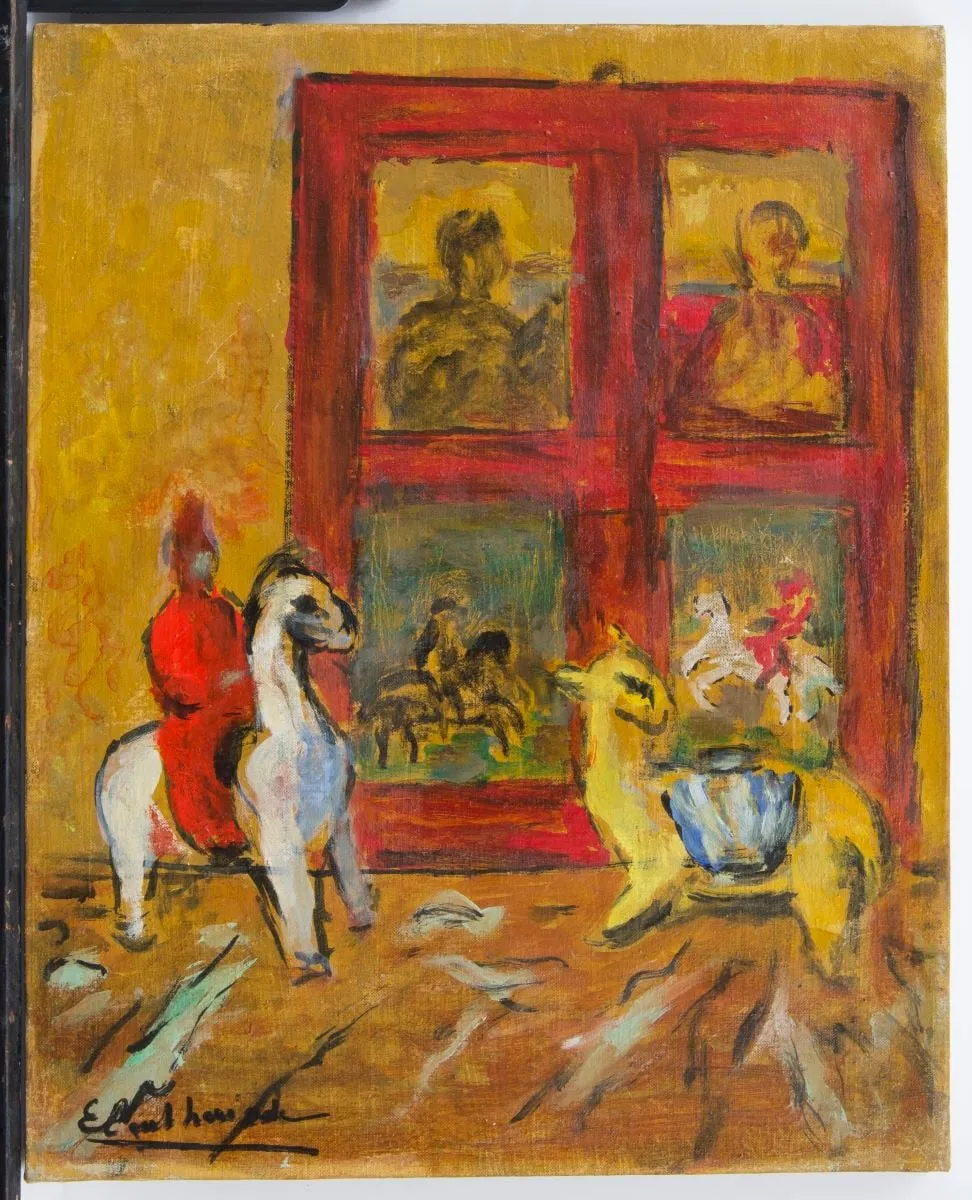
Călărețul roșu is an unspecified painting by Micaela Eleutheriade. It dates from 1977 and is held in the collection of the National Museum of Art of Romania.
About this work
Overview
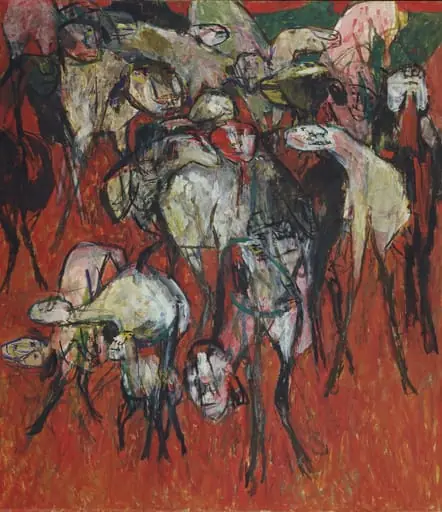
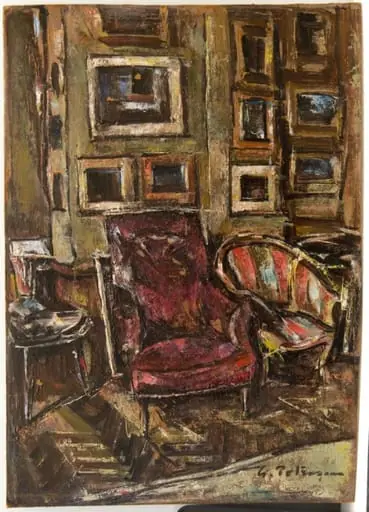
Călărețul roșu, dated around 1977, is a small-scale painting by Micaela Eleutheriade that presents a domestic interior charged with symbolic tension.
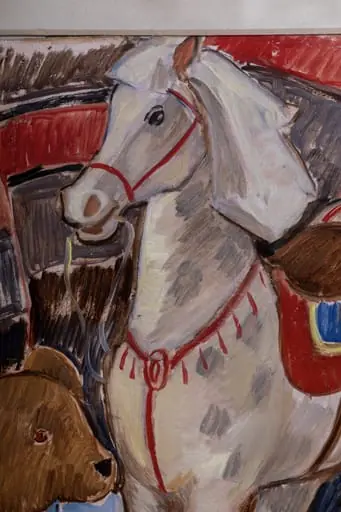
Călărețul roșu, dated around 1977, is a small-scale painting by Micaela Eleutheriade that presents a domestic interior charged with symbolic tension. The scene is dense with objects and color, arranged without conventional perspective. A solitary red rider on a white horse anchors the left side, while the room’s walls and floor hold fragmented, almost childlike elements that suggest layered meanings beyond literal representation.
Subject & Meaning
The central figure—a motionless red rider—appears more like a toy than a living being, blurring boundaries between the animate and the artificial. The window in the center displays three miniature paintings, each depicting riders, creating a recursive visual loop. A yellow goat and a blue-and-white vase, alongside scattered fragments, introduce organic and domestic motifs that resist clear interpretation, evoking memory or psychological displacement rather than narrative.
Technique & Style
Eleutheriade employs thick, uneven brushwork that emphasizes texture over refinement. Colors are applied with raw intensity—reds, yellows, and blues clash and glow without blending, creating a sense of urgency. The rough handling of paint gives the surface a tactile, almost sculptural quality, while the lack of smooth transitions suggests intentional incompleteness, reinforcing the work’s dreamlike, unstable atmosphere.
History & Provenance
The painting emerged from Eleutheriade’s mid-1970s period, a time when she was exploring personal symbolism through domestic interiors. It remained in private hands until the early 2000s, when it was acquired by a regional museum in Romania. No exhibition history or documented artist commentary accompanies the work, leaving its intent open to interpretation through visual cues alone.
Context
Created during Romania’s communist era, the painting’s surreal domesticity contrasts with the state’s emphasis on realism and public heroism. Its fragmented imagery and toy-like figures may reflect private resistance or psychological retreat, common among artists navigating censorship. The work aligns with broader Eastern European tendencies to encode subversion through metaphor and domestic symbolism.
Legacy
Călărețul roșu has not been widely reproduced or critically analyzed, but it is recognized within Romanian art circles as an early example of symbolic interiorism. Its influence is subtle, seen in later artists who used domestic spaces to explore identity and memory. The painting endures as a quiet, enigmatic artifact of personal expression amid political constraint.
Artist & collection

Artist
Micaela Eleutheriade (1900–1982) was a noted Romanian painter and engraver. She was a descendant, through her mother, of the painter Gheorghe Tattarescu, the pioneer of neoclassicism in Romania.