Artwork
L'Allemand expulsé (The German Expelled)
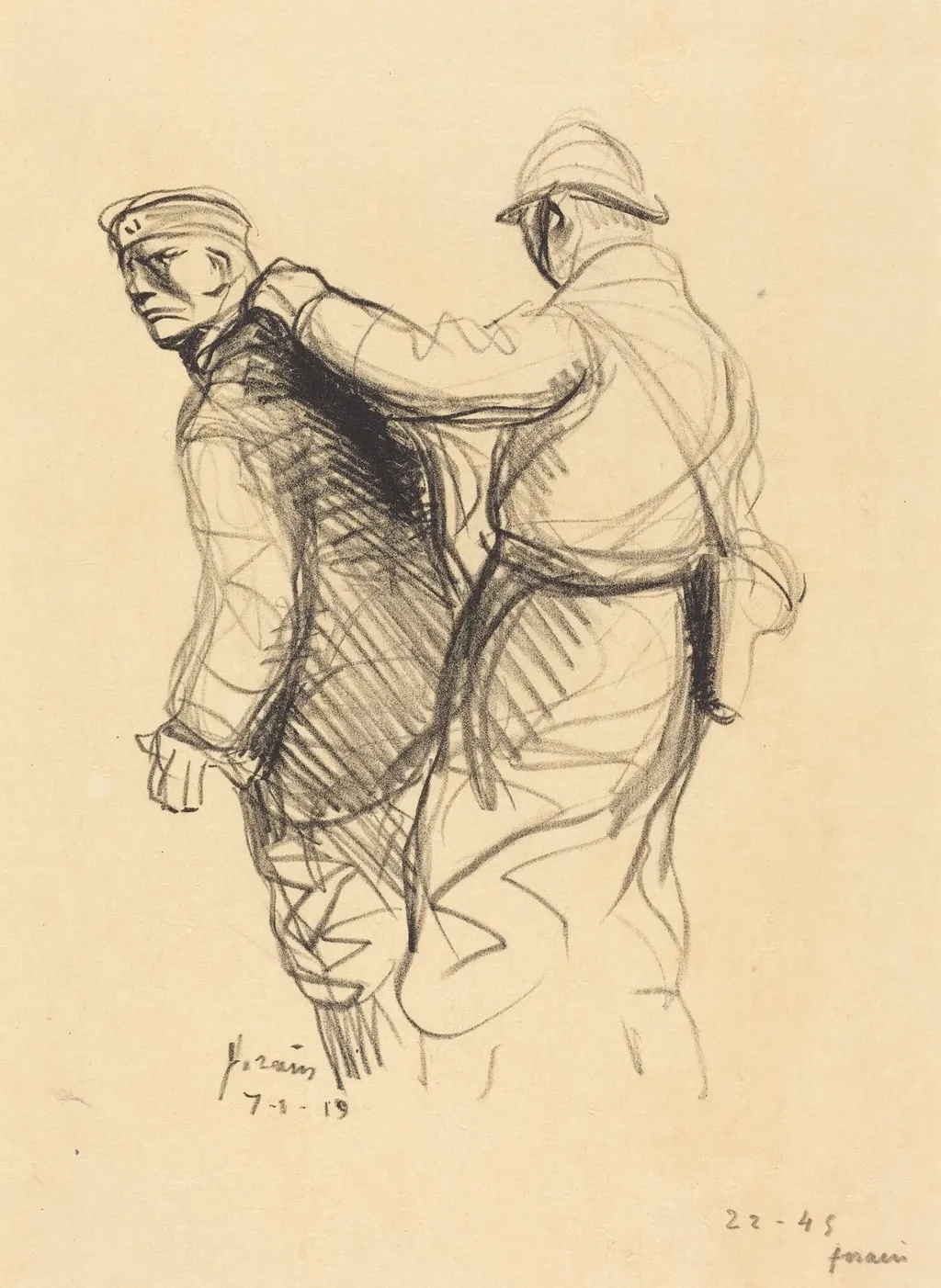
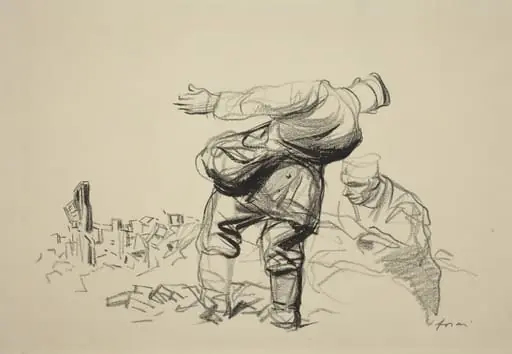
L'Allemand expulsé (The German Expelled) is an ink print by Jean-Louis Forain. It dates from 1919 and is held in the collection of the National Gallery of Art.
About this work
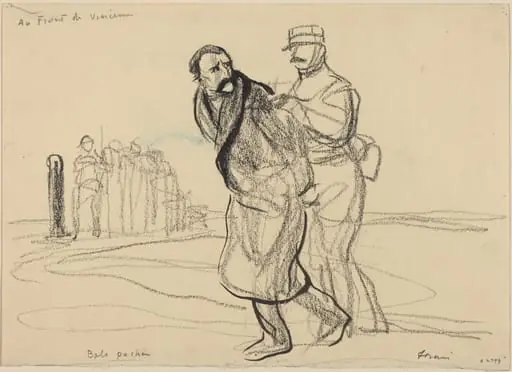
The man on the left wears a cap and holds his arm out stiffly, while the man on the right bends over to support him.
This sketch shows two soldiers in uniform, one helping the other walk. The man on the left wears a cap and holds his arm out stiffly, while the man on the right bends over to support him. Their clothes are baggy, and the lines are rough, like quick pencil strokes.
The drawing looks like it was made fast, almost like a note from the front lines. The artist signed it "Forain" in the corner, along with a date that looks like 1919.
If you want to see more by this artist, check out Forain, Jean-Louis.
Overview
Created in 1919, *L'Allemand expulsé* is a lithograph by Jean-Louis Forain, executed on laid paper. It belongs to a body of work produced in the aftermath of World War I, reflecting the artist’s shift toward politically charged subjects. Unlike his earlier satirical scenes, this print conveys a somber, humanistic tone. Forain, primarily known for his versatility across media, used lithography here to capture a fleeting, intimate moment with minimal detail and urgent line work.
Subject & Meaning
The image depicts two wounded soldiers, one supporting the other as they move forward. The man on the left, stiff and burdened, is assisted by his comrade, whose posture suggests fatigue and empathy. The title, referencing a German expelled, may allude to the postwar displacement of enemy soldiers or the broader moral reckoning after conflict. The ambiguity of identity underscores the universality of suffering, stripping away national labels to focus on shared human vulnerability.
Technique & Style
Forain employed rapid, sketch-like lithographic lines to convey motion and exhaustion. The figures are rendered with loose, almost hasty strokes, suggesting immediacy rather than polish. Fabric folds and bodily weight are suggested through minimal contours, not detailed modeling. The rough texture of the laid paper enhances the rawness of the image, reinforcing the sense of a field sketch—unrefined, direct, and emotionally unvarnished.
History & Provenance
The print was produced shortly after the Armistice, during a period when Forain turned from social satire to wartime testimony. It was likely part of a private or limited circulation, not widely exhibited at the time. While Forain enjoyed commercial success in his prime, this work remained relatively obscure, preserved in institutional collections rather than public display. Its survival reflects its role as a quiet, personal response to trauma rather than a public statement.
Context
In 1919, France was grappling with the physical and psychological toll of war. Artists like Forain, who had previously mocked bourgeois life, now turned to documenting the soldier’s experience. This print aligns with a broader trend of postwar visual testimony, where imagery moved away from propaganda toward introspection. The absence of overt nationalism or heroism distinguishes it from official war art, offering instead a muted, human-centered perspective.
Legacy
Though Forain’s reputation faded relative to his Impressionist contemporaries, *L'Allemand expulsé* endures as a quiet testament to his capacity for empathy in later life. It stands apart from his more famous satires, revealing a depth of feeling often overlooked in assessments of his career. The work is now recognized in museum collections as an example of how printmaking could convey the emotional weight of war without spectacle or sentimentality.
Own this work as a print
Artist & collection

Artist
Jean-Louis Forain (French pronunciation: ; 23 October 1852 – 11 July 1931) was a French Impressionist painter and printmaker, working in media including oils, watercolour, pastel, etching and lithograph.

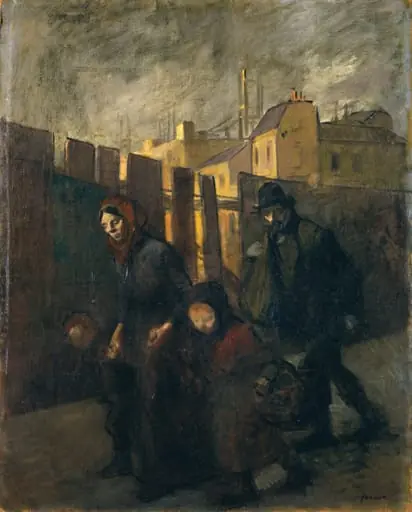
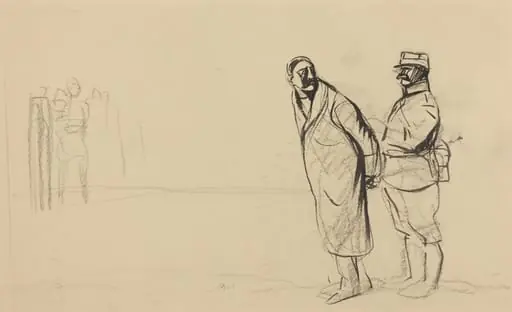 a) Au front de Vincennes, Bolo pacha (recto); b) Sketch for Au front de Vincennes, Bolo pacha (verso)
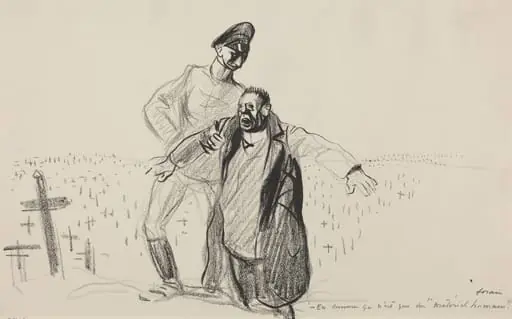 En somme ca n'est que du "materiel humain."
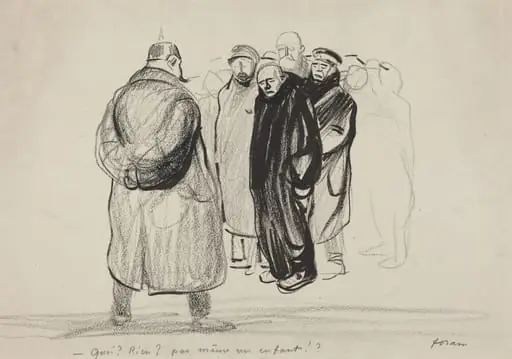 Bredouilles, l'Equipage d'un Zeppelin
 The Empire Destroys, The Republic Pays
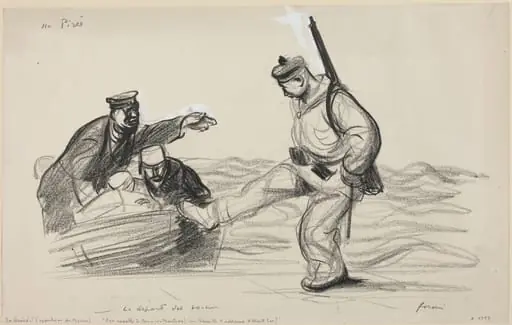 Au Pireê. -Le depart des boches.
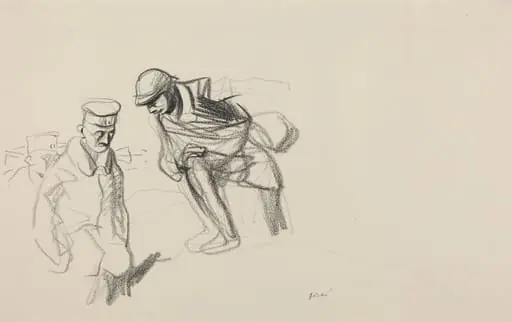 Lost Illusions
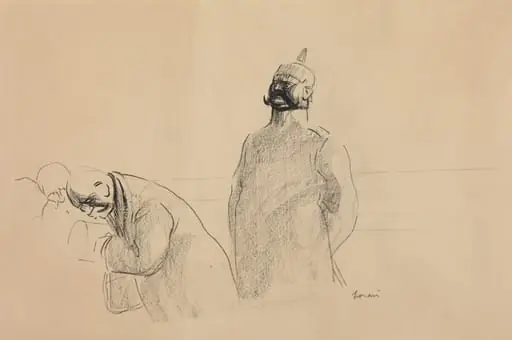 Prussian Soldier and Civilians
 Au Front de Vincennes, Bolo pacha
 Poilu and Tommy Conversing