Artwork
Winter Landscape with the Adoration of the Shepherds
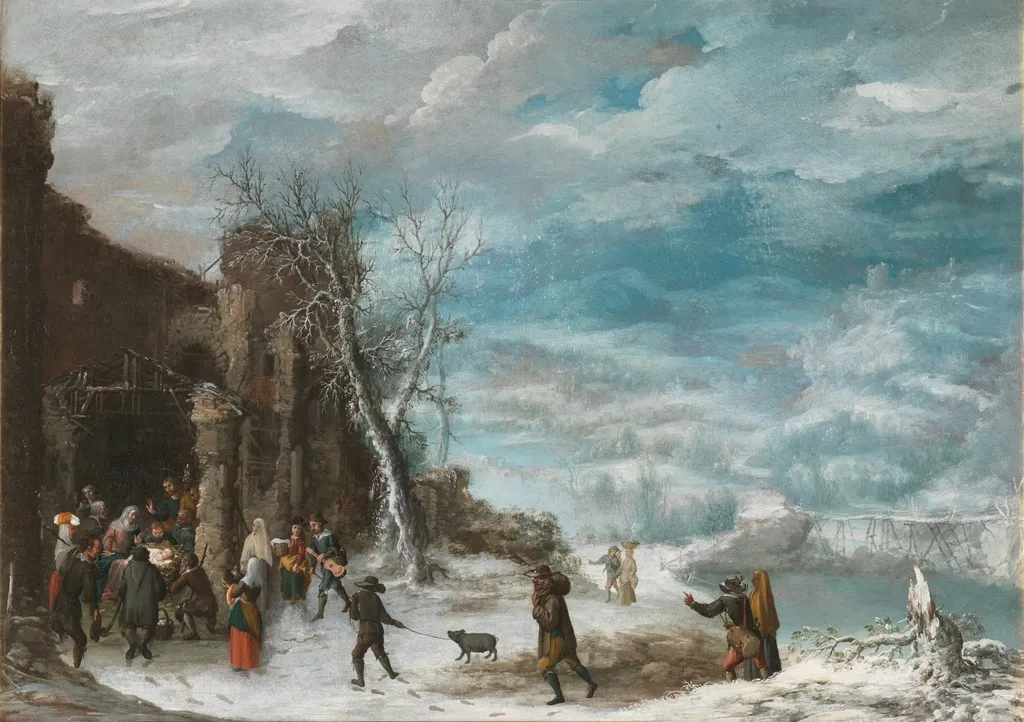
Winter Landscape with the Adoration of the Shepherds is an oil painting by the Early Baroque Italian artist Francisco Collantes. It dates from 1630 and is held in the collection of the Museo del Prado.
About this work
Overview
Created in 1630 by the Spanish Baroque artist Francisco Collantes, this oil painting combines a wintry countryside with the biblical scene of the shepherds’ adoration. The work is part of the Museo del Prado’s collection in Madrid and exemplifies Collantes’ interest in both landscape and religious narrative.
Subject & Meaning
The composition shows a snow‑covered setting where a group of figures gathers around a humble manger holding the infant Jesus. Shepherds and onlookers, bundled against the cold, are depicted in quiet reverence, some holding musical instruments, suggesting a harmonious celebration of the nativity within a stark winter environment.
Technique & Style
Collantes employs a pronounced chiaroscuro, using contrasts of light and shadow to model forms and create a sense of depth across the snowy terrain. The muted palette of grays and whites is punctuated by warmer tones on the figures, while the atmospheric sky and distant structures contribute to a balanced, naturalistic rendering typical of early‑17th‑century Spanish painting.
Context
Active in the early 1600s, Collantes was influenced by the Neapolitan School, particularly Jusepe de Ribera, and by the coloristic traditions of 16th‑century Venetian artists. His work reflects the period’s synthesis of dramatic Baroque lighting with the detailed observation of landscape that was gaining popularity in Spanish art.
History & Provenance
Since its creation, the painting has remained in Spain and is now housed in the Prado Museum, where it is displayed among other works that illustrate the development of Spanish Baroque religious and landscape painting.
Artist & collection
Artist
Francisco Collantes (1599–1656) was a Spanish Baroque era painter. Collantes was born in Madrid but sought influence from Jusepe de Ribera and the Neapolitan School. He was also influenced by 16th century Venetian…