Artwork
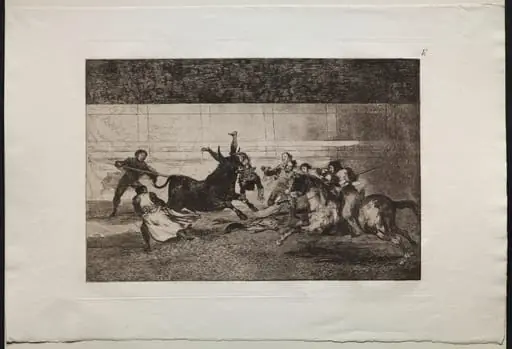
Bullfights: The Unlucky Death of Pepe Illo, in the Ring at Madrid
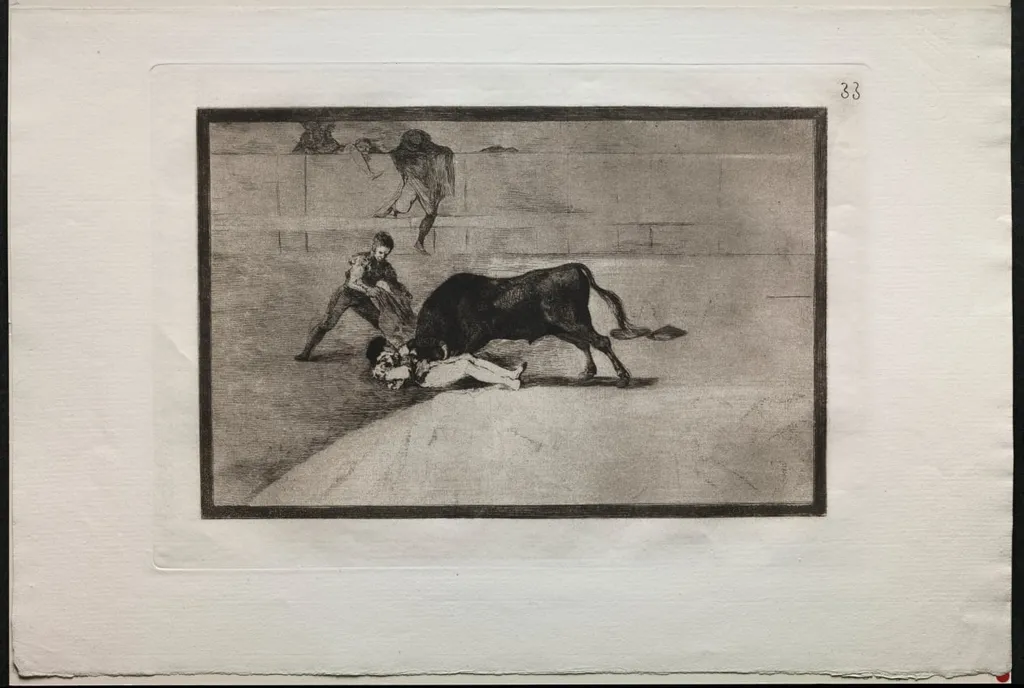
Bullfights: The Unlucky Death of Pepe Illo, in the Ring at Madrid is a print by the Romanticist artist Francisco Goya. It dates from 1816 and is held in the collection of the Cleveland Museum of Art. Created in 1816, this print by Francisco de Goya depicts the fatal moment of bullfighter Pepe Illo’s collapse in Madrid’s ring.
About this work
You see a bullfighter in pink pants lying on the ground. A bull stands over him, its horns near his chest. The crowd in the stands looks on. The fight just ended badly.
This was printed long after Goya painted it. He made the first version in 1816. The later print shows his sharp eye for chaos and fear. The dark edges make the scene feel closer.
Goya often watched bullfights. He knew the danger well. Look at the way the light hits the pink pants. It feels like the last thing the fighter sees.
Check out Francisco de Goya (Spanish, 1746–1828) next.
Overview
Created in 1816, this print by Francisco de Goya depicts the fatal moment of bullfighter Pepe Illo’s collapse in Madrid’s ring.
Created in 1816, this print by Francisco de Goya depicts the fatal moment of bullfighter Pepe Illo’s collapse in Madrid’s ring. Though originally painted that year, the printed version emerged later, reflecting Goya’s continued engagement with the scene. The Cleveland Museum of Art holds the print, which captures the brutality of the spectacle with stark immediacy, emphasizing the vulnerability of the human figure against the animal’s power.
Subject & Meaning
The scene portrays the sudden end of Pepe Illo’s career—and life—after being gored by the bull. The fighter’s pink trousers, vivid against the darkening ground, mark his body as the focal point of tragedy. The crowd’s passive observation underscores the ritualized nature of violence in public spectacle. Goya presents death not as heroism, but as a quiet, inevitable consequence of the arena’s unforgiving logic.
Technique & Style
Goya uses deep, enclosing shadows to compress the space, drawing the viewer into the moment of impact. The bull’s horns loom close to the fallen man’s chest, heightening tension without overt drama. Light falls sharply on the pink fabric, isolating the fighter’s final posture. The print’s tonal contrasts and loose, expressive lines convey urgency, reflecting Goya’s shift toward darker, more psychological modes of representation.
History & Provenance
The image originated as a painting in 1816, part of Goya’s series on bullfighting. The printed version, produced later, allowed wider circulation and preserved his vision beyond the original canvas. It entered the Cleveland Museum of Art’s collection through established acquisition channels, becoming a key example of Goya’s late graphic work. The print’s survival reflects its significance in documenting Spanish cultural practices through a critical lens.
Context
Goya was a frequent spectator of bullfights, witnessing their evolution from noble tradition to popular spectacle. By 1816, Spain was politically unstable, and the violence of the ring mirrored broader societal tensions. His depictions of bullfighting moved beyond entertainment to reveal the fragility of life and the indifference of the crowd, aligning with his broader preoccupations with mortality and human folly.
Legacy
This print stands as a quiet but forceful testament to Goya’s ability to transform observed reality into enduring visual commentary. Its unembellished portrayal of death influenced later artists grappling with violence and spectacle. Unlike romanticized depictions of bullfighting, Goya’s version resists glorification, offering instead a sober record of consequence—an image that continues to provoke reflection on public ritual and personal fate.
Artist & collection
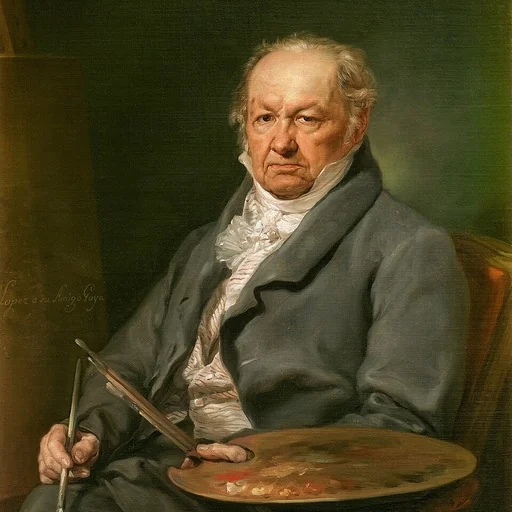
Artist
Francisco José de Goya y Lucientes (; Spanish: ; 30 March 1746 – 16 April 1828) was a Spanish romantic painter and printmaker.

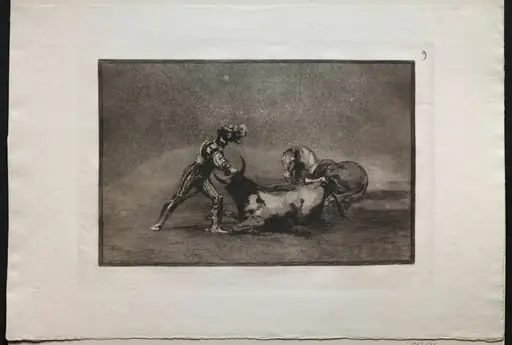 Bullfights: A Spanish Knight Kills the Bull After Having Lost His Horse
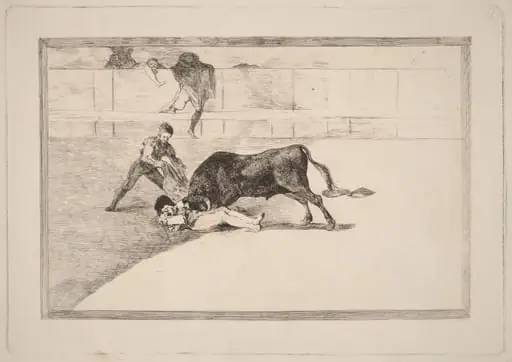 La desgraciada muerte de Pepe Illo en la plaza de Madrid (The Unlucky Death of Pepe Illo in the Ring at Madrid)
 Bullfights: The Death of Pepe Illo (2nd Composition)
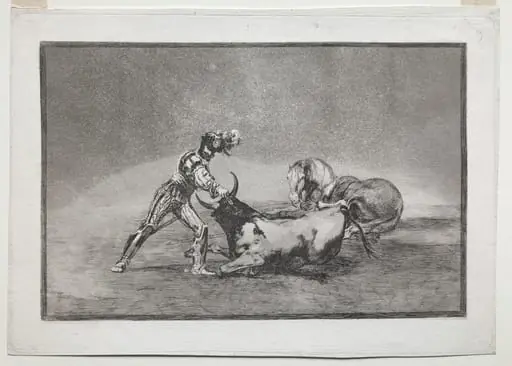 La Tauramaquia: A Spanish Knight Kills the Bull after Having Lost His Horse
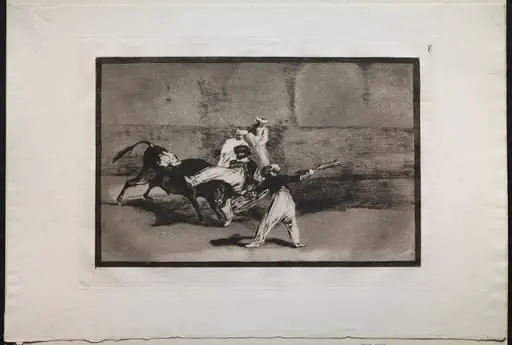 Bullfights: A Moor Caught by a Bull in the Ring
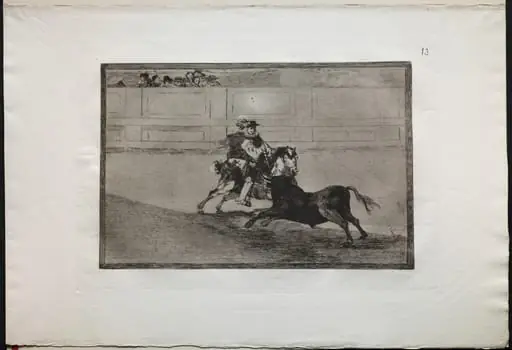 Bullfights: A Spanish Mounted Knight in the Ring Breaking Short Spears Without the Help of Assistants
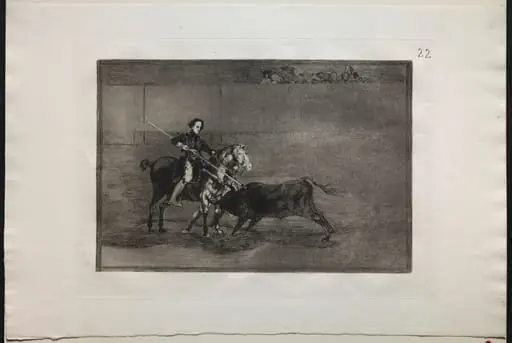 Bullfights: Manly Courage of the Celebrated Pajuelera in (the Ring) at Saragosa
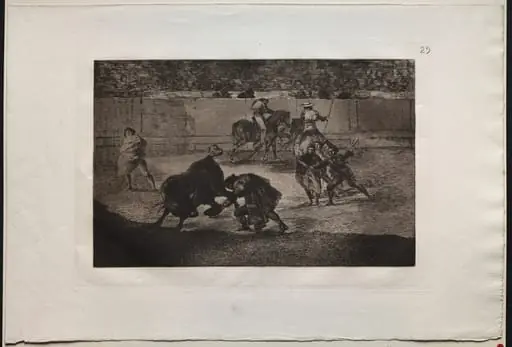 Bullfights: Pepe Illo Making the Pass of the "Recorte"
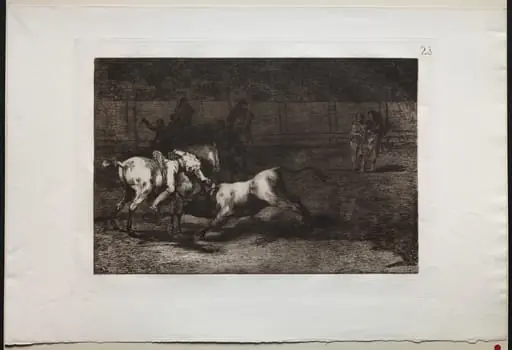 Bullfights: Mariano Ceballos, Alias the Indian, Kills the Bull From his Horse
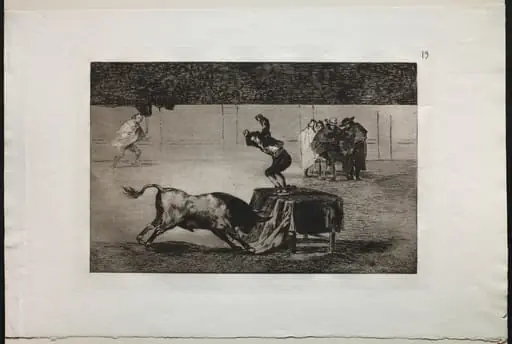 Bullfights: Another Madness of his in the Same Ring
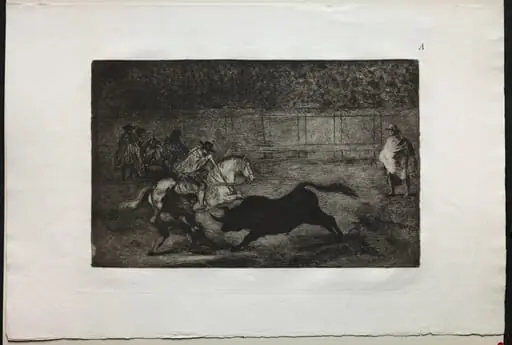 Bullfights: A Spanish Mounted Knight Breaking Short Spears with the Help of Assistants