Artwork
Young Woman (possibly a Sex Worker) with a Man (recto); Young Woman Wringing Her Hands over a Man's Naked Body (verso)
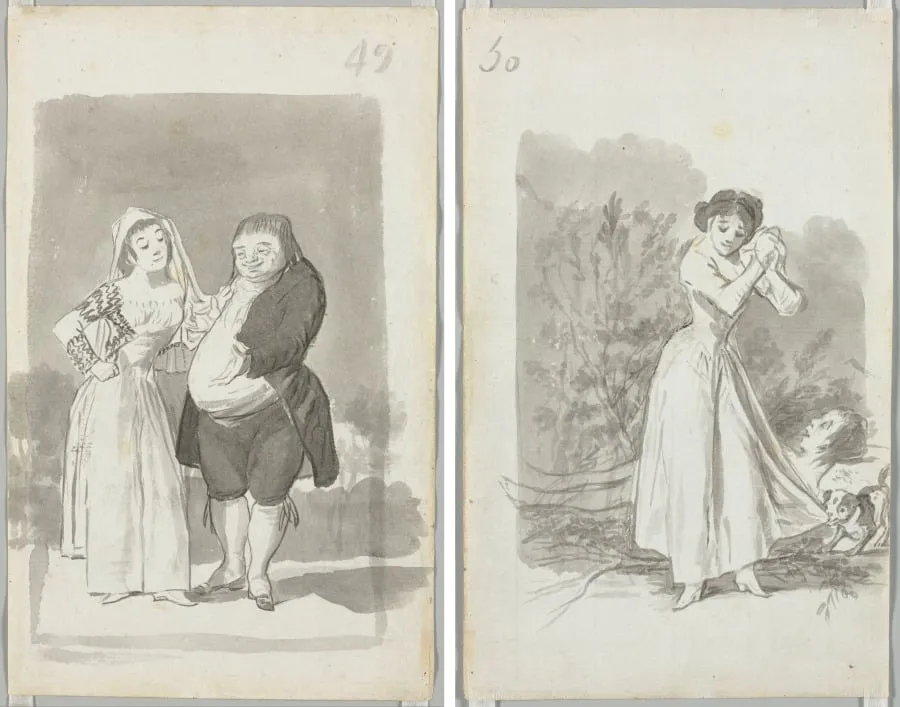
Young Woman (possibly a Sex Worker) with a Man (recto); Young Woman Wringing Her Hands over a Man's Naked Body (verso) is a drawing by the Romanticist artist Francisco Goya. It dates from 1796 and is held in the collection of the Cleveland Museum of Art. This double‑sided drawing originates from Goya’s so‑called Album B, part of a series of personal sketchbooks he kept over three decades.
About this work
The woman’s face is calm in the first scene but frantic in the second, like a story told in two frames.
You see two quick sketches on the same sheet of paper. One side shows a woman and a man talking in a dim room. The other side shows the same woman, now alone, twisting her hands over a man’s bare body.
Goya drew these in private notebooks—no one was meant to see them. The woman’s face is calm in the first scene but frantic in the second, like a story told in two frames. These sketches feel raw, almost like a secret diary.
To see more of Goya’s private drawings, look up Francisco de Goya (Spanish, 1746–1828).
Overview
This double‑sided drawing originates from Goya’s so‑called Album B, part of a series of personal sketchbooks he kept over three decades. After his death the pages were dispersed among various public and private holdings, and the sheet now presents two contrasting scenes on its opposite faces.
Subject & Meaning
On the recto, a plump, lecherous man engages with a woman whose demeanor is calm, suggesting a transactional encounter that Goya renders with unflinching directness. The verso shows the same woman alone, hands twisted over a nude male form, a composition that echoes the traditional narrative of Saint Margaret of Cortona, a former lover turned penitent.
Technique & Style
Both images are executed in rapid, gestural pencil strokes, characteristic of Goya’s private studies. The sketches convey immediacy through loose line work and minimal shading, emphasizing expression and movement rather than detailed finish.
History & Provenance
The sheet belonged to Goya’s Madrid Album, one of eight sketchbooks compiled between the 1770s and early 1800s. Following the artist’s death, the albums were broken up, and individual pages entered collections worldwide, eventually reuniting in the present institution.
Context
Goya’s graphic output often served as a personal commentary on social mores, employing satire to critique the hypocrisy of his era. The juxtaposition of a vulgar encounter with a penitential motif reflects his interest in the moral contradictions of contemporary Spanish society.
Artist & collection
Artist
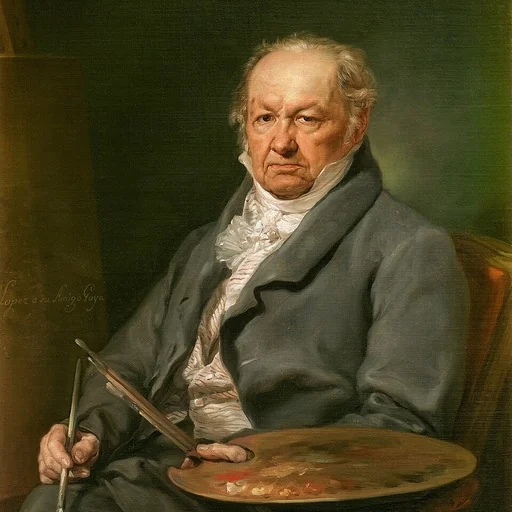
Francisco José de Goya y Lucientes (; Spanish: ; 30 March 1746 – 16 April 1828) was a Spanish romantic painter and printmaker.