Artwork
Witches' Sabbath
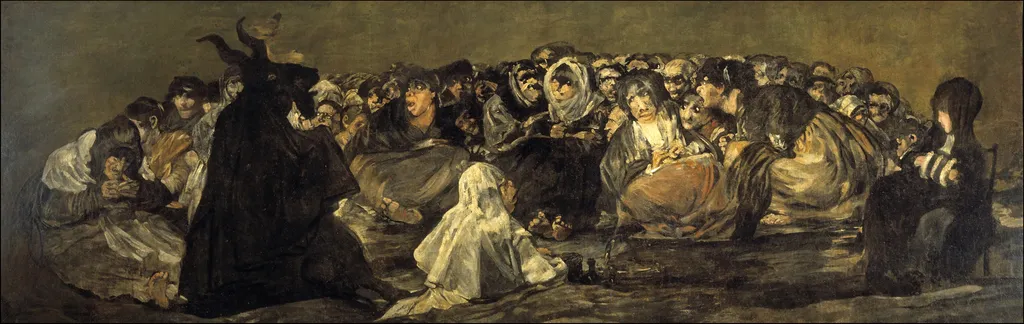
Witches' Sabbath is an oil painting by the Romanticist artist Francisco Goya. It dates from 1820 and is held in the collection of the Museo del Prado. Created between 1820 and 1823, this oil mural by Francisco de Goya forms part of his late series known as the Black Paintings.
About this work
Overview
Created between 1820 and 1823, this oil mural by Francisco de Goya forms part of his late series known as the Black Paintings. Executed directly on the plaster walls of his home, the Quinta del Sordo, the work portrays a nocturnal gathering dominated by a goat‑headed figure. The composition is stark, its palette limited to deep blacks and muted tones, conveying a somber, unsettling atmosphere.
Subject & Meaning
The scene evokes themes of superstition, fear, and mortality, with the goat often interpreted as a demonic embodiment of Satan.
The central figure, a hulking goat with horns, presides over a circle of aged, frightened women, suggesting a witches’ sabbat. The scene evokes themes of superstition, fear, and mortality, with the goat often interpreted as a demonic embodiment of Satan. Scholars view the image as a critique of the credulity and cruelty associated with the Spanish Inquisition’s witch trials, reflecting Goya’s own disillusionment.
Technique & Style
Goya applied oil directly onto wet plaster, allowing the pigment to soak into the wall surface. The painting relies on dramatic chiaroscuro: a faint, moonlit glow outlines the goat’s silhouette, while the surrounding figures dissolve into shadow. The brushwork is loose and expressive, emphasizing texture over detail, a hallmark of the Black Paintings’ raw, almost sculptural quality.
History & Provenance
After Goya’s death, the murals remained in the Quinta del Sordo until 1874, when they were removed and transferred to canvas. During this process the work lost a substantial portion of its original width, reducing its scale considerably. The canvas version entered public collections in the early twentieth century, where it has been exhibited as part of the Black Paintings series.
Context
Painted when Goya was in his mid‑seventies, the work emerged during a period of personal illness and isolation. It follows his earlier anti‑superstition prints, such as The Sleep of Reason Produces Monsters, and anticipates the political commentary of the Disasters of War series. The Black Paintings collectively reveal Goya’s bleak view of humanity and the darkness he perceived in contemporary Spanish society.
Artist & collection
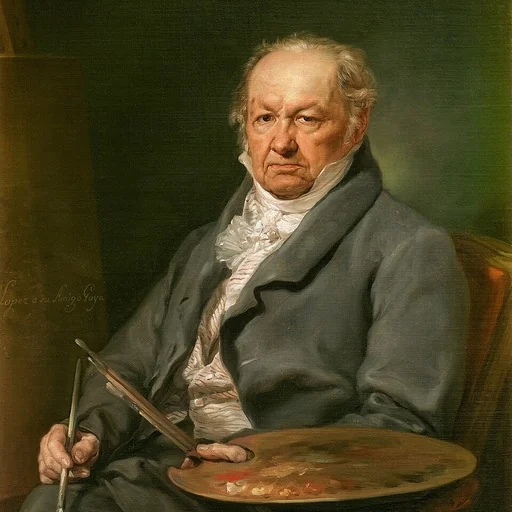
Artist
Francisco José de Goya y Lucientes (; Spanish: ; 30 March 1746 – 16 April 1828) was a Spanish romantic painter and printmaker.