Artwork
Armistice Day, Paris
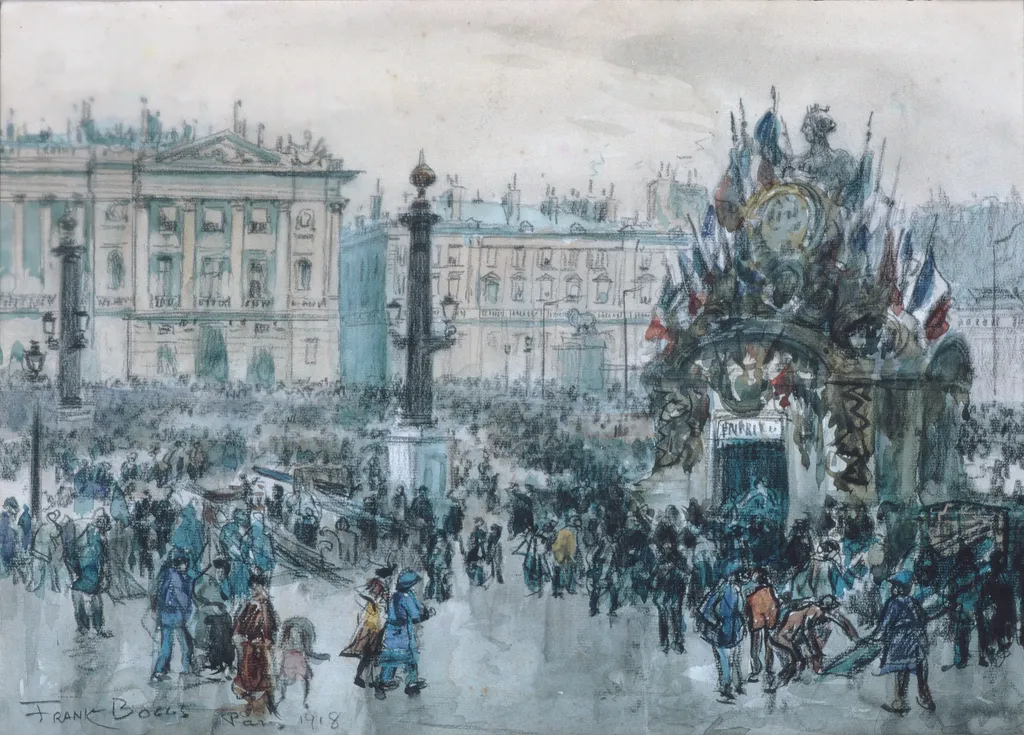
Armistice Day, Paris is an unspecified painting by the Impressionist artist Frank Myers Boggs. It dates from 1918 and is held in the collection of the Metropolitan Museum of Art. Frank Myers Bogus’s 1918 canvas records the immediate aftermath of the First World War as it unfolded on the streets of Paris.
About this work
If you like this painting, you might want to learn more about the artist, Frank Myers Boggs.
This painting shows a bustling street scene in Paris on Armistice Day in 1918. People are walking in every direction, some carrying flags or banners. In the background, there are large buildings and a clock tower decorated with flags.
The painting is done in muted colors, with lots of blues and grays. The artist has used loose brushstrokes to capture the energy of the scene. You can see the excitement and celebration in the faces of the people.
If you like this painting, you might want to learn more about the artist, Frank Myers Boggs.
Overview
Frank Myers Bogus’s 1918 canvas records the immediate aftermath of the First World War as it unfolded on the streets of Paris. The composition captures a lively boulevard on the day the armistice was signed, populated by pedestrians, banners and flags, while a prominent clock tower in the background bears celebratory decorations. The work now belongs to the collection of the Metropolitan Museum of Art.
Subject & Meaning
The painting portrays Parisians emerging from wartime restraint to express collective relief and jubilation. Figures move in varied directions, some clutching national symbols, suggesting a shared public ritual of gratitude. The juxtaposition of ordinary commuters with overt patriotic iconography underscores how the cease‑fire transformed everyday urban life into a moment of communal celebration.
Technique & Style
Executed with a palette of subdued blues and grays, the artist employs loose, impressionistic brushwork to convey movement and atmosphere. Broad strokes suggest the bustling crowd and the architectural backdrop without detailing every element, allowing the viewer to sense the energy of the day rather than a precise documentary record. The muted tones lend a somber yet hopeful mood appropriate to the historic occasion.
History & Provenance
Born in the United States, Bogus settled in Montmartre and later obtained French citizenship in 1923 after studying under Jean‑Léon Gérôme at the École des Beaux‑Arts. Though associated with the Impressionist tendency, he maintained a personal approach to contemporary events. The painting entered the Metropolitan Museum of Art’s holdings, where it remains part of the museum’s European paintings collection.
Own this work as a print
Artist & collection

Artist
Frank Myers Boggs (December 6, 1855 in Springfield, Ohio- 1926) was an American-born French painter.