Artwork
David and Abigail
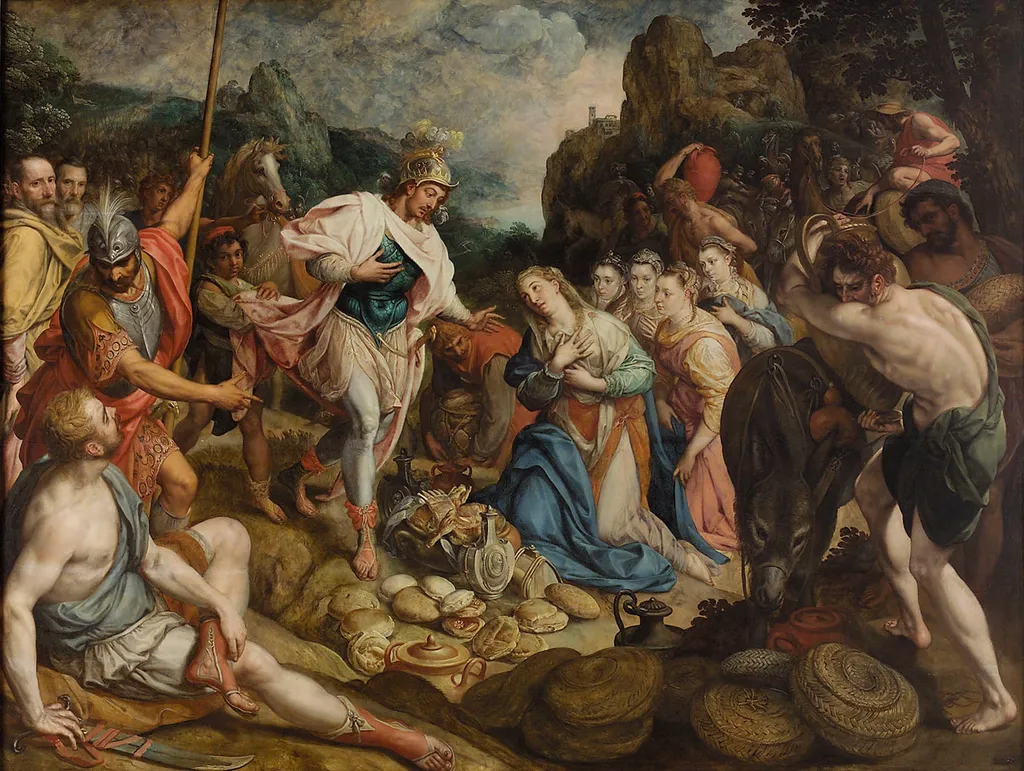
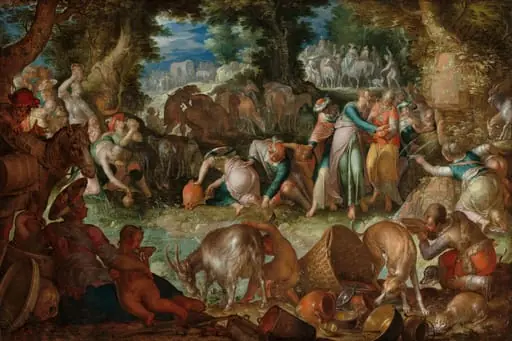
David and Abigail is an unspecified painting by the Early Baroque Italian artist Frans Pourbus the Elder. It dates from 1575 and is held in the collection of the Kunsthistorisches Museum.
About this work
Overview
Frans Pourbus the Elder, a Flemish painter active in the late 16th century, completed *David and Abigail* in 1575.
Frans Pourbus the Elder, a Flemish painter active in the late 16th century, completed *David and Abigail* in 1575. Born in Bruges into a family of artists, he was known for religious narratives and portraiture. This work, now in the Kunsthistorisches Museum in Vienna, reflects his engagement with biblical themes during a period of artistic transition in Northern Europe, blending regional detail with emerging dramatic conventions.
Subject & Meaning
The painting illustrates a moment from 1 Samuel 25, when Abigail, wife of Nabal, approaches David to appease his anger after her husband’s insult. She kneels before him, offering gifts and pleading for mercy. David, crowned and robed, stands as a figure of restrained authority. The scene captures moral tension—retribution versus wisdom—emphasizing Abigail’s courage and David’s capacity for restraint.
Technique & Style
Pourbus employs chiaroscuro to model figures with subtle gradations of light and shadow, enhancing their three-dimensionality. The composition centers David in a vertical axis, with Abigail’s kneeling form creating diagonal movement that draws the eye. Rich fabrics, detailed facial expressions, and a textured rocky landscape reflect Flemish attention to material realism, while the spatial depth suggests influence from Italian Renaissance practices.
History & Provenance
Painted in 1575, the work entered the Habsburg collections likely through imperial patronage or acquisition in the late 16th or early 17th century. It has remained in the Kunsthistorisches Museum since its founding in 1891, preserved as part of the imperial art holdings. Its continuous presence in Vienna underscores its recognition as a significant example of Northern Renaissance biblical painting.
Context
Created during the Counter-Reformation, the painting aligns with Catholic efforts to use visual art for moral instruction. While Italian artists emphasized grandeur and movement, Pourbus retained Northern European precision in detail and psychological nuance. His work bridges the late Renaissance and early Baroque, reflecting a Northern response to Italianate drama without abandoning local traditions of narrative clarity and realism.
Legacy
Pourbus’s *David and Abigail* stands as a representative work of Flemish religious painting in the late 1500s. Though less widely known than contemporaries like Rubens, his synthesis of Northern detail and Italianate composition influenced regional artists. The painting remains a key example of how biblical stories were rendered with psychological depth and formal control in the decades before the full emergence of the Baroque style in the Low Countries.
Artist & collection
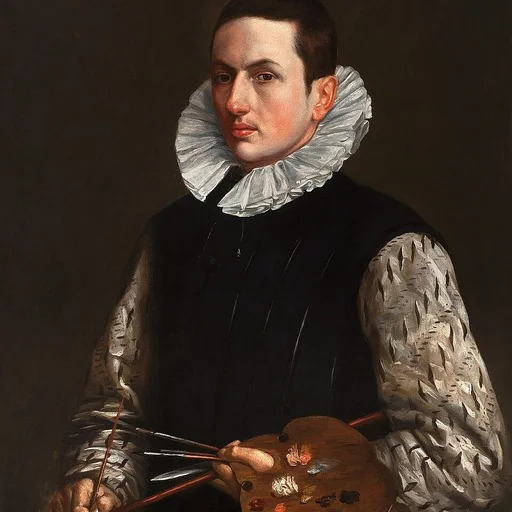
Artist
Frans Pourbus the Elder (Bruges, 1545 – Antwerp, 19 September 1581) was a Flemish Renaissance painter who is known primarily for his portraits and religious compositions, as well as a few genre scenes.