Artwork
The Temple of Dendur, Showing the Pylon and Terrace
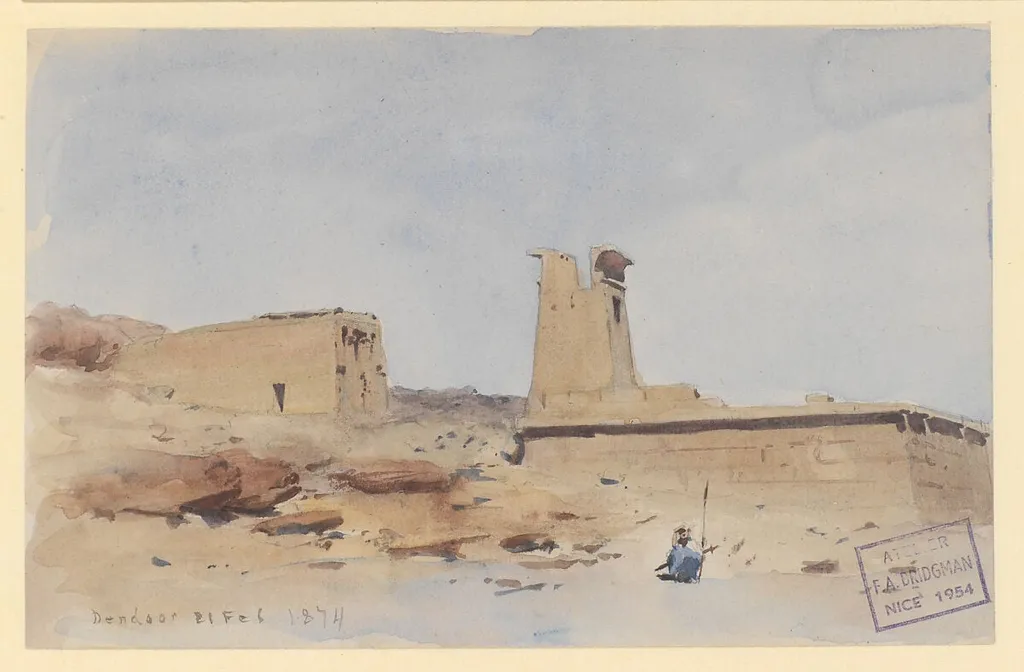
The Temple of Dendur, Showing the Pylon and Terrace is a watercolor work on paper by the American Impressionist artist Frederick Arthur Bridgman. It dates from 1874 and is held in the collection of the Metropolitan Museum of Art.
About this work
You see a sunlit Egyptian temple, its stone walls golden against a pale sky, with steps leading up to a carved doorway.
Bridgman painted this in 1874, long before the real Temple of Dendur was moved to New York. He used watercolor to catch the dry heat and quiet age of the ruins—no people, just shadows and time.
If you like how light plays on old stone, look up *glazing*.
Overview
The composition centers on the temple's pylon and terrace, rendered with a focus on the interplay of light and shadow across the weathered stone.
Frederick Arthur Bridgman's 1874 watercolor and gouache, The Temple of Dendur, Showing the Pylon and Terrace, depicts the ancient Egyptian sanctuary as it appeared in its original Nubian setting prior to its relocation to the United States. The composition centers on the temple's pylon and terrace, rendered with a focus on the interplay of light and shadow across the weathered stone. Bridgman employs a warm, golden palette to capture the intense sunlight of the Egyptian landscape, contrasting the textured masonry against a pale, expansive sky. The work is notable for its absence of human figures, directing the viewer's attention entirely to the architectural grandeur and the quiet desolation of the ruins. Executed during the height of the Orientalist movement, this piece reflects Bridgman's extensive travels in North Africa and his reputation for meticulous archaeological accuracy combined with atmospheric sensitivity. The medium of watercolor and gouache on off-white wove paper allows for both the crisp definition of architectural details and the soft diffusion of light characteristic of the desert environment. This work stands as a significant document of the temple's pre-relocation state and exemplifies the artist's contribution to 19th-century American Orientalist landscape painting.
Subject & Meaning
The composition focuses on the temple’s massive stone walls, rendered in a warm, golden hue against a clear sky. Steps ascend toward an elaborately carved doorway, while the absence of figures emphasizes the timeless stillness of the ancient site.
Technique & Style
Bridgman combined watercolor’s translucency with the opacity of gouache to capture the harsh, dry light of the desert landscape. The delicate washes convey atmospheric clarity, while the gouache highlights architectural details, creating a subtle contrast between illuminated stone and shadow.
History & Provenance
Created well before the actual relocation of the Temple of Dendur to the Metropolitan Museum of Art, the painting reflects 19th‑century Western interest in Egyptian antiquities. It entered the museum’s American Wing collection as part of the museum’s effort to document historic architecture through fine art.
Context
The work belongs to a period when American artists traveled abroad to document exotic locales for an audience eager for visual accounts of distant cultures. Bridgman, known for his Orientalist subjects, employed a scientific eye for architectural accuracy while maintaining a lyrical treatment of light.
Artist & collection

