Artwork
The Whiskey Rebellion
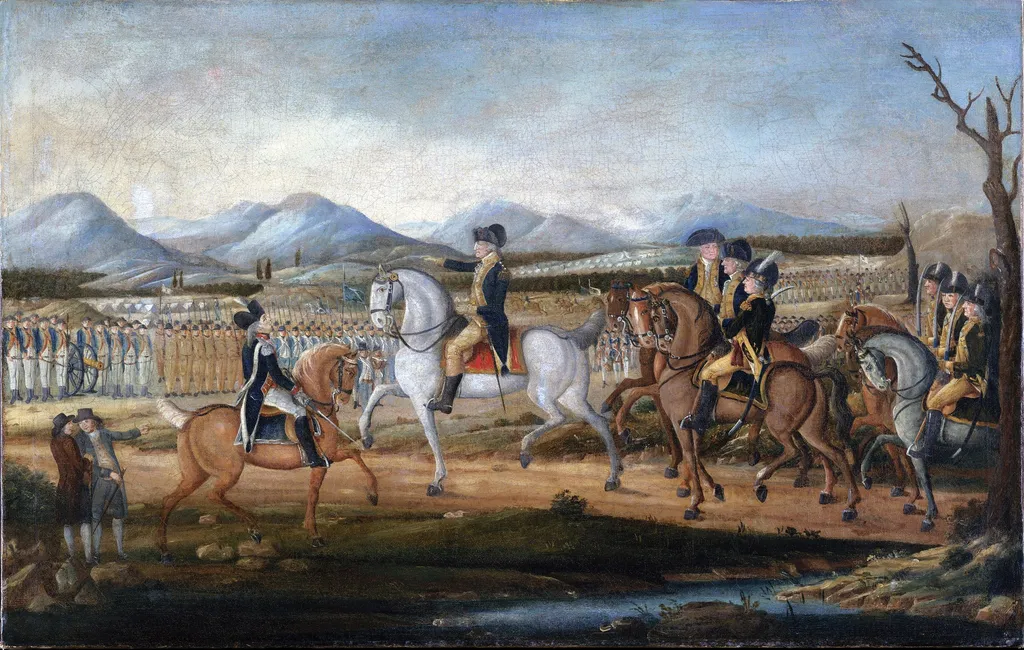
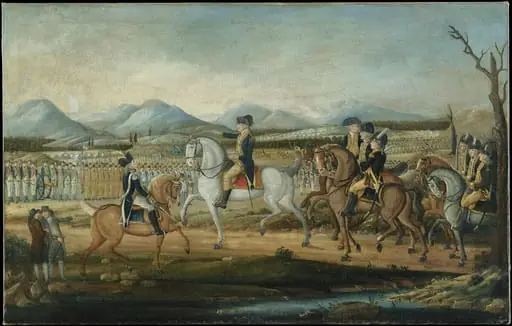
The Whiskey Rebellion is an unspecified painting by the American Folk Art artist Frederick Kemmelmeyer. It dates from 1798 and is held in the collection of the Metropolitan Museum of Art.
About this work
Overview
Frederick Kemmelmeyer, a self‑taught American artist, completed the oil painting *The Whiskey Rebellion* in 1798. The work belongs to the folk‑art tradition, noted for its direct, narrative quality, and it is part of the Metropolitan Museum of Art’s collection.
Subject & Meaning
The canvas portrays a moment from the 1790s tax protest known as the Whiskey Rebellion. In the foreground, mounted men charge across a grassy plain, while a mass of uniformly dressed figures lines the background, suggesting the tension between insurgent riders and the assembled populace.
Technique & Style
Kemmelmeyer employs bold, vigorous brushwork to render the horses and riders, giving them a sense of kinetic energy that contrasts with the relatively flat, static crowd behind them. The palette is restrained, dominated by earthy browns, muted greens and soft blues, and the sky is rendered in a pale, almost washed‑out tone.
History & Provenance
Created shortly after the rebellion’s suppression, the painting reflects contemporary interest in the young nation’s internal conflicts. It entered the Metropolitan Museum of Art’s holdings through acquisition, where it remains on display as an example of early American folk painting.
Own this work as a print
Artist & collection

Artist
Frederick Kemmelmeyer (c. 1755 – c. 1821) was an American painter. He was entirely self-taught and his work is generally classified as folk art.