Artwork
The Coral Necklace
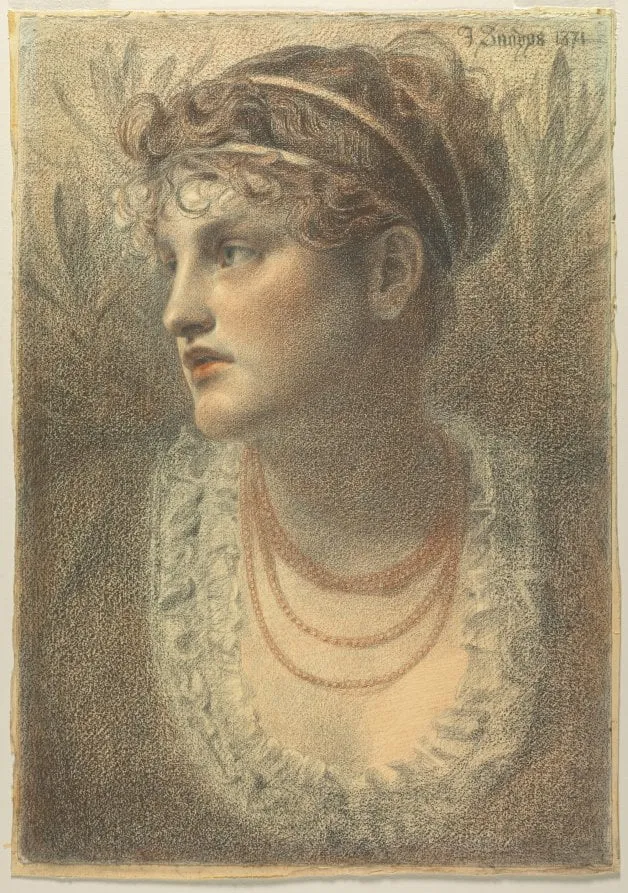
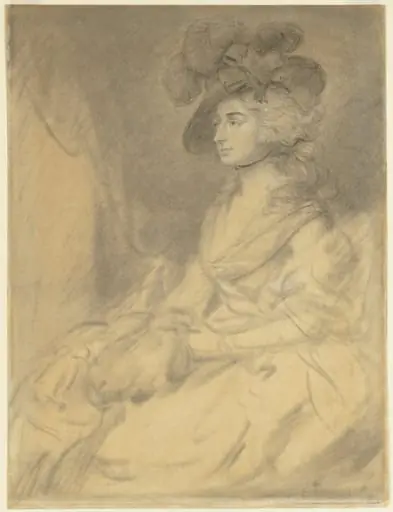
The Coral Necklace is a drawing by the Impressionist artist Frederick Sandys. It dates from 1871 and is held in the collection of the Cleveland Museum of Art.
About this work
Overview
Frederick Sandys created this chalk drawing as a intimate study of Mary Emma Jones, a central figure in his personal and artistic life.
Frederick Sandys created this chalk drawing as a intimate study of Mary Emma Jones, a central figure in his personal and artistic life. Executed on rough-textured paper, the work emphasizes tonal gradations over linear definition, exploiting the paper’s surface to create a luminous, atmospheric effect. The subject’s poised stillness and subtle modeling reflect Sandys’s mastery of medium and his focus on quiet psychological presence.
Subject & Meaning
Mary Emma Jones, Sandys’s long-term partner and the mother of his nine children, appears here with a string of red coral beads held loosely in her hands. Her pale complexion and parted lips suggest a moment of suspended thought, evoking a sense of introspection rather than narrative. The coral, often symbolizing life or protection, adds a quiet chromatic counterpoint to her dark attire and the muted tones of the background.
Technique & Style
Sandys employed chalk with exceptional control, building form through layered tones rather than outlines. By preserving the paper’s untouched low points, he achieved a stippled glow across the skin, enhancing the softness of the cheeks and jawline. This method, akin to sfumato in painting, dissolves edges into atmospheric haze, creating a tender, almost ethereal rendering of the figure.
History & Provenance
The drawing dates from Sandys’s most active period in London’s Pre-Raphaelite circles, where he was closely linked to Dante Gabriel Rossetti. Though never married to Jones, he relied on her as his primary model for over a decade. The work remained within his personal collection and was later dispersed through private sales, eventually entering public institutional holdings.
Context
In the 1860s, Sandys’s focus on intimate portraiture diverged from the narrative grandeur favored by some Pre-Raphaelites. His use of chalk on textured paper aligned with a broader interest in material tactility and the expressive potential of drawing as an end in itself. Jones’s repeated presence in his work reflects both personal devotion and a deliberate artistic choice to explore a single subject across time.
Legacy
This drawing exemplifies Sandys’s reputation as a draftsman of exceptional sensitivity. Though less celebrated than his contemporaries, his ability to convey emotional depth through subtle tonal shifts influenced later generations focused on intimate portraiture. The work endures as a quiet testament to the relationship between artist and model, and to the expressive power of drawing beyond line and detail.
Artist & collection

Artist
Anthony Frederick Augustus Sandys (born Antonio Frederic Augustus Sands), 1 May 1829 – 25 June 1904, usually known as Frederick Sandys, was a British painter, illustrator, and draughtsman, associated with the Pre-Raphaelites.