Artwork
A Woman Sitting by the Window
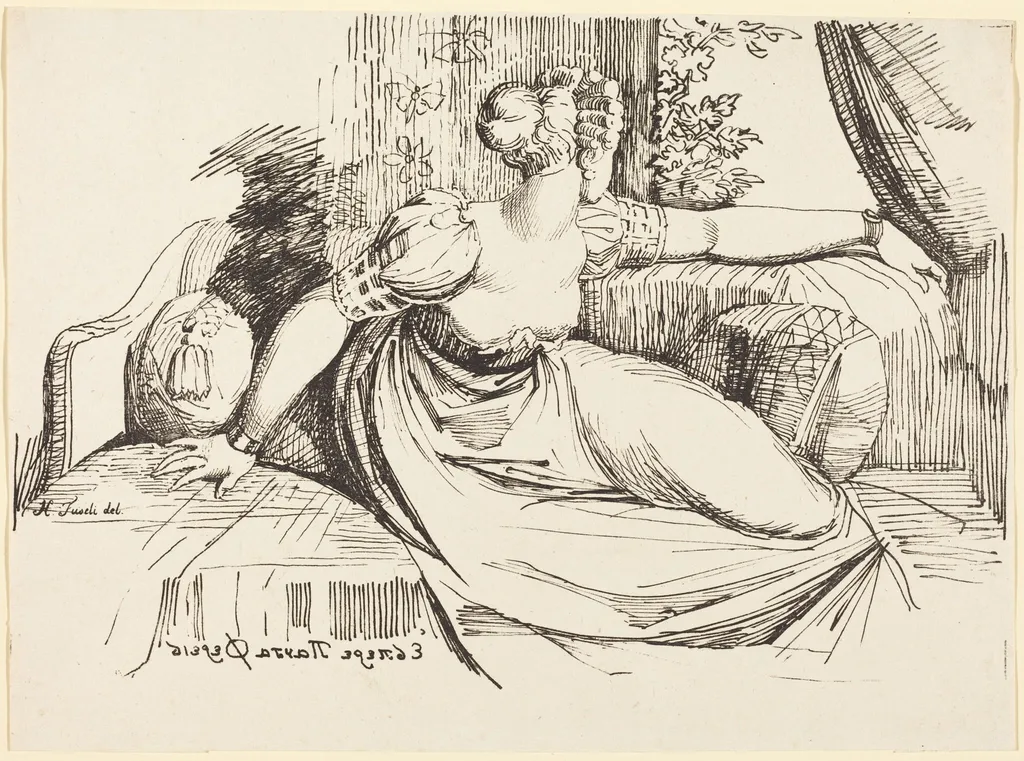
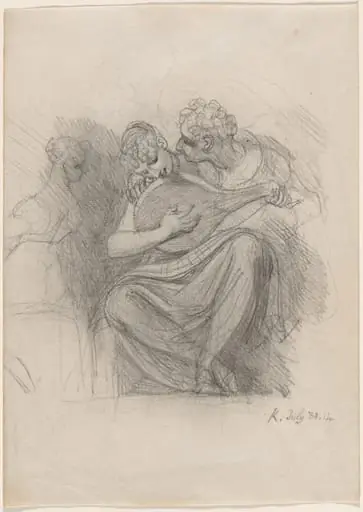
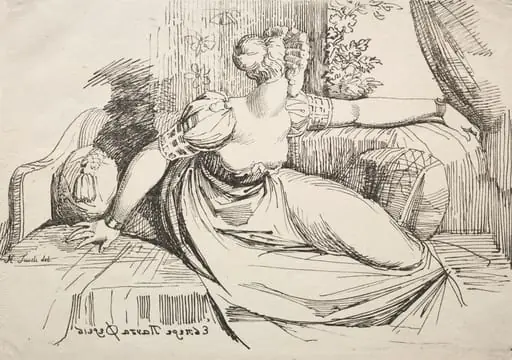
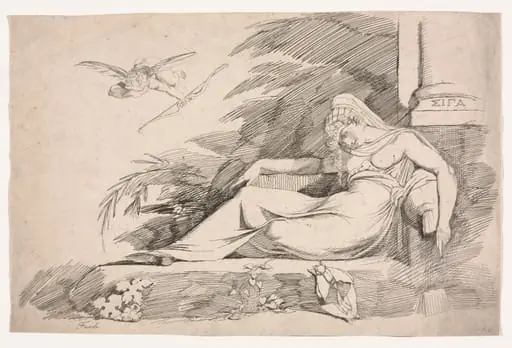
A Woman Sitting by the Window is an ink print by the Romanticist artist Henry Fuseli. It dates from 1802 and is held in the collection of the National Gallery of Art.
About this work
Overview
Created in 1802, this lithograph by Henry Fuseli is a rare example of his work in the medium, executed in pen and tusche. It captures a quiet interior scene with two women seated near a window, rendered through rapid, expressive lines that suggest movement and mood rather than precise detail. The composition balances intimacy with ambiguity, inviting contemplation without narrative clarity.
Subject & Meaning
The heavy curtain and the faint outline of a tree branch outside imply a threshold between interior solitude and the unseen world beyond.
Two women occupy a dimly lit room, their postures suggesting quiet companionship tinged with unease. One holds a fan, the other rests her head on her hand, eyes averted. The heavy curtain and the faint outline of a tree branch outside imply a threshold between interior solitude and the unseen world beyond. Their stillness feels charged, as if suspended in an unspoken moment of anticipation or concealment.
Technique & Style
Fuseli employed pen and tusche to achieve a range of tonal effects, using dense hatching for shadowed areas and sparse, sketchy lines for lighter zones. The fluid, almost improvisational strokes convey immediacy, emphasizing gesture over finish. The contrast between the soft gradations of ink and the stark outlines of the curtain and window frame heightens the atmospheric tension of the scene.
History & Provenance
This print dates from Fuseli’s later years, when he increasingly explored printmaking as a means of personal expression. It was likely produced for private circulation rather than public sale, reflecting his interest in psychological nuance over commercial appeal. Its survival in limited impressions underscores its status as a study in mood rather than a widely disseminated image.
Context
In early 19th-century Britain, lithography was emerging as a new reproductive technique, but Fuseli used it experimentally, favoring its capacity for expressive line over mechanical precision. His focus on intimate, psychologically charged interiors aligned with Romantic-era interests in inner life, contrasting with the grand historical subjects that dominated his earlier work.
Legacy
Though not widely exhibited in his lifetime, this work exemplifies Fuseli’s shift toward introspective imagery in his final decades. Its emphasis on emotional ambiguity and tactile line quality influenced later artists exploring psychological depth in printmaking, particularly those drawn to the expressive potential of sketch-like forms over polished finish.
Artist & collection