Artwork
Equestrian Portrait of Emperor Paul I with his Sons and Joseph I, King of Hungary
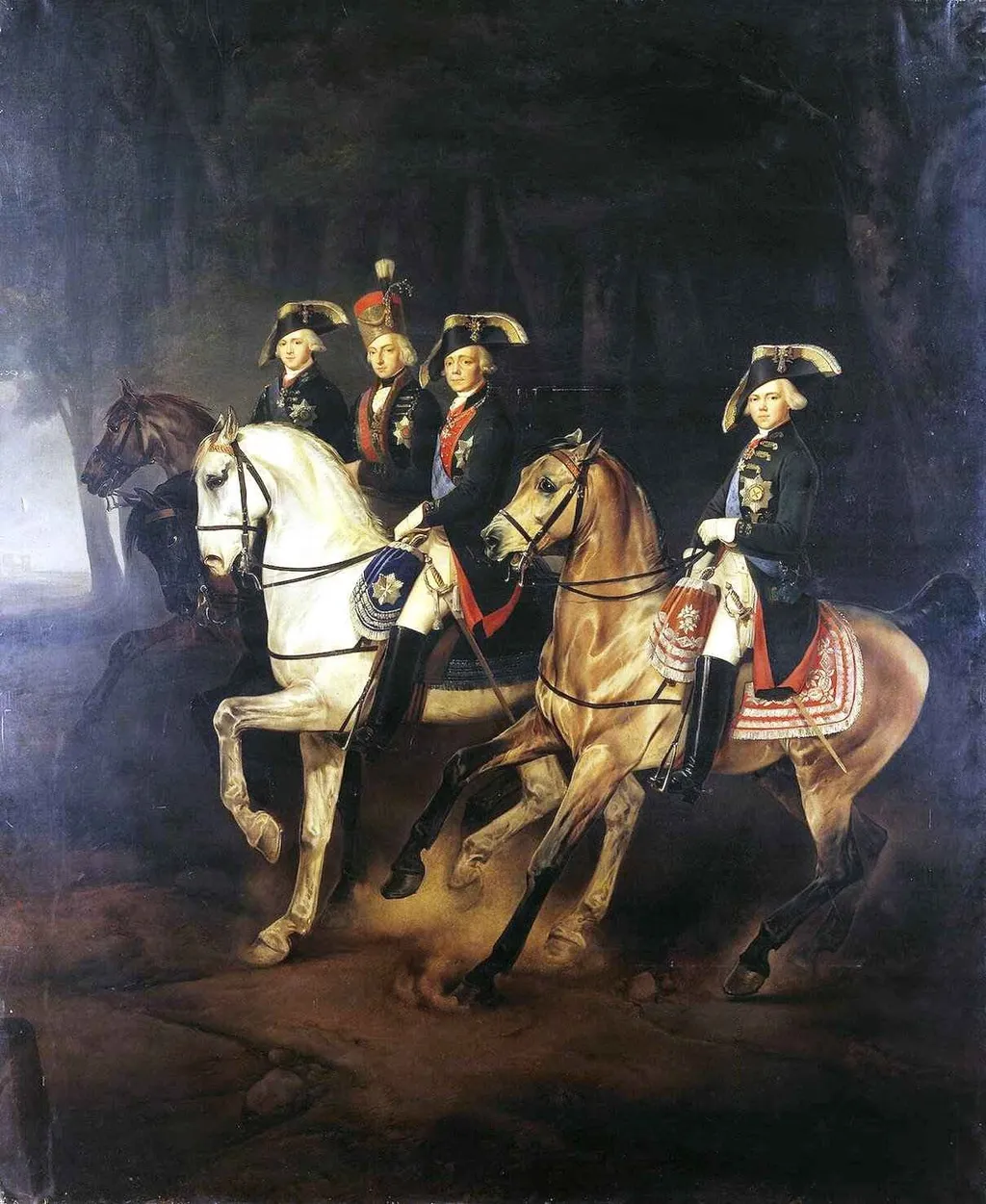
Equestrian Portrait of Emperor Paul I with his Sons and Joseph I, King of Hungary is an oil painting by the Realist artist Georg von Bothmann. It dates from 1848 and is held in the collection of the Hermitage Museum.
About this work
Overview
This large-scale canvas, executed in oil, presents its subjects mounted on horses, a traditional format for depicting royalty and military leaders.
Georg von Bothmann's 1848 oil painting, Equestrian Portrait of Emperor Paul I with his Sons and Joseph I, King of Hungary, captures a formal grouping of prominent European figures. This large-scale canvas, executed in oil, presents its subjects mounted on horses, a traditional format for depicting royalty and military leaders. The artwork is currently preserved within the collection of the State Hermitage Museum.
Subject & Meaning
The composition features Alexander I and Grand Duke Konstantin Pavlovich, both sons of Emperor Paul I of Russia, alongside Archduke Joseph, Palatine of Hungary. Each figure is presented in an official equestrian pose, a convention that historically conveyed power, status, and military prowess. Their elaborate uniforms, adorned with sashes and medals, underscore their high rank and the formal nature of the occasion.
Technique & Style
Bothmann employed oil paint to create a dramatic visual effect, utilizing a dark, undefined background to emphasize the figures. Light strategically illuminates the riders' faces, polished boots, and the ornate details of their uniforms, including feathered hats and gleaming medals. The artist rendered the horses with muscular definition, their prancing forms conveying dynamism, while the interplay of light and shadow contributes to a sense of three-dimensionality across the canvas.
Artist & collection