Artwork
Untitled
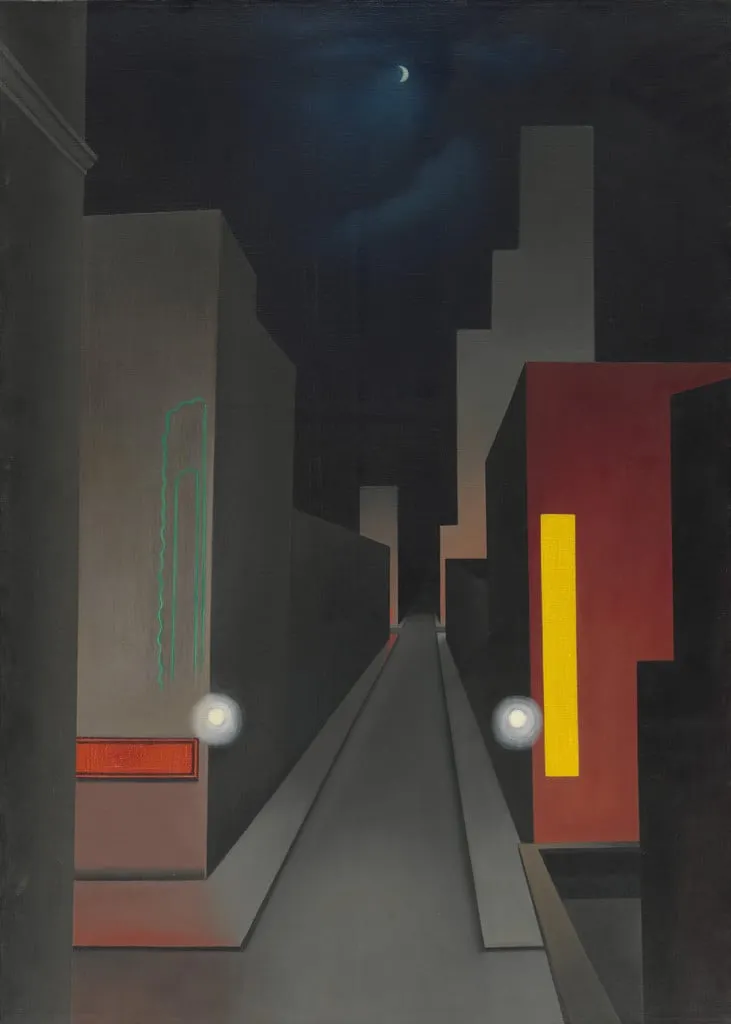
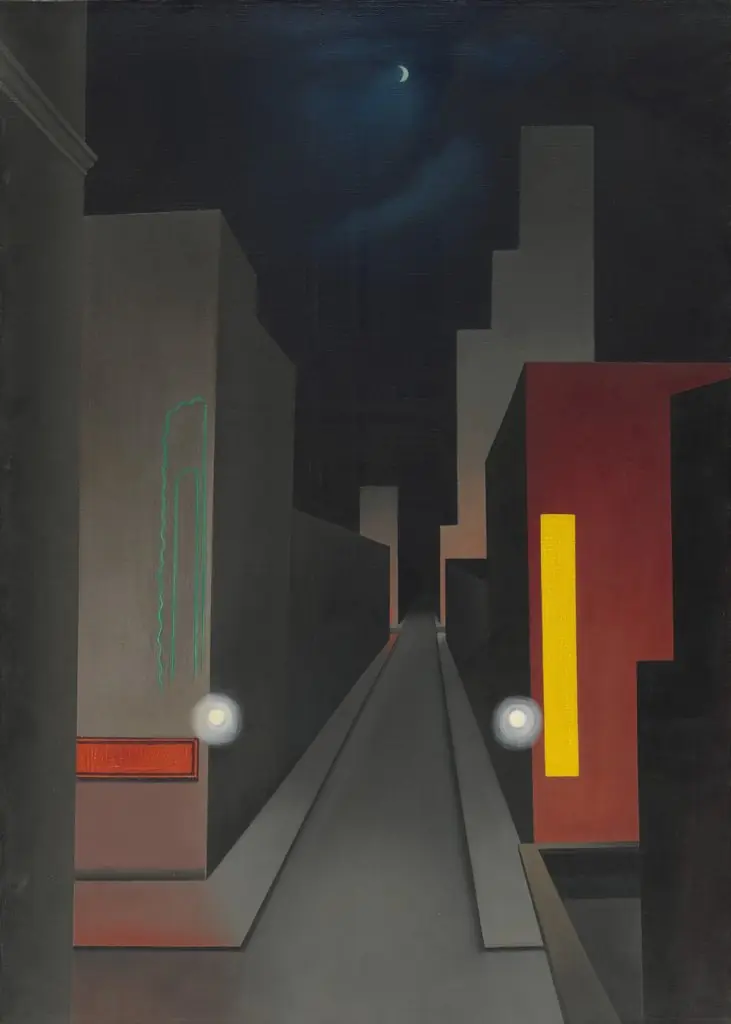
Untitled is an oil painting by the American Impressionist artist George Ault. It dates from 1945 and is held in the collection of the Museum of Modern Art.
About this work
Overview
A thin crescent of moon punctuates the black sky, emphasizing the scene’s quiet, after‑hours atmosphere.
George Ault’s 1945 oil painting, untitled, presents a nocturnal city alley rendered in stark contrast. The composition is dominated by dark, flat walls—one brown, the other a deep red—interrupted by vivid accents: a green sign, a yellow rectangle, a red door, and two suspended white lights that emit a faint illumination. A thin crescent of moon punctuates the black sky, emphasizing the scene’s quiet, after‑hours atmosphere.
Subject & Meaning
The work captures an empty urban passage at night, inviting contemplation of solitude within the built environment. The limited human presence, suggested only by the illuminated doorway and hanging lamps, underscores a sense of stillness and introspection, while the bright color patches serve as focal points that break the monotony of darkness, hinting at hidden narratives within the city’s hidden corners.
Technique & Style
Ault employs a chiaroscuro approach, using pronounced light‑and‑dark juxtapositions to model space and form. The oil medium allows for smooth, flat planes of color that contrast sharply with the luminous accents. The limited palette and simplified geometry reflect a restrained realism, while the precise rendering of light sources creates depth without relying on detailed texture.
History & Provenance
Created in the immediate post‑World War II period, the painting entered the collection of the Museum of Modern Art, where it remains on display. Its acquisition reflects the museum’s interest in mid‑century American urban scenes and Ault’s contribution to the development of American realist painting during that era.
Artist & collection

Artist
George Copeland Ault was an American painter. He was loosely grouped with the Precisionist movement and, though influenced by Cubism and Surrealism, his most lasting work is of a realist nature.