Artwork
Olive Trees at Tivoli
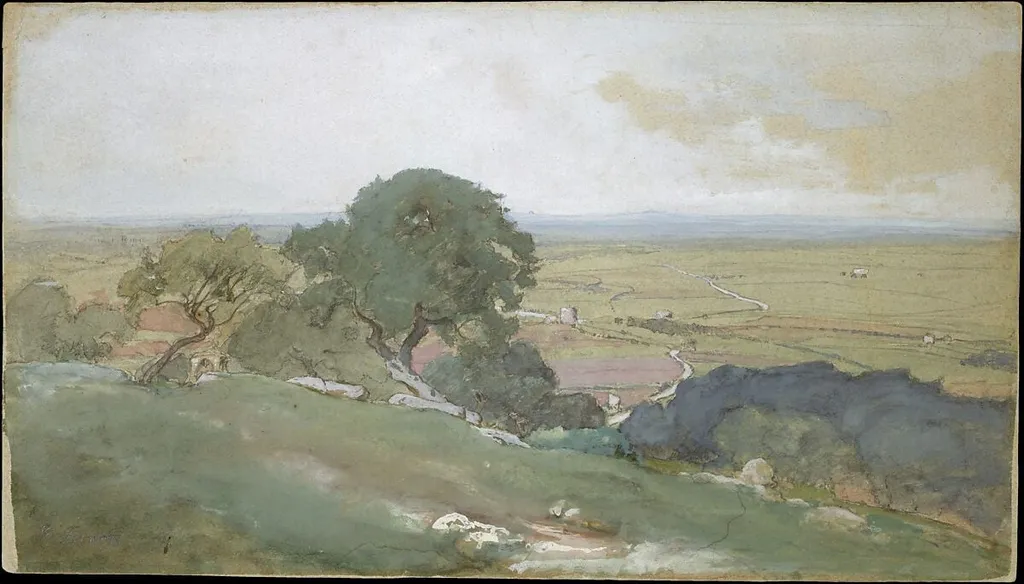
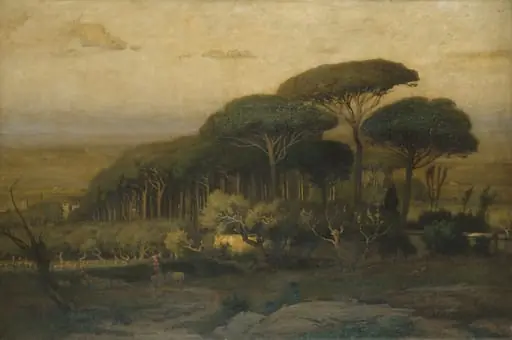
Olive Trees at Tivoli is a watercolor work on paper by the Hudson River School artist George Inness. It dates from 1873 and is held in the collection of the Metropolitan Museum of Art.
About this work
Overview
Created in 1873, *Olive Trees at Tivoli* is a small-scale landscape executed on blue wove paper that incorporates gouache, watercolor, and graphite.
Created in 1873, *Olive Trees at Tivoli* is a small-scale landscape executed on blue wove paper that incorporates gouache, watercolor, and graphite. The composition depicts a cluster of olive trees set against rolling hills, rendered with a muted palette that emphasizes atmospheric depth. The work exemplifies George Inness’s mature period, when his approach to nature had moved beyond the early Hudson River School conventions.
Subject & Meaning
The painting presents a tranquil Italian countryside scene, focusing on the interplay of light and shadow among the olive groves and distant terrain. While no explicit narrative is provided, the serene arrangement reflects Inness’s interest in the spiritual qualities of the natural world, a concern that aligns with his engagement with Swedenborgian ideas about the divine presence in everyday landscapes.
Technique & Style
Inness combined the opacity of gouache with the translucency of watercolor, allowing him to model forms while preserving luminous washes. Graphite outlines add structural definition, and the colored fibers embedded in the paper contribute subtle texture. The overall effect balances detailed brushwork with atmospheric washes, a synthesis characteristic of his later style that merges American landscape traditions with European tonal influences.
History & Provenance
The work entered the collection of the American Wing of the museum in the early twentieth century, acquired through a donation from a private collector of American art. It has remained in the museum’s holdings, serving as a representative example of Inness’s mature output and his transition from Hudson River School realism to a more poetic, mood-driven approach.
Context
Inness’s artistic development was shaped by early training within the Hudson River School, but his later exposure to the Barbizon painters and to the philosophical writings of Emanuel Swedenborg prompted a shift toward softer, more contemplative landscapes. *Olive Trees at Tivoli* illustrates this evolution, merging precise natural observation with an emphasis on spiritual resonance that marked American landscape painting in the post‑Civil War era.
Artist & collection

Artist
George Inness (May 1, 1825 – August 3, 1894) was an American landscape painter. Now recognized as one of the most influential American artists of the nineteenth century, Inness was influenced by the Hudson River School…