Artwork
Sringara Rasa
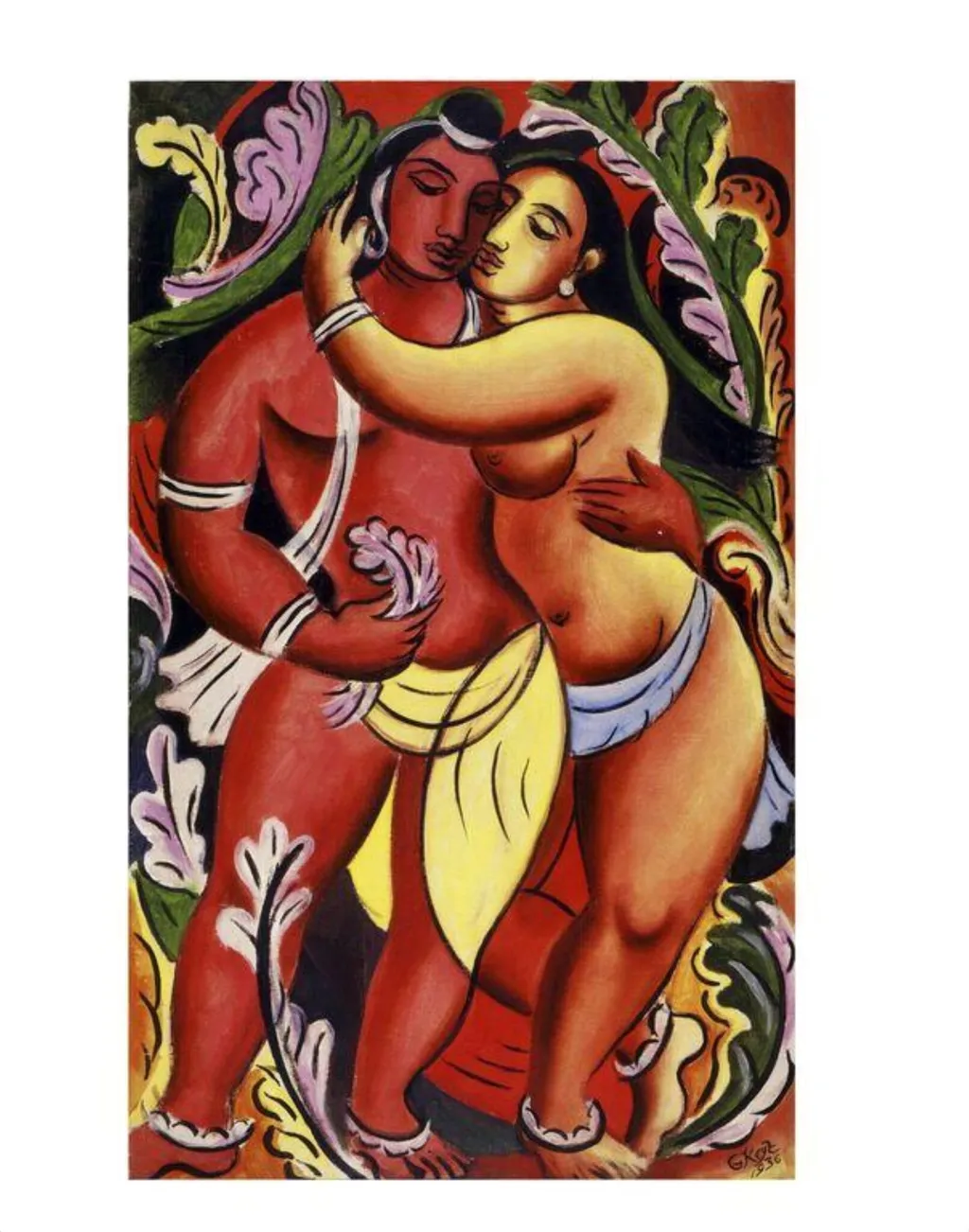
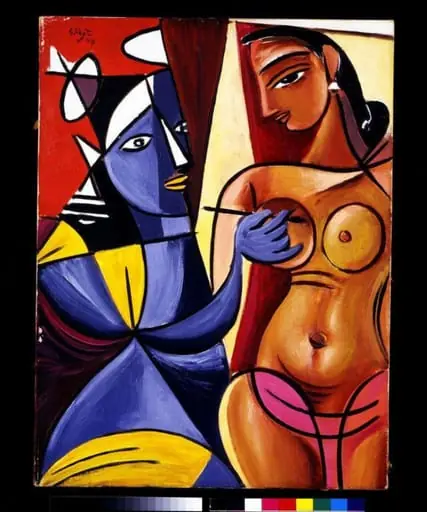
Sringara Rasa is a paint painting by George Keyt. It dates from 1956 and is held in the collection of the Victoria and Albert Museum.
About this work
The work blends Indian and Western styles, mixing cubism’s sharp angles with Kalighat art’s bold lines.
George Keyt painted *Sringara Rasa* in 1956. It shows two lovers dancing in a forest, set against a bold red backdrop. The work blends Indian and Western styles, mixing cubism’s sharp angles with Kalighat art’s bold lines.
Kalighat is a folk style from Bengal, known for simple lines and big eyes. Keyt uses those traits here, but also adds cubism’s angular shapes. The result is lively and a little abstract.
Look next at subject: kalighat.
Overview
Painted in 1956 by George Keyt, Sringara Rasa explores the Indian aesthetic concept of romantic love through a stylized depiction of two figures in motion. Set against a flat red ground and simplified trees, the composition merges Indian visual traditions with modernist Western forms. Keyt’s synthesis reflects his personal journey from colonial education to a deep engagement with South Asian spiritual and artistic heritage.
Subject & Meaning
The painting illustrates Sringara Rasa, one of the nine classical rasas in Indian aesthetics, representing the emotional essence of love and desire. Two figures, entwined in dance, inhabit a forested space that suggests both intimacy and transcendence. Their interaction is not narrative but symbolic, evoking the spiritual dimension of earthly passion as understood in Hindu literary and devotional traditions.
Technique & Style
Keyt employs bold, flowing lines reminiscent of Kalighat folk art, particularly in the exaggerated eyes and sinuous contours of the bodies. These are juxtaposed with angular, fragmented forms drawn from Cubism, creating a tension between fluidity and geometry. The palette is restrained—red background, green foliage, minimal flesh tones—emphasizing form over realism and aligning with modernist reductions of space and color.
History & Provenance
George Keyt, born in colonial Ceylon and educated in British-style institutions, gradually turned away from Western artistic norms toward Indian mythology and aesthetics. By the 1950s, he had developed a unique hybrid style, integrating Cubist structure with South Asian iconography. Sringara Rasa emerged from this period of synthesis, reflecting his mature engagement with both local traditions and global modernism.
Context
In mid-20th century Sri Lanka, artists like Keyt were redefining cultural identity amid postcolonial transition. His work responded to a broader movement seeking indigenous artistic languages, while remaining open to international currents. The fusion of Kalighat’s populist energy and Cubism’s formal innovation positioned him as a bridge between regional heritage and avant-garde experimentation.
Legacy
Sringara Rasa exemplifies Keyt’s role in shaping a modern Sri Lankan visual language rooted in South Asian thought yet unafraid of global dialogue. His blending of folk and modernist idioms influenced later generations of artists seeking to reconcile tradition with innovation. The painting remains a quiet but significant marker in the evolution of postcolonial art in South Asia.
Artist & collection
Artist
George Percival Sproule Keyt, (17 April 1901 – 31 July 1993) was a Sri Lankan painter.