Artwork
Garrick in the Role of Richard III
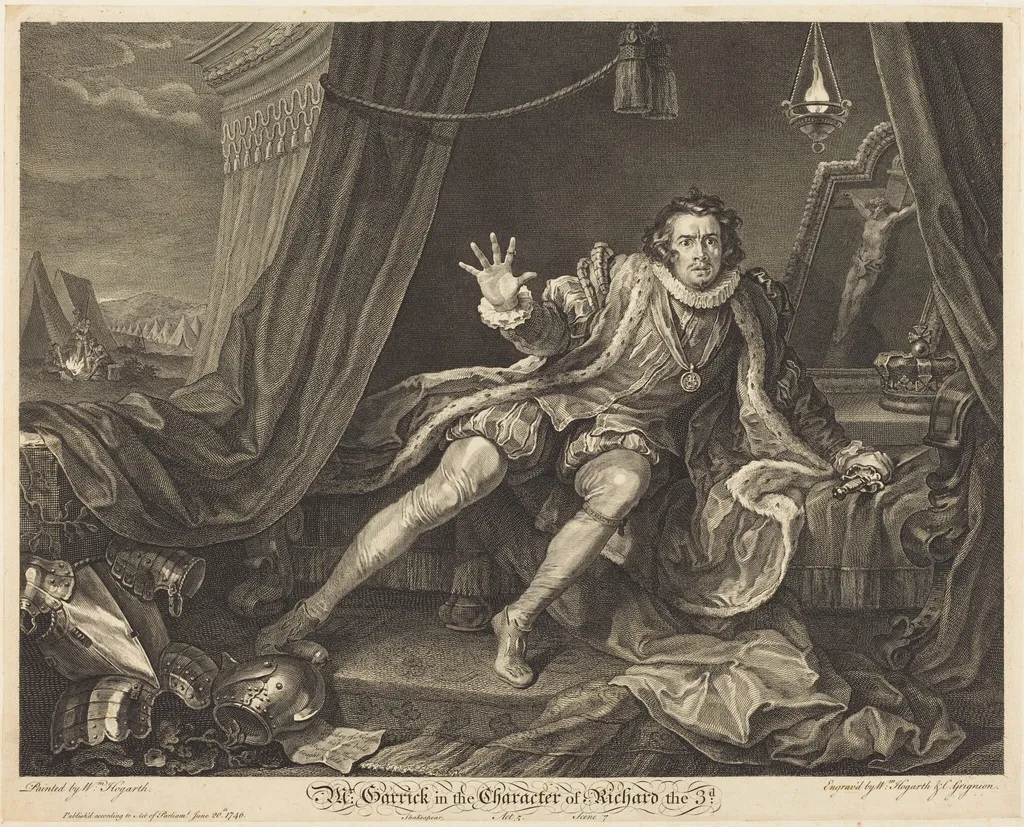
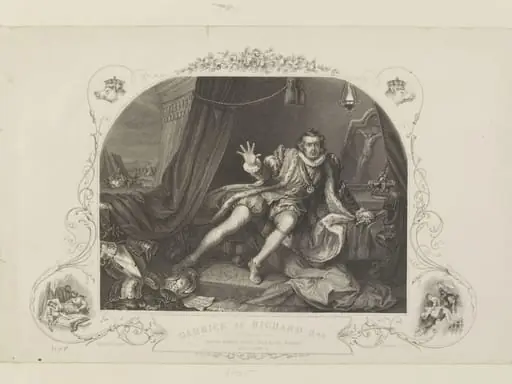
Garrick in the Role of Richard III is an ink print by the Baroque artist Charles Grignion. It dates from 1746 and is held in the collection of the National Gallery of Art.
About this work
Overview
Created in 1746 by Charles Grignion the Elder, this print captures actor David Garrick in his celebrated portrayal of Shakespeare’s Richard III.
Created in 1746 by Charles Grignion the Elder, this print captures actor David Garrick in his celebrated portrayal of Shakespeare’s Richard III. Executed in etching and engraving on laid paper, the image was mounted on a second sheet of the same material for stability. Grignion, trained in London by Hubert-François Gravelot, specialized in reproductive prints that translated theatrical performances into graphic form, bridging stage and print culture.
Subject & Meaning
The scene depicts Garrick as the tormented monarch in a moment of psychological unraveling, likely from Act V, Scene 3, just before the Battle of Bosworth. His reclining posture, disheveled attire, and distant gaze convey inner turmoil. The helmet and gauntlets on the floor suggest impending violence, while the distant castle and statue hint at the weight of legacy and divine judgment, reinforcing the play’s moral themes.
Technique & Style
Grignion employed fine etched lines and precise engraving to render texture in fabric, metal, and drapery. The layered technique allowed subtle gradations of light and shadow, enhancing the drama of the scene. The use of laid paper, with its characteristic chain lines, added a tactile quality. Background elements like the landscape and statue are rendered with lighter, more suggestive strokes, creating spatial depth without distracting from the central figure.
History & Provenance
The print was produced during the height of Garrick’s fame, when his performances were widely discussed and imitated. It likely served as a commemorative object for theatergoers and collectors. Though its early ownership is undocumented, such prints were commonly circulated in London’s artistic circles. The mounting on a second sheet of laid paper suggests careful preservation, possibly by a private collector or theater enthusiast of the period.
Context
In mid-18th-century Britain, theatrical portraiture flourished as public interest in actors rose. Garrick’s naturalistic style revolutionized Shakespearean performance, and prints like this helped disseminate his image beyond the stage. Grignion’s work reflects a broader trend of translating live performance into reproducible art, aligning with the era’s growing print culture and the rising status of actors as cultural figures.
Legacy
This print remains a key document of 18th-century theatrical representation, illustrating how performance was preserved and interpreted through print. Grignion’s technical skill and attention to psychological nuance influenced later theatrical illustrators. Though not widely exhibited today, it endures in institutional collections as evidence of the intersection between drama, portraiture, and printmaking in Georgian England.
Artist & collection

Artist
Charles Grignion the Elder (1721–1810) was a British engraver and draughtsman. Grignion was born in London to Huguenot refugees. He was a prolific historical engraver and book illustrator. He studied in London at…