Artwork
The White House
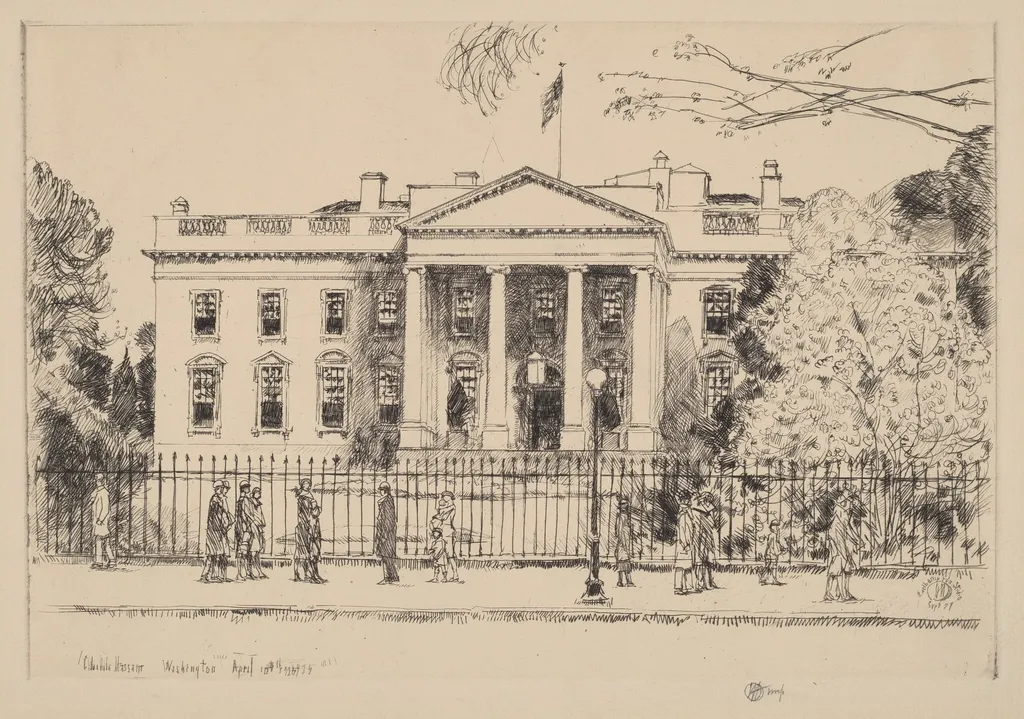
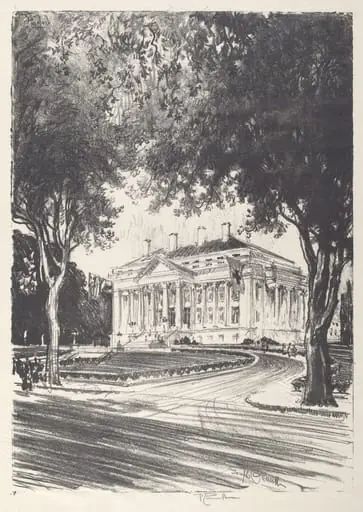
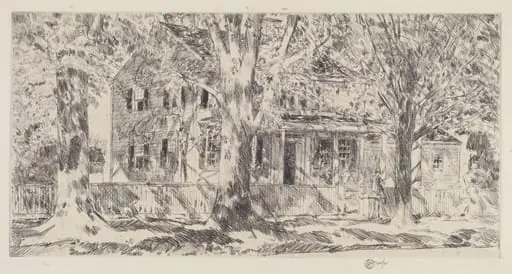
The White House is an ink print by Childe Hassam. It dates from 1925 and is held in the collection of the National Gallery of Art.
About this work
Overview
Childe Hassam produced *The White House* in 1925 as an etching, one of over 3,000 works he created across print, paint, and watercolor. Known for his interest in light and urban environments, Hassam turned to the federal building as a subject late in his career, capturing it not as a monument but as a lived-in structure within a dynamic public space.
Subject & Meaning
The etching portrays the White House framed by trees and bounded by a wrought-iron fence, with a scattered crowd of figures moving in front. Rather than emphasizing presidential authority, Hassam focuses on the building’s presence amid everyday life—its grandeur softened by the casual activity of passersby, suggesting a democratic intimacy between institution and citizen.
Technique & Style
Using etching’s fine, incised lines, Hassam rendered the building’s architecture with precise detail while employing loose, energetic strokes for foliage and figures. The contrast between sharp architectural elements and fluid, sketch-like marks conveys movement and atmosphere. The monochrome palette heightens the sense of immediacy, as if the scene was observed and recorded in a single moment.
History & Provenance
Created in 1925, near the end of Hassam’s life, this print reflects his enduring interest in architectural subjects and printmaking. It was likely produced for a limited edition, common among American artists of the period seeking broader circulation of their work. The etching entered public collections soon after, reflecting its status as a representative example of his late-period printmaking.
Context
In the 1920s, American artists increasingly turned to civic architecture as subjects, responding to national identity and urban change. Hassam, though associated with Impressionism, had long moved beyond pure plein air painting. His etching of the White House aligns with a broader trend of artists documenting public spaces with psychological nuance rather than patriotic grandeur.
Legacy
*The White House* remains a quiet but significant example of Hassam’s printmaking, illustrating his ability to infuse formal subjects with human texture. It stands apart from more celebratory depictions of the building, offering instead a contemplative, almost intimate view that influenced later artists exploring the intersection of public architecture and private observation.
Own this work as a print
Artist & collection
Artist
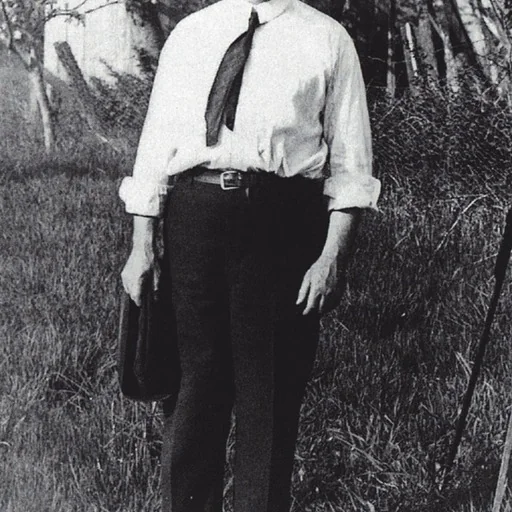
Frederick Childe Hassam was an American Impressionist painter, noted for his urban and coastal scenes.