Artwork
St. Malo
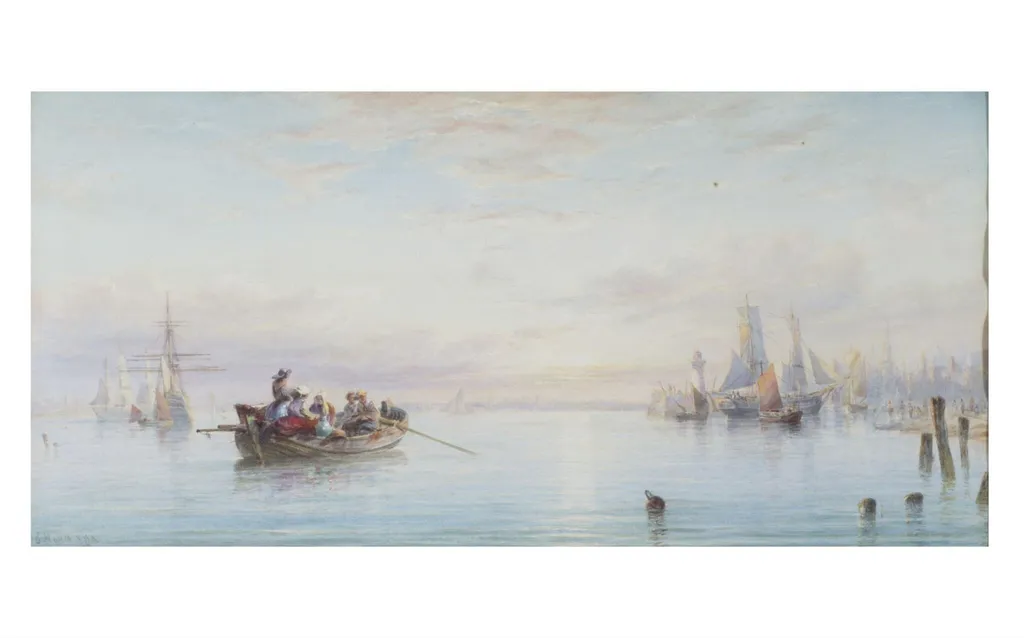
St. Malo is a watercolor work on paper by the British Romanticist artist Edwin Hayes. It dates from 1862 and is held in the collection of the Victoria and Albert Museum.
About this work
Overview
The medium’s transparency enhances the softness of the scene, aligning with 19th-century British watercolour traditions.
Painted in 1862 by Edwin Hayes, this watercolour captures the coastal town of St. Malo with quiet precision. Signed and dated by the artist, the work reflects a deliberate, restrained approach to landscape. Its delicate washes and minimal detail suggest a moment of stillness, emphasizing atmosphere over narrative. The medium’s transparency enhances the softness of the scene, aligning with 19th-century British watercolour traditions.
Subject & Meaning
The scene centers on a small rowboat with four figures, their gestures suggesting farewell or greeting. Beyond, larger vessels and the fortified shoreline of St. Malo recede into a hazy horizon. No dramatic event is depicted; instead, the focus lies in the quiet interaction between human activity and the maritime environment. The composition invites contemplation of travel, distance, and the passage of time.
Technique & Style
Hayes employed light, layered washes to render the misty sky and calm sea, avoiding sharp outlines. The boats are rendered with subtle linework, balancing simplicity with discernible form. The water’s surface is smooth, reflecting the pale sky without ripples, reinforcing the scene’s tranquility. Color is restrained—soft grays, blues, and ochres—creating a muted tonality typical of British watercolour practice of the period.
History & Provenance
The work is signed and dated by Edwin Hayes, a British marine artist known for coastal scenes. While specific ownership history is unrecorded, its date places it within his active period, following his training under established watercolourists. It likely originated as a personal study or travel sketch, later preserved as a finished work. No major exhibitions or collections are documented for this piece.
Context
In 1862, British artists increasingly turned to coastal subjects as travel became more accessible. Watercolour was favored for its portability and immediacy, especially among amateurs and professionals documenting landscapes. Hayes’s approach aligns with the tradition of topographical watercolour, distinct from the emerging Impressionist focus on light, yet sharing an interest in atmospheric effect.
Legacy
Though not widely exhibited, Hayes’s work contributes to the broader corpus of 19th-century British marine watercolours. His restrained technique reflects a transitional moment between topographical accuracy and emerging tonal sensitivity. This piece remains a quiet example of how artists captured everyday maritime life without theatricality, preserving a sense of place through subtlety.
Own this work as a print
Artist & collection

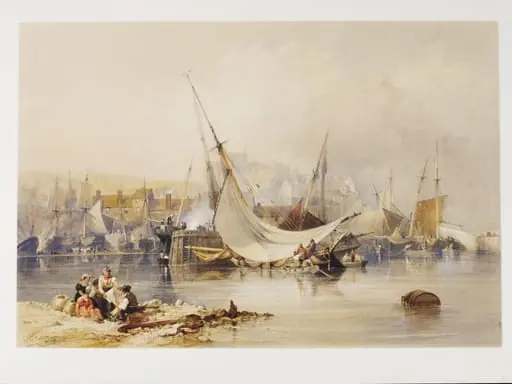 Whitby
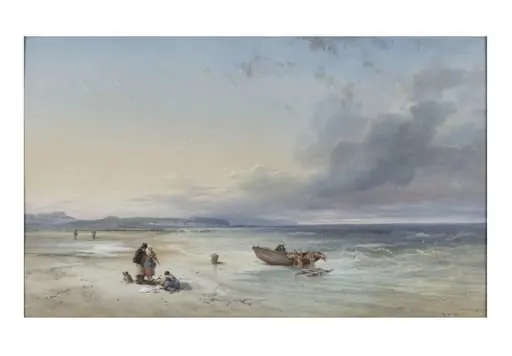 The sands of Cullercoats in Northumberland
 Shipping in a Fresh Breeze
 Marine View
 View of the Avignon port
 The Liner Carl XIII getting its Sails dry behind Kastellholmen
 View from Langelinie towards the Royal naval Dockyards at Nyholm, Copenhagen. Morning Light
 Lago di Garda
 View from Langelinie towards the Royal naval Dockyards at Nyholm, Copenhagen. Morning Light
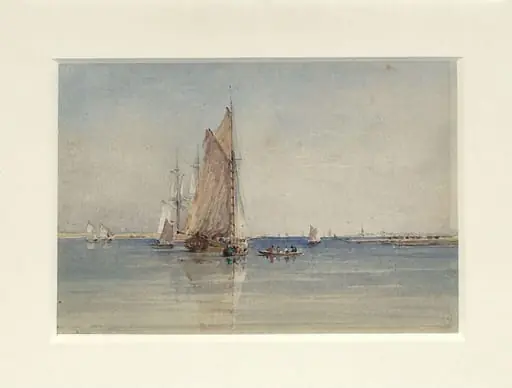 The Thames, Off Gravesend
 Fishing Boats on calm Water
 Sea Piece