Artwork
The Madonna of Ivory
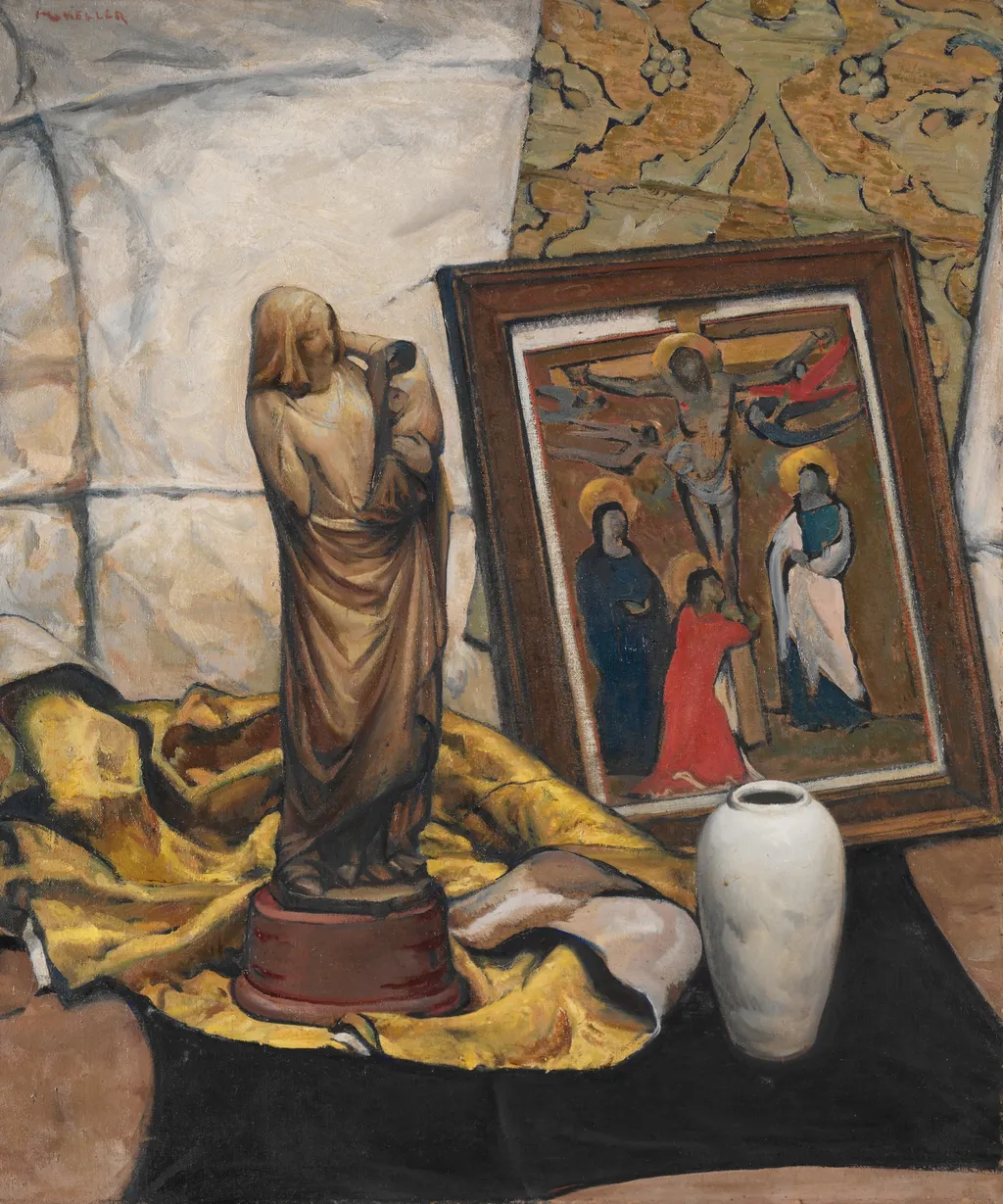
The Madonna of Ivory is an oil painting by the American Impressionist artist Henry Keller. It dates from 1924 and is held in the collection of the Cleveland Museum of Art.
About this work
Overview
The Madonna of Ivory, executed in oil in 1924, is a work by Henry Keller, an American painter of German origin. It is part of the Cleveland Museum of Art’s collection and exemplifies Keller’s engagement with religious subject matter within his broader Impressionist practice.
Subject & Meaning
The composition presents an intimate interior where a carved ivory-like statue of a woman clutching a scroll rests on a pedestal. Adjacent to the figure, a framed panel depicts a traditional religious scene featuring a cross and robed figures, suggesting a layered contemplation of faith and iconography.
Technique & Style
Keller applies an American Impressionist palette, yet the painting incorporates chiaroscuro to model the statue’s smooth surface against the rough stone wall and wooden floor. The contrast between the flat, muted tones of the inner framed work and the more tactile textures of the surrounding space highlights his nuanced handling of light and material.
History & Provenance
Created during Keller’s mature period, the painting reflects his role as a leading educator at the Cleveland School of Art and his summer school in Berlin Heights, Ohio. It entered the Cleveland Museum of Art’s holdings as part of the museum’s effort to document the regional Cleveland School movement.
Context
The work belongs to the religious genre, a less common focus for Keller, who is better known for landscapes and genre scenes. Its intimate setting and reverent objects echo the early‑20th‑century American interest in European devotional art, while remaining rooted in the Midwestern artistic community that Keller helped shape.
Artist & collection

Artist
Henry George Keller (April 3, 1869 – August 3, 1949) was an American artist who led a generation of Ohio watercolor painters of the Cleveland School.