Artwork
The Millinery Shop
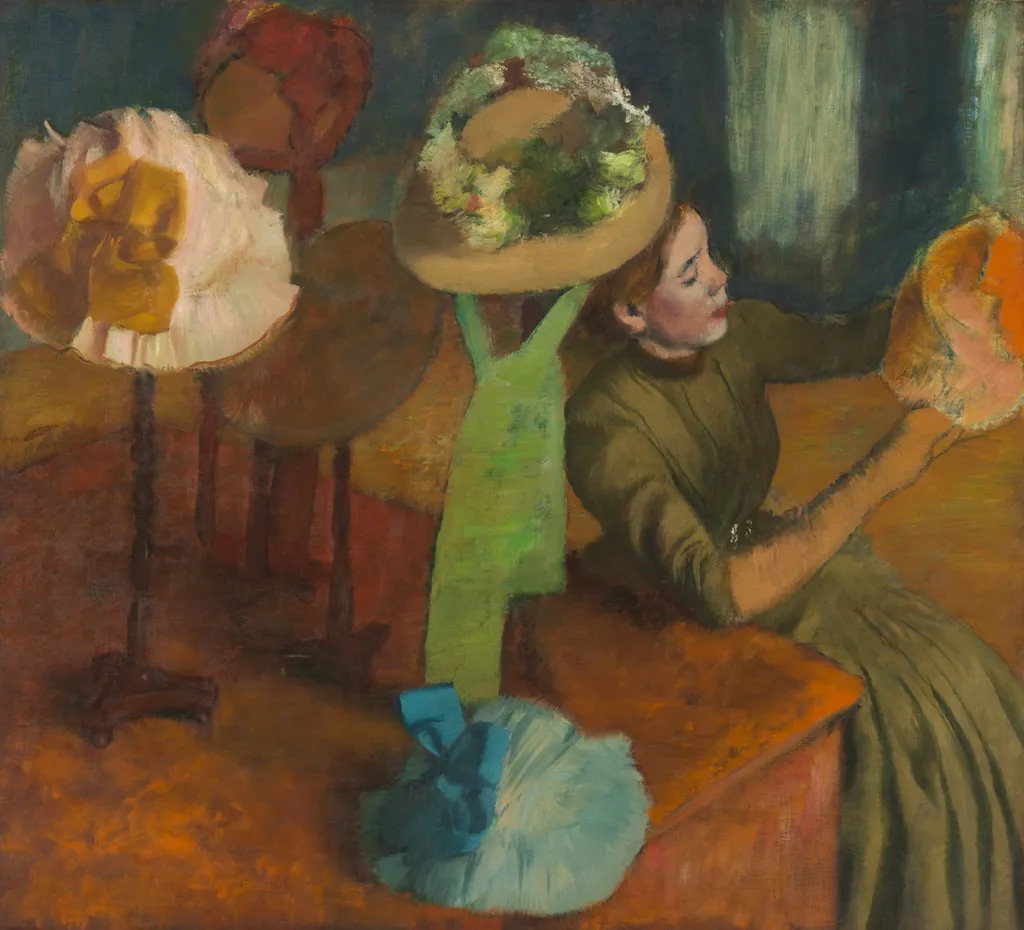
The Millinery Shop is an oil painting by the Impressionist artist Edgar Degas. It dates from 1882 and is held in the collection of the Art Institute of Chicago.
About this work
Overview
Degas developed the composition through numerous preparatory drawings and pastels, refining her posture and attire with meticulous care.
The Millinery Shop is Edgar Degas’s largest painting centered on a milliner at work. Executed in oil on canvas, it captures a solitary woman in a hat shop, deeply absorbed in examining a large-brimmed hat. Degas developed the composition through numerous preparatory drawings and pastels, refining her posture and attire with meticulous care. The scene unfolds in quiet stillness, emphasizing observation over narrative.
Subject & Meaning
The woman, dressed in a fashionable green wool dress and long gloves, occupies an ambiguous social space. Her clothing could belong to either a client or an employee, reflecting the blurred class boundaries in late 19th-century Paris. By placing a hat atop her head without her wearing it, Degas visually suggests uncertainty—she is neither fully client nor fully servant, embodying the shifting roles of women in urban commerce.
Technique & Style
Degas employed careful observation and layered revision to achieve the painting’s subtle realism. His preparatory studies reveal extensive experimentation with posture, fabric, and hat placement. The brushwork is precise yet unobtrusive, favoring tonal harmony over dramatic contrast. Light falls evenly across the scene, enhancing the quiet intimacy and reinforcing the painting’s restrained emotional tone.
History & Provenance
Created in the early 1880s, the painting emerged during a period when Degas increasingly turned to interior scenes of modern labor. It was likely exhibited in private circles before entering public collections. Its provenance traces through French collectors who appreciated Degas’s focus on contemporary life, though it never achieved widespread fame during his lifetime.
Context
Millinery was a respected trade for young women in Paris, offering modest upward mobility. Unlike domestic service, it required aesthetic judgment and craftsmanship, granting workers a degree of social visibility. Degas’s choice to depict this setting reflects broader societal changes, where fashion and labor intersected in new, often ambiguous ways for urban women.
Legacy
The painting stands as a quiet commentary on class and gender in modern France. It influenced later artists interested in the psychology of everyday work and the subtleties of social performance. Though not widely celebrated in its time, its nuanced portrayal of identity continues to inform discussions of modernity and representation in 19th-century art.
Own this work as a print
Artist & collection

Artist
Born Hilaire-Germain-Edgar De Gas on 19 July 1834 in Paris, Edgar Degas came from an affluent banking family with aristocratic roots and spent his childhood among the cultivated circles of the French capital.