Artwork
Telemachus Ravaged by Love
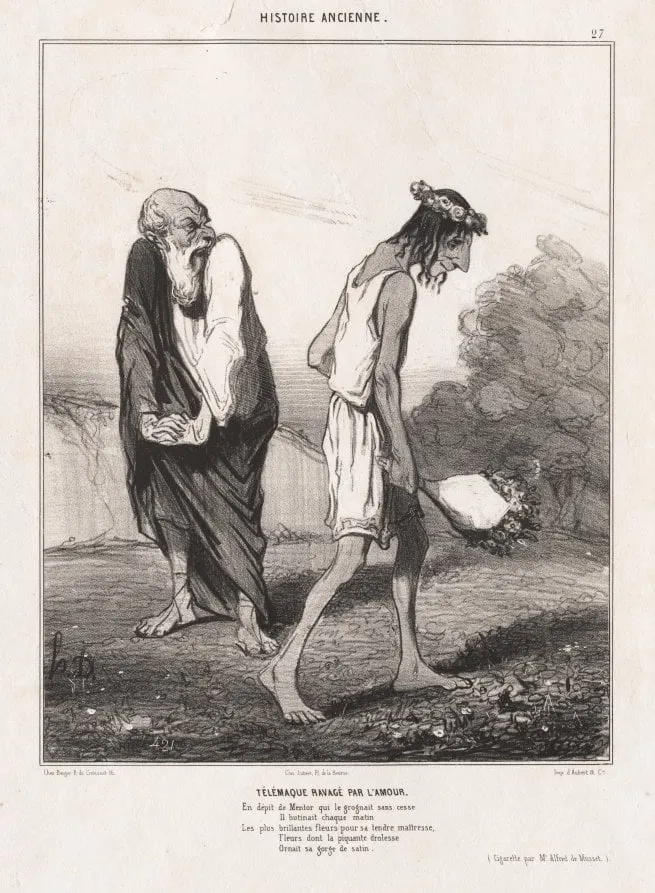
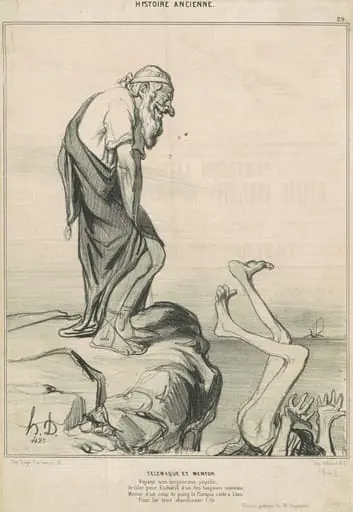
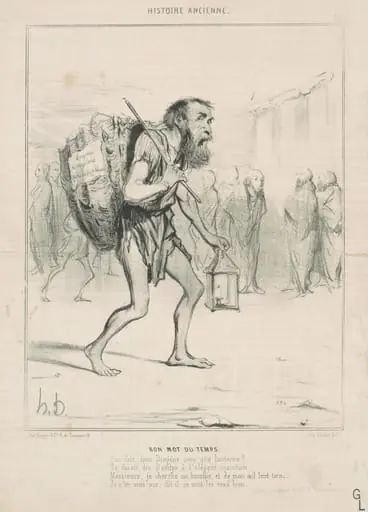
Telemachus Ravaged by Love is a print by the Romanticist artist Honoré Daumier. It dates from 1842 and is held in the collection of the Cleveland Museum of Art.
About this work
This print shows Telemachus, the Greek hero, looking disturbed as he clutches his chest. His wild hair and messy clothes make him look more troubled than heroic.
Daumier made this for a funny magazine called *Le Charivari*. Telemachus was a serious figure in ancient stories, but here he’s turned into a joke about love’s pain.
Look up Honoré Daumier (French, 1808–1879) next.
Overview
Created by Honoré Daumier and published in Le Charivari on October 9, 1842, this lithograph is the twenty-seventh plate in the series Ancient History.
Created by Honoré Daumier and published in Le Charivari on October 9, 1842, this lithograph is the twenty-seventh plate in the series Ancient History. It reimagines a figure from classical myth in a satirical, contemporary context. Rather than portraying Telemachus as a noble son of Odysseus, Daumier depicts him as a disheveled, emotionally overwhelmed man, aligning the ancient tale with modern social commentary on romantic distress.
Subject & Meaning
Telemachus, traditionally known for his dutiful search for his father in Homer’s Odyssey, is here reduced to a figure tormented by unrequited love. His wild hair, disordered attire, and hand pressed to his chest suggest internal turmoil rather than heroic resolve. Daumier uses this inversion to mock the melodrama of romantic sentiment, contrasting classical ideals with the exaggerated emotionalism of 1840s French society.
Technique & Style
Executed in lithography, the print employs bold, fluid lines and stark contrasts to emphasize Telemachus’s agitation. Daumier’s loose, expressive brushwork and exaggerated features reflect his background in caricature. The absence of detailed background focuses attention on the figure’s psychological state, transforming myth into a psychological sketch that prioritizes emotional immediacy over historical accuracy.
History & Provenance
The print originated as part of a serialized satirical project in Le Charivari, a Parisian weekly known for its political and cultural caricatures. Daumier contributed regularly to the publication during the 1840s, using classical references to critique contemporary mores. This image was likely distributed widely among urban readers, reinforcing the magazine’s role in shaping public opinion through humor and irony.
Context
In 1842, France was under the July Monarchy, a period marked by rising bourgeois values and heightened interest in personal emotion. Daumier’s reinterpretation of Telemachus reflects a cultural moment where ancient narratives were repurposed to lampoon modern behaviors. The series Ancient History used myth as a veil for social critique, allowing satire to bypass censorship while resonating with educated readers familiar with classical texts.
Legacy
Daumier’s Telemachus exemplifies his broader contribution to visual satire: reanimating classical subjects to expose contemporary absurdities. The print influenced later artists who blended myth with social commentary, and remains a key example of how 19th-century lithography could elevate caricature into incisive cultural analysis. Its enduring relevance lies in its unflinching portrayal of emotional vulnerability as a universal, if ridiculed, human condition.
Artist & collection

Artist
Honoré-Victorin Daumier was a French painter, sculptor, and printmaker, whose many works offer commentary on the social and political life in France, from the Revolution of 1830 to the fall of the Second French Empire in 1870.