Artwork
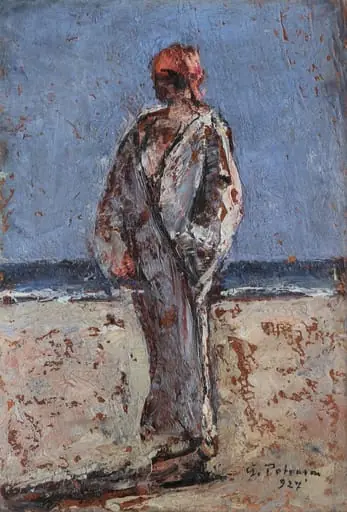
Femeie la malul mării
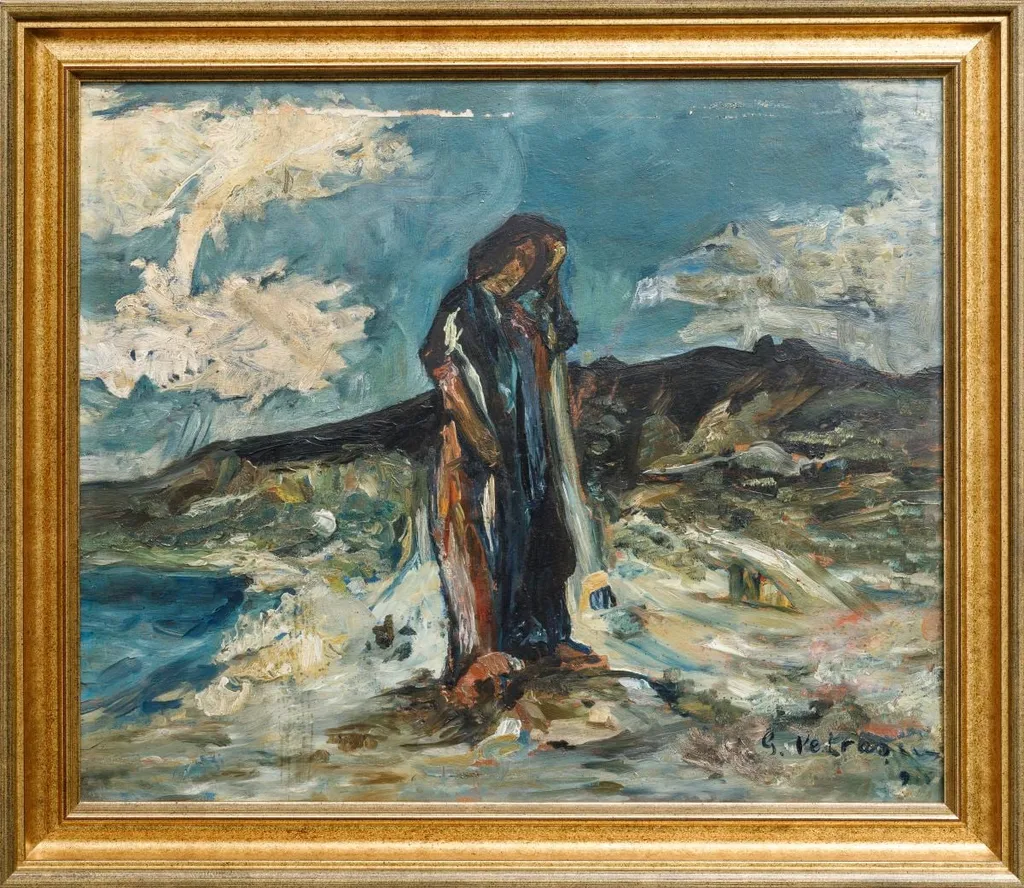
Femeie la malul mării is an unspecified painting by Gheorghe Petrașcu. It dates from 1915 and is held in the collection of the National Museum of Art of Romania.
About this work
Overview
The painting’s mood is subdued, emphasizing isolation and quiet contemplation through its restrained palette and textured surface.
Painted in 1915 by Gheorghe Petrașcu, this work depicts a solitary figure on a coastal landscape. The composition centers on a woman standing motionless against a turbulent seascape. The painting’s mood is subdued, emphasizing isolation and quiet contemplation through its restrained palette and textured surface. The medium is oil on canvas, with a focus on physical paint application rather than refined detail.
Subject & Meaning
The woman, cloaked in a dark coat with hands withdrawn into her sleeves, appears withdrawn from the environment around her. Her bowed posture and stillness contrast with the restless sea and overcast sky, suggesting inner solitude or emotional weight. The figure is not idealized; her anonymity invites interpretation as a universal symbol of human vulnerability amid nature’s indifference.
Technique & Style
Petrașcu employs thick, deliberate brushstrokes to build the surface, using impasto to convey the energy of wind and water. The paint is applied with a tactile urgency, especially in the waves and sky, where layers of raw blue, brown, and white collide. Details are minimized; form emerges through texture rather than line, aligning the work with expressive realism rather than academic precision.
History & Provenance
Created during World War I, the painting reflects a period of personal and national uncertainty in Romania. It remained in the artist’s possession until his death, later entering a public collection through bequest. Its survival through wartime instability underscores its significance to Petrașcu, who rarely exhibited it publicly during his lifetime.
Context
Petrașcu worked in a Romanian artistic milieu influenced by French Impressionism and Post-Impressionism, yet he developed a distinct, somber style. Unlike contemporaries who favored luminous landscapes, he emphasized emotional gravity and materiality. This painting aligns with broader early 20th-century European trends that prioritized psychological depth over picturesque scenery.
Legacy
Though not widely known outside Romania, the work is regarded as a key example of Petrașcu’s mature style. Its emphasis on emotional resonance through texture and tone influenced later Romanian realists who sought to express inner states through landscape. The painting is now held in a national collection, studied for its quiet intensity and technical restraint.
Artist & collection
Artist
Gheorghe Petrașcu painted quiet scenes of buildings, streets, and still lifes in the 1920s and ’30s Romania.