Artwork
King Bikramaditya Summons Madhava, from a Madhavanala Kamakandala
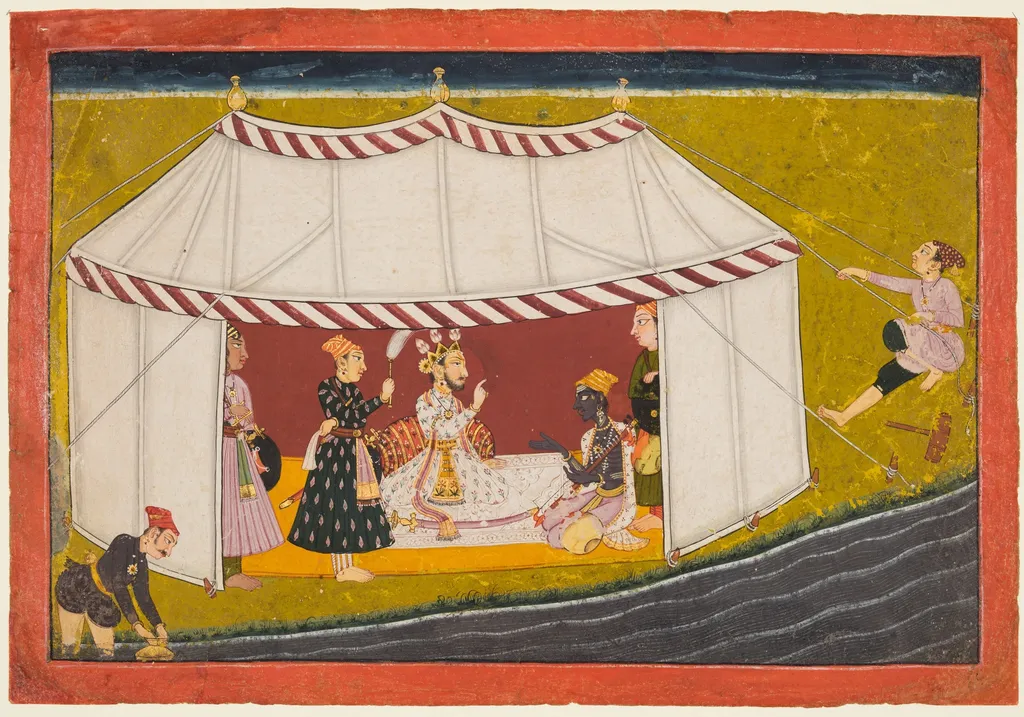
King Bikramaditya Summons Madhava, from a Madhavanala Kamakandala is an unspecified painting. It dates from 1700 and is held in the collection of the Cleveland Museum of Art. The work depicts a vivid scene set inside a red tent edged with white stripes.
About this work
Overview
The work depicts a vivid scene set inside a red tent edged with white stripes. A crowned figure presides on a raised platform, gesturing toward a kneeling individual, while a crowd of onlookers surrounds them. Beyond the tent’s interior, a tightrope performer balances above a man holding a pole, creating a dynamic exterior tableau.
Subject & Meaning
The central figures suggest a ceremonial or narrative moment, with the crowned person possibly representing a ruler or deity directing attention to the supplicant. The surrounding participants, some holding objects, appear to witness or support the exchange, while the acrobatic figures outside may symbolize balance or the precarious nature of authority.
Technique & Style
The composition employs a flattened pictorial space, arranging figures in stacked layers rather than employing linear perspective. Bold, saturated hues of red, yellow, and green dominate the palette, and the tightrope walker is rendered as a near‑silhouette, emphasizing shape over volume.
History & Provenance
The painting originates from a Madhavanala Kamakandala manuscript tradition, a textual source that combines literary and visual elements. Its creation reflects the artistic conventions of that cultural context, though specific details of its commissioning or ownership history remain undocumented.
Context
Within the broader visual culture of the period, such works often illustrated stories from courtly literature, serving both decorative and didactic purposes. The use of vivid colors and stylized figures aligns with contemporary manuscript illumination practices.
Artist & collection