Artwork
Leaf from a Romance of Chandrabhanu and Lavanyavati of Upendra Bhanja (Indian, died 1740)
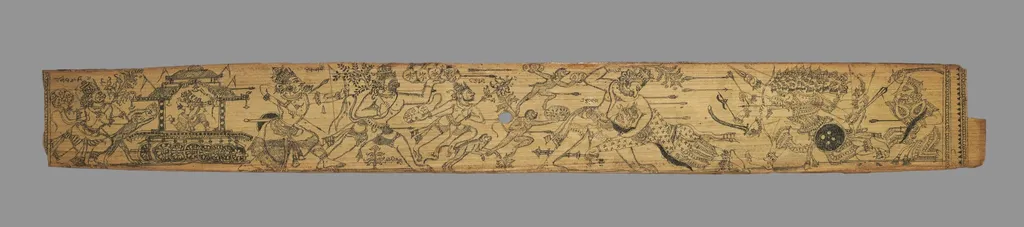
Leaf from a Romance of Chandrabhanu and Lavanyavati of Upendra Bhanja (Indian, died 1740) is an unspecified painting by Unknown. It dates from 1774 and is held in the collection of the Cleveland Museum of Art. This narrow, elongated scroll, executed in ink on a yellowed paper support, presents a densely populated narrative scene.
About this work
Overview
This narrow, elongated scroll, executed in ink on a yellowed paper support, presents a densely populated narrative scene.
This narrow, elongated scroll, executed in ink on a yellowed paper support, presents a densely populated narrative scene. Tiny figures populate the surface, depicting a succession of events that include elephant processions, sword combat, musical performances, and dances beneath trees. The composition is crowded with riders on horses, airborne beings, architectural fragments, animals and ornamental swirls, all rendered in fine black line work that demands close inspection.
Subject & Meaning
The imagery corresponds to a romantic episode drawn from the Odia poem "Romance of Chandrabhanu and Lavanyavati" by the 18th‑century poet Upendra Bhanja. The scroll visualizes the lovers' encounters, heroic battles, and festive celebrations that accompany their story, emphasizing themes of love, valor, and courtly entertainment. The juxtaposition of martial and musical elements reflects the poem’s blend of passion and spectacle.
Technique & Style
The artist employed delicate brush‑ink drawing, using a fine nib to achieve minute details on a light, yellowish ground. Linear contours define figures and objects, while repetitive decorative motifs create rhythmic background patterns. The work exemplifies the miniature narrative tradition of eastern India, where dense storytelling is achieved through compact, highly controlled line work rather than color or shading.
History & Provenance
Created in the early 18th century, the scroll originates from the Indian subcontinent, likely from a workshop familiar with Upendra Bhanja’s literary output. It entered the collection of the Cleveland Museum of Art through acquisition in the late 20th century, where it is now conserved and displayed as part of the museum’s South Asian holdings.
Context
During the period of Upendra Bhanja’s activity, courtly poetry often inspired visual narratives that served both decorative and didactic purposes. Scroll paintings such as this one were used for private enjoyment or as gifts among elite patrons, reflecting the cultural exchange between literary and visual arts in pre‑colonial eastern India.
Artist & collection

 Domestic Scene
 Giacomo and Cardinal Marco, investing Andrea, Abbot of San Zeno, with his Benefice
 The Nymph of Fontainebleau
 Portrait of a Woman
 Madonna and Child with Saints in the Enclosed Garden
 Venus and Minerva
 Family Group of Four on Sofa
 Wall painting from Room H of the Villa of P. Fannius Synistor at Boscoreale
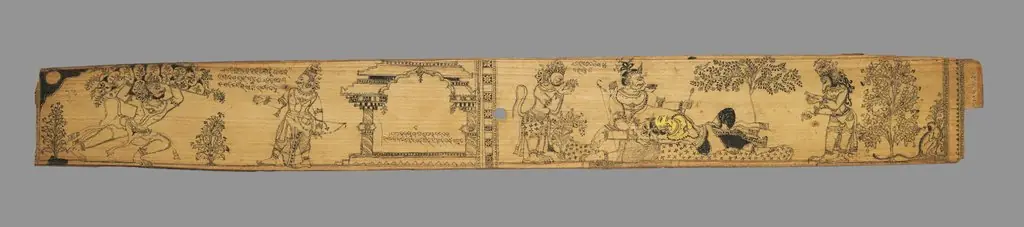
 Hanuman Brings the Mountain of Healing Plants; Rama Extracts the Arrow from Lakshmana as Hanuman and a Bear Prepare to Treat Him (recto), from a Romance of Chandrabhanu and Lavanyavati of Upendra Bhanja (Indian, died 1740)
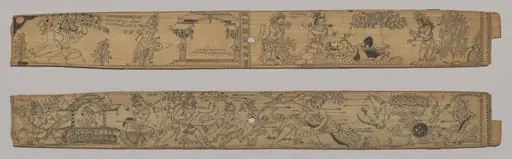 Leaf from a Romance of Chandrabhanu and Lavanyavati of Upendra Bhanja (Indian, died 1740)
 Hanuman Brings the Mountain of Healing Plants; Rama Extracts the Arrow from Lakshmana as Hanuman and a Bear Prepare to Treat Him (recto), from a Romance of Chandrabhanu and Lavanyavati of Upendra Bhanja (Indian, died 1740)
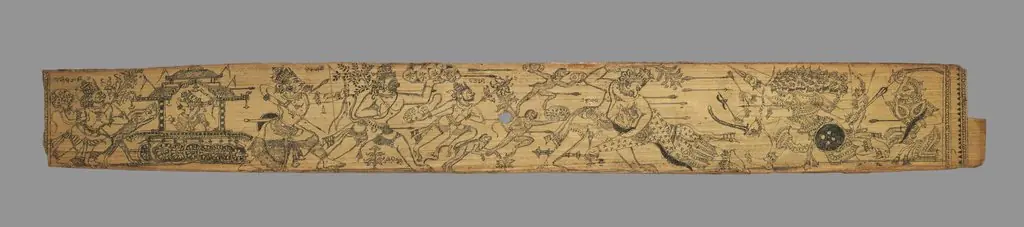
 The Monkeys and Bears Fight Ravana and His Demons (verso), from a Romance of Chandrabhanu and Lavanyavati of Upendra Bhanja (Indian, died 1740)
 The Monkeys and Bears Fight Ravana and His Demons (verso), from a Romance of Chandrabhanu and Lavanyavati of Upendra Bhanja (Indian, died 1740)
 A Prince Performs Austerities (recto), from a Romance of Chandrabhanu and Lavanyavati of Upendra Bhanja (1670–1740)
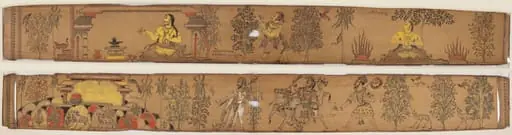 A Prince Performs Austerities (recto); Shiva and His Followers Return to Mount Kailash (verso), from a Romance of Chandrabhanu and Lavanyavati of Upendra Bhanja (1670–1740)
 Shiva and His Followers Return to Mount Kailash (verso), from a Romance of Chandrabhanu and Lavanyavati of Upendra Bhanja (1670–1740)