Artwork
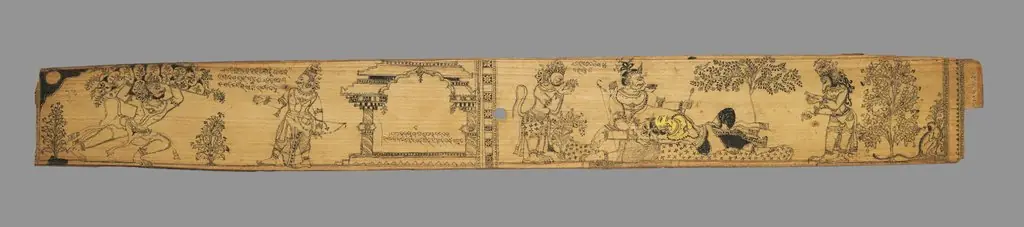
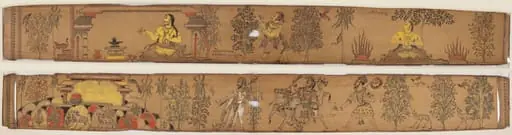
Hanuman Brings the Mountain of Healing Plants; Rama Extracts the Arrow from Lakshmana as Hanuman and a Bear Prepare to Treat Him (recto), from a Romance of Chandrabhanu and Lavanyavati of Upendra Bhanja (Indian, died 1740)

Hanuman Brings the Mountain of Healing Plants; Rama Extracts the Arrow from Lakshmana as Hanuman and a Bear Prepare to Treat Him (recto), from a Romance of Chandrabhanu and Lavanyavati of Upendra Bhanja (Indian, died 1740) is an unspecified painting by the Romanticist artist Unknown. It dates from 1704 and is held in the collection of the Cleveland Museum of Art. The work is a narrow, elongated wood relief depicting three consecutive episodes from the epic romance of Chandrabhanu and Lavanyavati.
About this work
Overview
The work is a narrow, elongated wood relief depicting three consecutive episodes from the epic romance of Chandrabhanu and Lavanyavati.
The work is a narrow, elongated wood relief depicting three consecutive episodes from the epic romance of Chandrabhanu and Lavanyavati. On the left, the monkey deity Hanuman transports a mountain laden with medicinal herbs; the central panel shows Rama extracting an arrow from Lakshmana’s shoulder while Hanuman and a bear observe; the rightmost scene presents a woman seated beneath a tree, fanning herself, with a standing male figure nearby. The composition is densely populated with miniature figures, animals and architectural elements.
Subject & Meaning
The narrative illustrates a moment of healing and rescue within the larger romance. Hanuman’s delivery of the herb‑filled mountain signals divine aid, while Rama’s removal of the arrow underscores the restoration of Lakshmana’s health. The accompanying bear and monkey serve as loyal attendants, reinforcing themes of companionship and protection. The concluding tableau of a woman and a man suggests a return to domestic tranquility after the crisis.
Technique & Style
Carved in low relief, the artist employed shallow incisions to produce subtle chiaroscuro, allowing light to accentuate raised surfaces and create a sense of depth. Dark outlines define the intricate foliage, figures and structures against a pale background, enabling the viewer to discern individual leaves and architectural details. The meticulous linear rendering reflects a tradition of narrative woodwork that blends pictorial storytelling with sculptural texture.
History & Provenance
The piece originates from the Indian subcontinent and is attributed to the late period of Upendra Bhanja, who died in 1740. It likely formed part of a larger illustrated manuscript or devotional object, though its exact original context remains undocumented. The relief has since entered a museum collection, where it is displayed as an example of 18th‑century narrative carving.
Context
During the 18th century, Indian artists frequently illustrated epic romances and mythological episodes on portable media such as wood panels, catering to both courtly patrons and devotional audiences. The inclusion of Hanuman, Rama and Lakshmana links the work to the broader Ramayana tradition, while the specific reference to Chandrabhanu and Lavanyavati reflects regional literary adaptations that blended classical motifs with local storytelling.
Artist & collection

 Domestic Scene
 Giacomo and Cardinal Marco, investing Andrea, Abbot of San Zeno, with his Benefice
 The Nymph of Fontainebleau
 Portrait of a Woman
 Madonna and Child with Saints in the Enclosed Garden
 Venus and Minerva
 Family Group of Four on Sofa
 Wall painting from Room H of the Villa of P. Fannius Synistor at Boscoreale
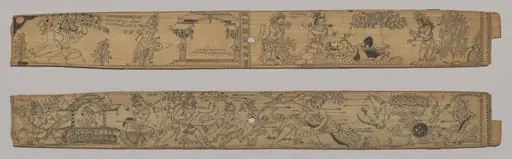 Leaf from a Romance of Chandrabhanu and Lavanyavati of Upendra Bhanja (Indian, died 1740)
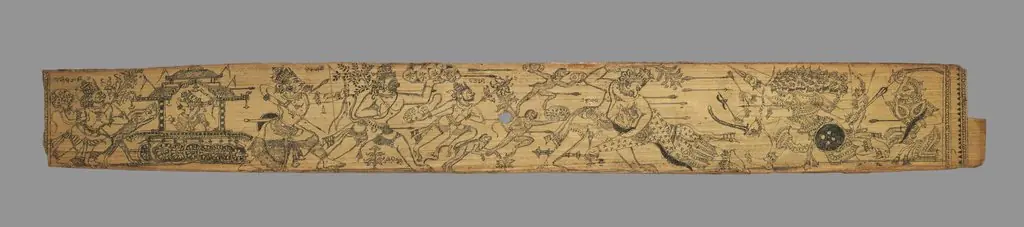
 The Monkeys and Bears Fight Ravana and His Demons (verso), from a Romance of Chandrabhanu and Lavanyavati of Upendra Bhanja (Indian, died 1740)
 Hanuman Brings the Mountain of Healing Plants; Rama Extracts the Arrow from Lakshmana as Hanuman and a Bear Prepare to Treat Him (recto), from a Romance of Chandrabhanu and Lavanyavati of Upendra Bhanja (Indian, died 1740)
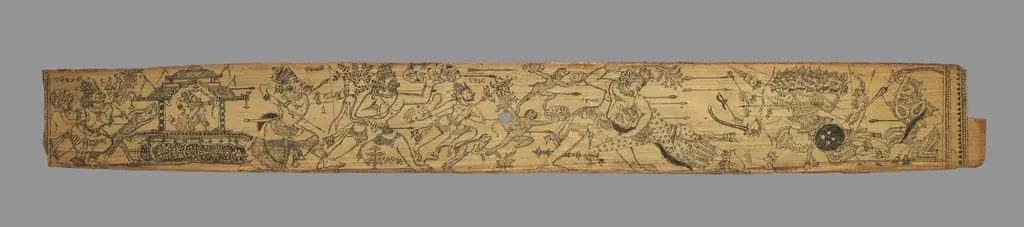 Leaf from a Romance of Chandrabhanu and Lavanyavati of Upendra Bhanja (Indian, died 1740)
 A Prince Performs Austerities (recto); Shiva and His Followers Return to Mount Kailash (verso), from a Romance of Chandrabhanu and Lavanyavati of Upendra Bhanja (1670–1740)
 A Prince Performs Austerities (recto), from a Romance of Chandrabhanu and Lavanyavati of Upendra Bhanja (1670–1740)
 The Monkeys and Bears Fight Ravana and His Demons (verso), from a Romance of Chandrabhanu and Lavanyavati of Upendra Bhanja (Indian, died 1740)
 A Prince Performs Austerities (recto); Shiva and His Followers Return to Mount Kailash (verso), from a Romance of Chandrabhanu and Lavanyavati of Upendra Bhanja (1670–1740)
 Shiva and His Followers Return to Mount Kailash (verso), from a Romance of Chandrabhanu and Lavanyavati of Upendra Bhanja (1670–1740)