Artwork
"British America" of Winsor N.S. Passing Flushing 1875
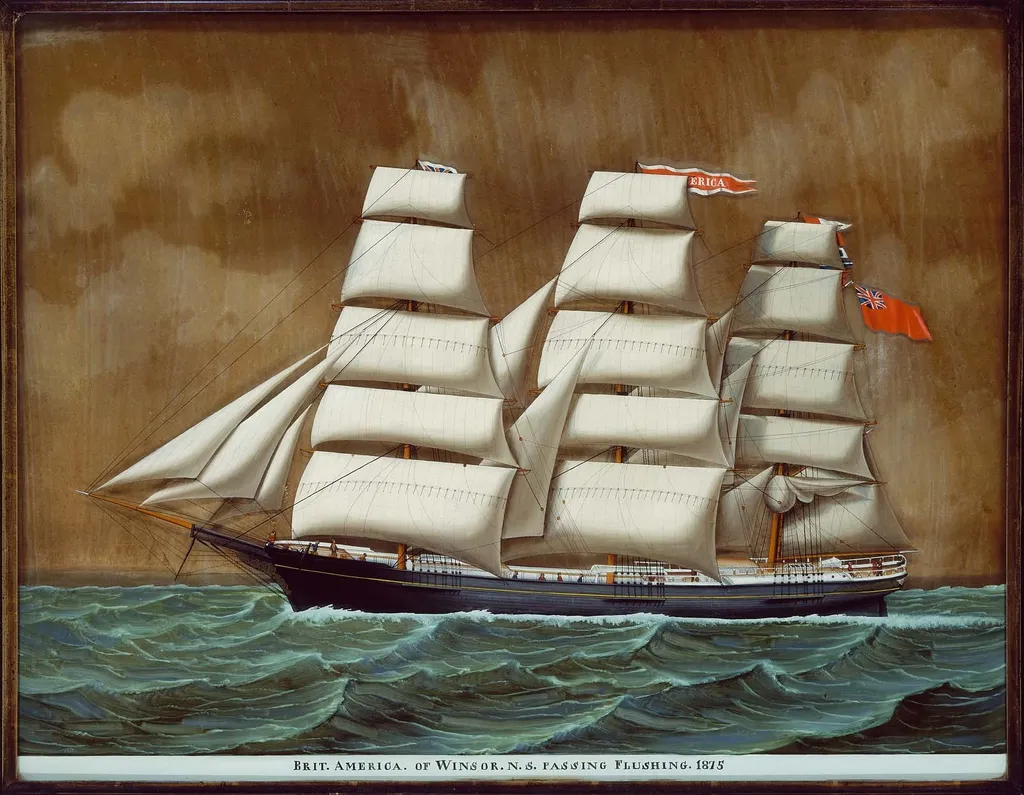
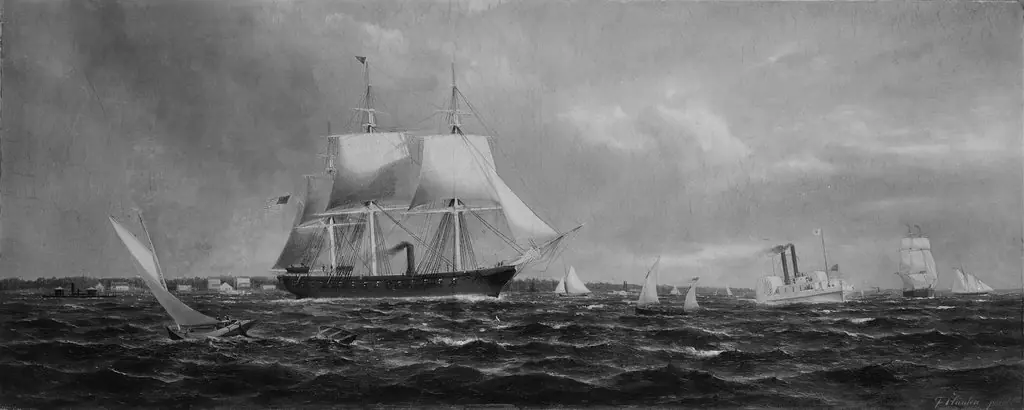
"British America" of Winsor N.S. Passing Flushing 1875 is an unspecified painting by the American Impressionist artist Unknown. It dates from 1875 and is held in the collection of the Museum of Fine Arts Boston. Painted in 1875 by Winsor Newton, this work captures a British merchant vessel under full sail, navigating rough seas near Flushing.
About this work
Overview
Painted in 1875 by Winsor Newton, this work captures a British merchant vessel under full sail, navigating rough seas near Flushing. The composition centers on the ship’s dynamic motion, rendered with attention to wind-filled sails and turbulent water. The muted brown background isolates the vessel, reinforcing its dominance in the scene without introducing distracting elements.
Subject & Meaning
The vessel, flying the British flag, represents the maritime trade networks of the British Empire during the late 19th century. Its speed and condition suggest active commercial service, likely transporting goods across imperial routes. The painting does not dramatize or idealize the scene but presents the ship as a functional, working entity within a natural environment.
Technique & Style
Newton employs precise brushwork to render the foam and ripples of the waves, emphasizing texture and movement. The hull is rendered in dark tones, contrasting with the bright white sails and deck, enhancing the sense of motion. The background’s subdued brown palette serves to focus attention on the ship and sea, avoiding narrative embellishment.
History & Provenance
The painting was completed in 1875 and is associated with Newton’s interest in maritime subjects during his later career. It was likely created for private or institutional collectors with ties to British naval or commercial interests. No public exhibition history is documented prior to its inclusion in later 20th-century collections.
Context
In the 1870s, Britain remained a global maritime power, with merchant fleets vital to its economy. Paintings of ships like this one reflected contemporary fascination with naval technology and trade, though they rarely celebrated heroism. Newton’s approach aligns with a quiet realism common among British marine artists of the period, avoiding romanticism in favor of observation.
Legacy
The work contributes to a modest but persistent body of 19th-century British marine painting that prioritizes accuracy over spectacle. While not widely exhibited or reproduced, it remains a representative example of how commercial shipping was visually documented during the height of the British Empire’s sea-based commerce.
Artist & collection

 Domestic Scene
 Giacomo and Cardinal Marco, investing Andrea, Abbot of San Zeno, with his Benefice
 The Nymph of Fontainebleau
 Portrait of a Woman
 Madonna and Child with Saints in the Enclosed Garden
 Venus and Minerva
 Family Group of Four on Sofa
 Wall painting from Room H of the Villa of P. Fannius Synistor at Boscoreale
 'King Arthur' schooner, Liverpool
 Bell of Plymouth
 The Ship "John W. Brewer"
 The Tern Schooner "Minnie G. Loud"
 Waterloo, off Conway causeway
 Julie
Julie Marys - New Quay built schooner
 Dashing Wave Clipper Ship off Boston Light
 Brig "Antelope" in Boston Harbor
 Clipper Ship HURRICANE in the English Channel
 Veleiro de três mastros (atribuído)
 New York Bay