Artwork
Vishnu on Ananta, the Endless Serpent
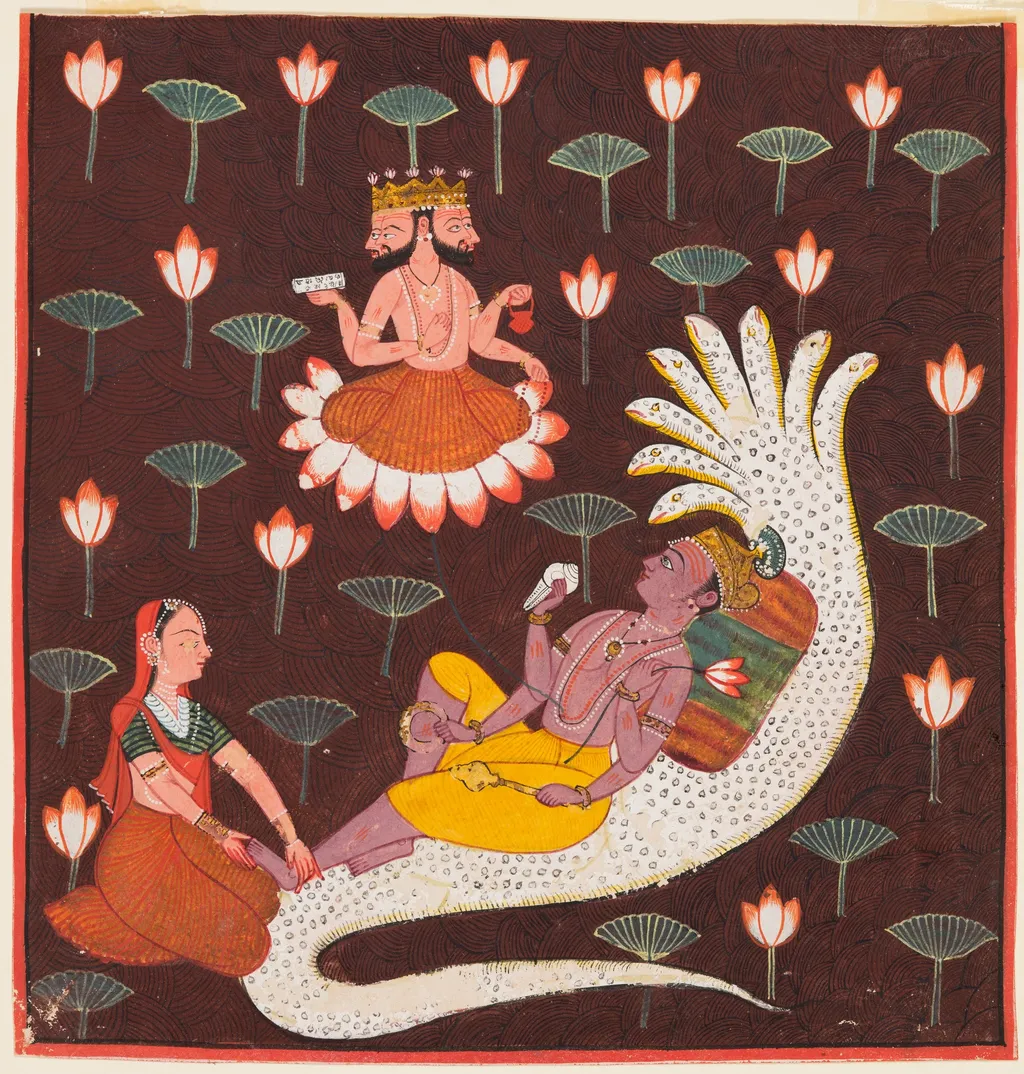
Vishnu on Ananta, the Endless Serpent is an unspecified painting. It dates from 1700 and is held in the collection of the Cleveland Museum of Art.
About this work
Overview
Beneath him a yellow‑clad woman leans against a white, hooded serpent, while a second woman in red is positioned nearby.
The work entitled *Vishnu on Ananda, the Endless Serpent* presents a vivid tableau in which the deity Vishnu is depicted seated cross‑legged upon a large red lotus. He wears a crown, sports a beard, and holds a small object in his hand. Beneath him a yellow‑clad woman leans against a white, hooded serpent, while a second woman in red is positioned nearby. The background is dominated by deep red tones, scattered lotus blossoms and green foliage.
Subject & Meaning
The central figure is the Hindu god Vishnu, traditionally associated with preservation and cosmic order. He is shown atop Ananta, the infinite serpent that symbolizes the endless cycle of time and the universe’s foundation. The accompanying female figures likely represent attendant deities or aspects of divine energy, reinforcing the theme of divine presence within the cosmic womb of the serpent.
Technique & Style
Executed in bright pigments, the painting employs a flattened perspective typical of Indian devotional art, emphasizing symbolic rather than realistic representation. The use of saturated reds, yellows and greens creates a striking visual contrast, while the intricate detailing of lotus petals and serpent scales reflects meticulous brushwork characteristic of the region’s classical painting traditions.
History & Provenance
The piece is part of the collection at the Cleveland Museum of Art, where it is displayed alongside other works illustrating Hindu iconography. Specific details regarding its date of creation, original patronage, or prior ownership have not been publicly documented, limiting a full provenance narrative.
Context
Images of deities reclining or seated upon the cosmic serpent Ananta are a recurrent motif in Hindu visual culture, appearing in temple reliefs, manuscripts and court paintings. Such depictions convey the god’s relationship to the eternal, underscoring theological concepts of continuity and the cyclical nature of existence.
Legacy
By preserving this iconographic tradition within a museum setting, the painting offers contemporary viewers insight into the visual language of Hindu spirituality. Its inclusion in a major public collection facilitates comparative study with other South Asian works, contributing to broader scholarly understanding of regional artistic conventions.
Artist & collection