Artwork
Portrait of Guilliam Courten, Husband of Margarita Cassier
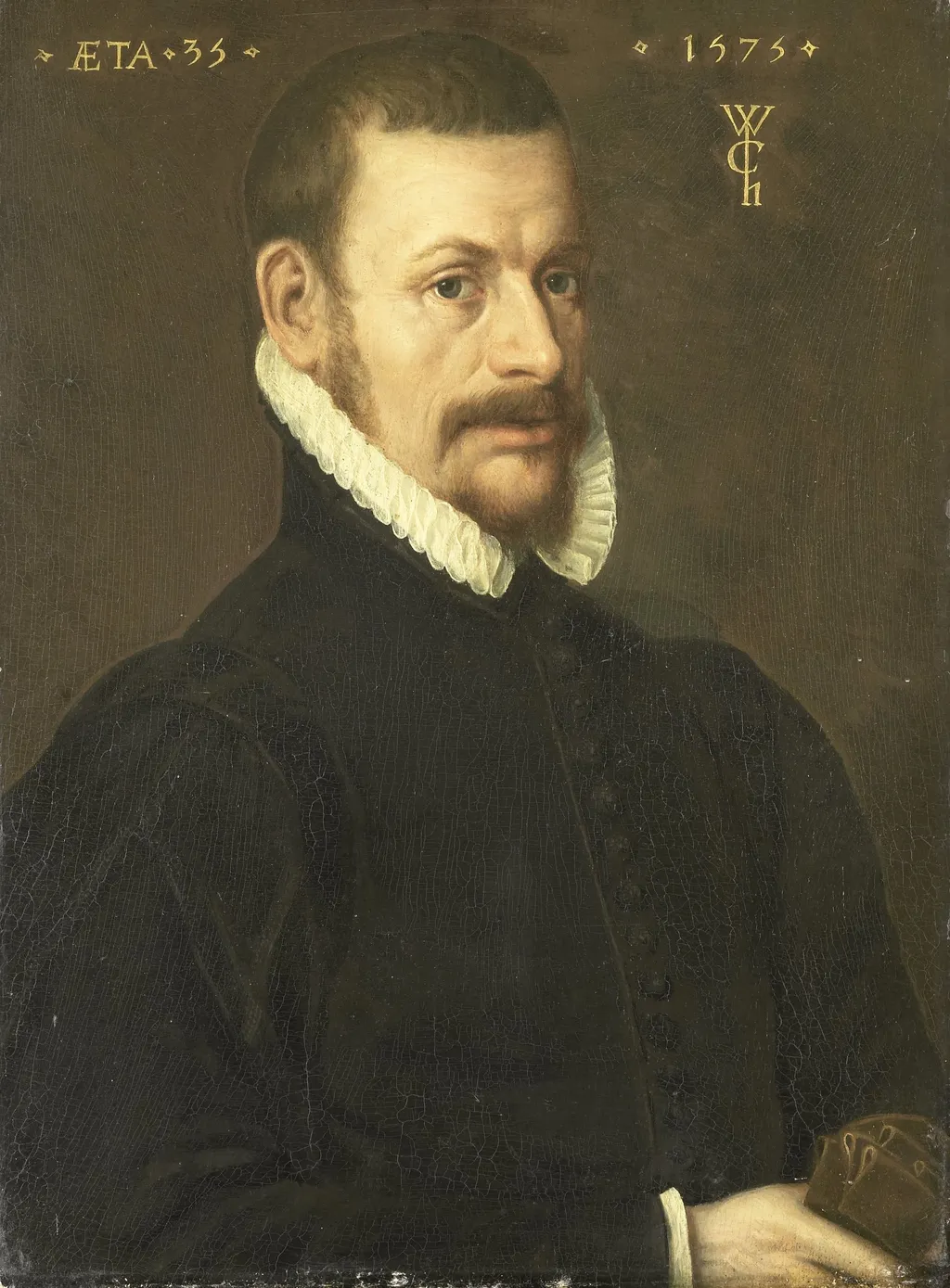
Portrait of Guilliam Courten, Husband of Margarita Cassier is an oil painting. It dates from 1575 and is held in the collection of the Rijksmuseum. The work is an oil painting portraying a solemn man dressed in a dark, textured coat with a prominent white ruff.
About this work
His white ruff collar stands out against his face, which has a short beard and mustache.
This painting shows a serious-looking man in a dark, textured black coat. His white ruff collar stands out against his face, which has a short beard and mustache. The background is plain and dark, keeping all focus on him.
The tiny date "1575" is scribbled in the top corners, hinting this is from long ago. His hand rests on what looks like a small object, maybe a book or a glove.
Next, check out chiaroscuro—this painting uses strong light and shadow to give it depth.
Overview
The work is an oil painting portraying a solemn man dressed in a dark, textured coat with a prominent white ruff. His face bears a short beard and moustache, and his right hand rests on a small, unidentified object. The background is uniformly dark, directing attention to the sitter. A diminutive date, 1575, appears in the upper corners, indicating the work’s early modern origin.
Subject & Meaning
The figure is identified as Guillam Courten, the husband of Margarita Cassier, suggesting a private commission intended to record his likeness for familial or social purposes. The restrained expression and formal attire convey a sense of dignity and status, while the modest hand gesture may allude to literacy or a personal attribute, though its exact symbolism remains ambiguous.
Technique & Style
The painting employs a pronounced chiaroscuro, contrasting illuminated areas of the face and ruff with deep shadows that model the coat and background. This handling of light creates a three‑dimensional presence despite the flat backdrop. The brushwork is fine in the facial details yet broader in the fabric, reflecting a balance between meticulous portraiture and broader painterly gestures typical of late‑16th‑century Northern European art.
History & Provenance
Dated 1575, the portrait belongs to the late Renaissance period in the Low Countries, a time when oil portraiture flourished among the mercantile class. The work’s provenance traces through private collections associated with the Courten and Cassier families before entering a public institution, where it now serves as a documented example of personal portraiture from that era.
Context
In the mid‑16th century, portraiture functioned as a visual assertion of identity and social standing, especially among prosperous merchants and civic leaders. The austere composition, dark background, and emphasis on attire align with contemporary conventions that prioritized the sitter’s status over narrative elements, reflecting broader cultural values of modesty and self‑presentation.
Artist & collection