Artwork
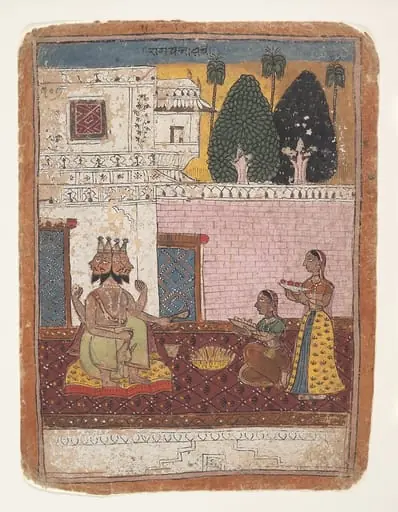
Rama, Sita, and Lakshmana visit the hermitage of the sage Bharadvaja at Prayaga, from Chapter 48 of the Ayodhya Kanda (Book of Ayodhya) of a Ramayana (Rama’s Journey)
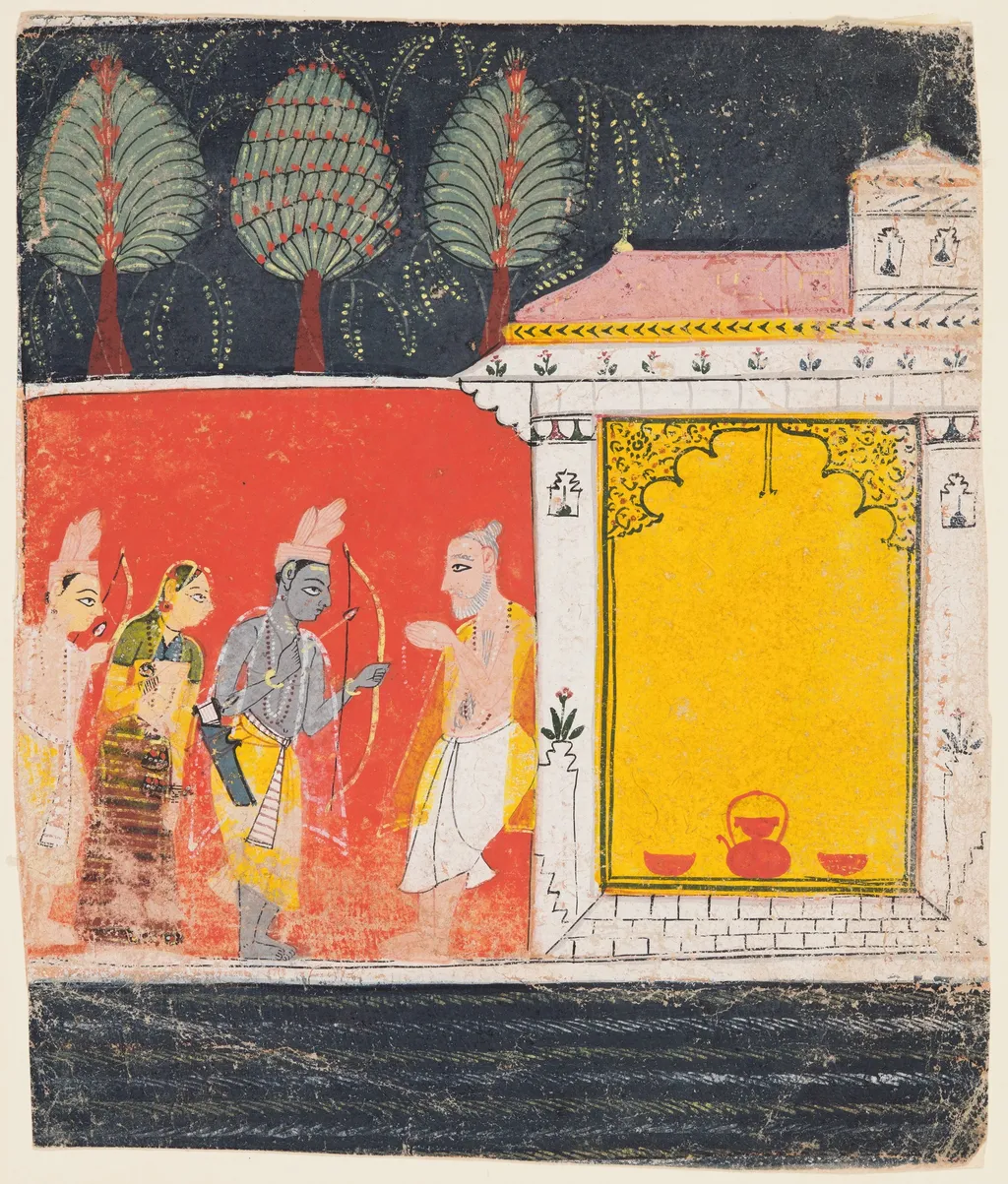
Rama, Sita, and Lakshmana visit the hermitage of the sage Bharadvaja at Prayaga, from Chapter 48 of the Ayodhya Kanda (Book of Ayodhya) of a Ramayana (Rama’s Journey) is an unspecified painting. It dates from 1650 and is held in the collection of the Cleveland Museum of Art. The work depicts three figures—Rama, Sita, and Lakshmana—standing within a vivid red doorway.
About this work
Overview
The work depicts three figures—Rama, Sita, and Lakshmana—standing within a vivid red doorway. Rama holds a staff, Sita is identified by a green sash, and Lakshmana by a yellow cloth draped over his shoulder. A small seated figure is visible behind them on a yellow wall, while three stylized trees bearing red fruit appear outside against a dark sky.
Subject & Meaning
The scene illustrates a episode from the Ayodhya Kanda of the Ramayana, in which the royal siblings visit the hermitage of the sage Bharadvaja at Prayaga. The composition emphasizes the sanctity of the sage’s abode and the devotion of the protagonists, underscoring themes of hospitality, piety, and the intertwining of royal duty with spiritual guidance.
Technique & Style
Executed in the miniature painting tradition of early‑modern India, the piece employs flat, saturated colors and simplified forms characteristic of 17th‑century courtly art. The bright red doorway, yellow wall, and stylized foliage are rendered with precise brushwork, while the figures are outlined in fine lines, creating a decorative yet narrative surface.
History & Provenance
The painting originates from the Indian subcontinent and dates to the 1600s, a period when miniature works were produced for royal patrons. It entered the collection of The Cleveland Museum of Art through acquisition in the early 20th century, where it now contributes to the museum’s representation of South Asian visual culture.
Artist & collection