Artwork
“Takebun,” from the Musical Drama “The New Piece” (Shinkyoku)
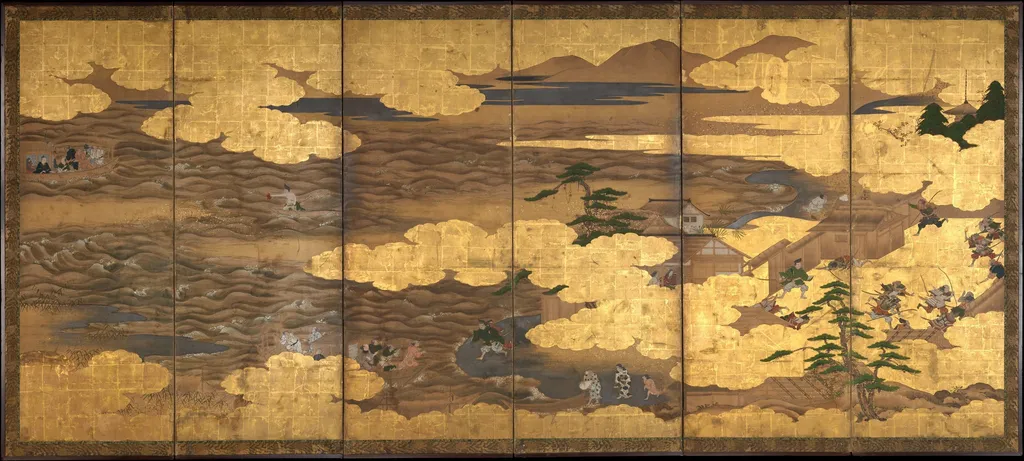
“Takebun,” from the Musical Drama “The New Piece” (Shinkyoku) is an unspecified painting. It dates from 1617 and is held in the collection of the Metropolitan Museum of Art.
About this work
Overview
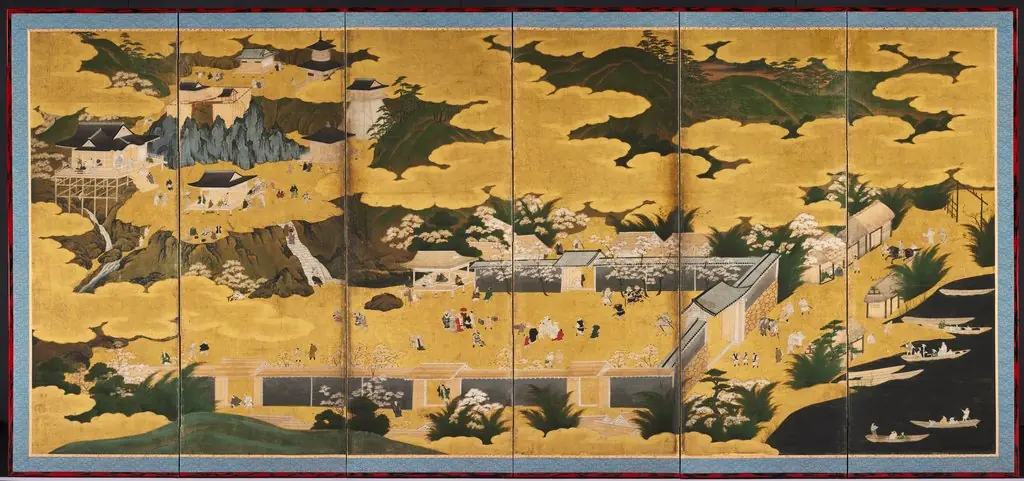
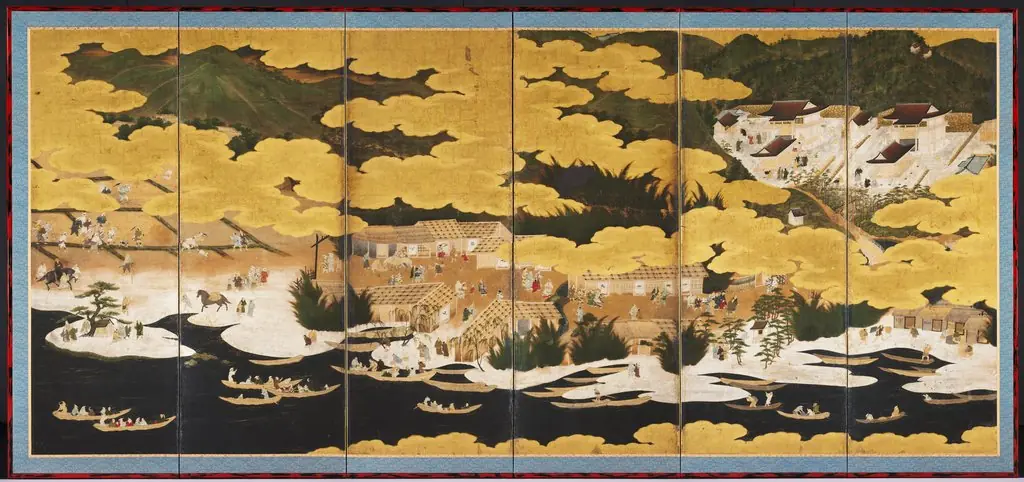
The work titled “Takebun,” created for the musical drama Shinkyoku, presents a broad, flattened landscape dominated by gentle hills, a meandering river, and a sky dotted with sparse clouds. Small groups of figures move on foot, on horseback, or gather near modest structures and trees, all set against a luminous gold ground that suggests warm daylight.
Subject & Meaning
The composition appears to depict a narrative moment from the stage production, with travelers and performers traversing the terrain, perhaps enacting a scene of communal activity or pilgrimage. The arrangement of figures and architecture hints at a story unfolding within an open, pastoral setting.
Technique & Style
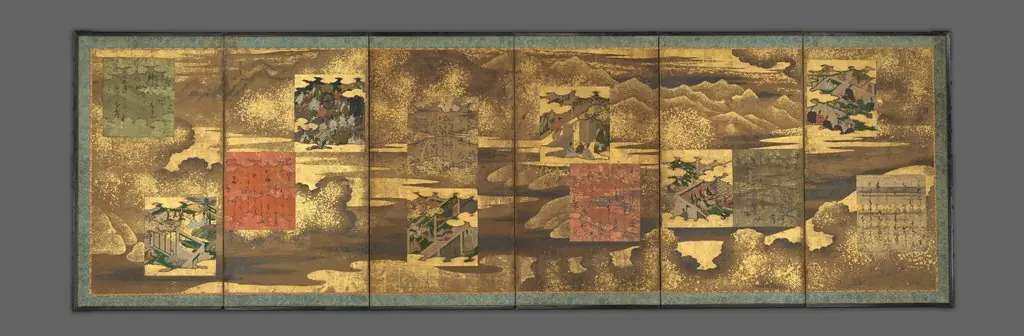
Executed in a palette of earthy golds, muted greens, and soft blues, the painting employs flat areas of color outlined in darker tones, reinforcing its two‑dimensional quality. The gold background functions both as a unifying field and as a visual metaphor for sunlight, while the simplified forms convey a stylized, decorative aesthetic typical of Japanese theatrical artwork.
History & Provenance
“Takebun” was produced as part of the visual program for the musical drama “The New Piece” (Shinkyoku). It is now part of the collection at the Metropolitan Museum of Art, where it can be viewed in person as an example of collaborative stage design and painting from the period.
Artist & collection