Artwork
Maharana Ari Singh II of Mewar (r. 1761–73) with His Consort on a Terrace
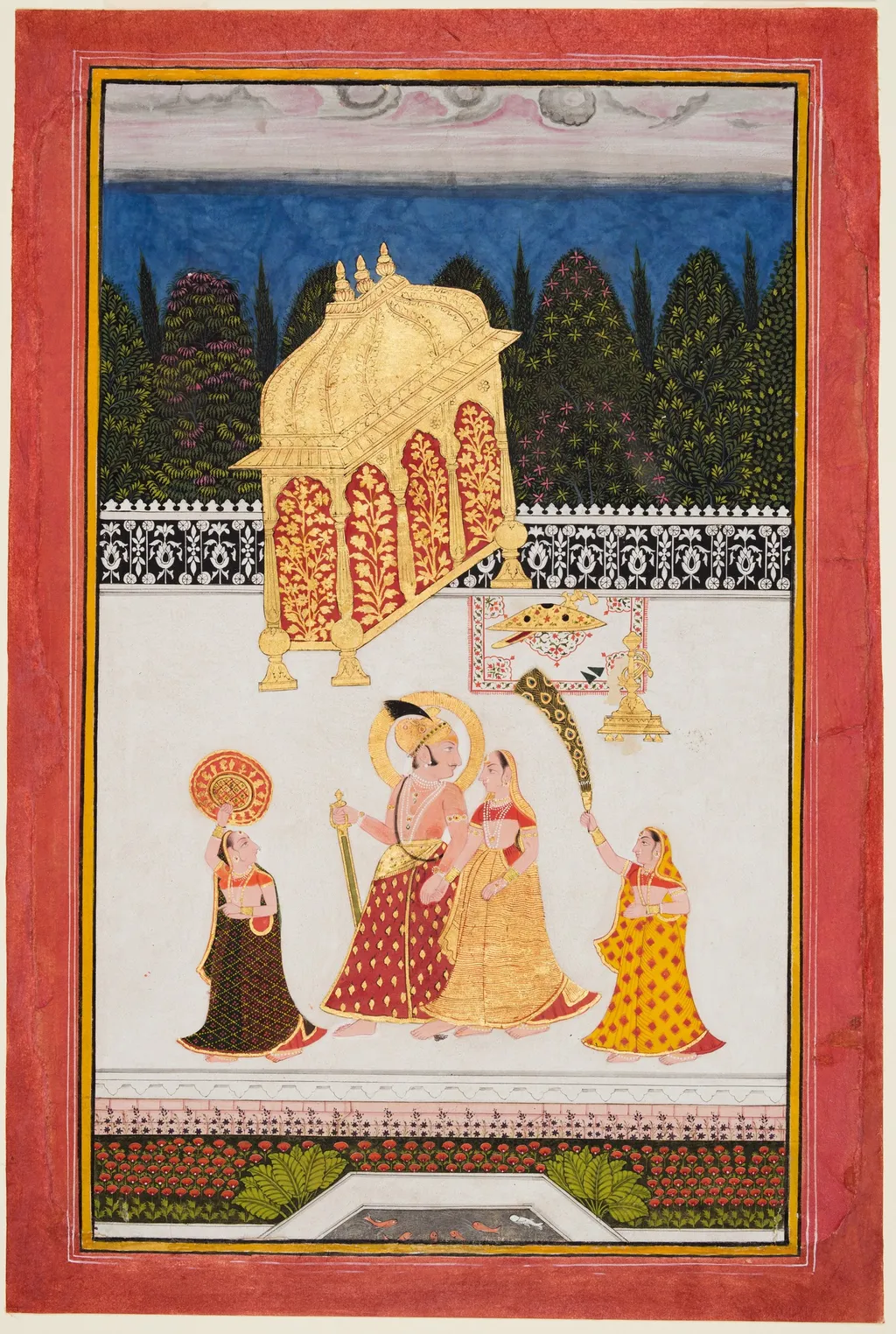
Maharana Ari Singh II of Mewar (r. 1761–73) with His Consort on a Terrace is an unspecified painting. It dates from 1761 and is held in the collection of the Cleveland Museum of Art. The work portrays Maharana Ari Singh II of Mewar, who ruled from 1761 to 1773, together with his consort on an elevated terrace.
About this work
Overview
Both figures are positioned amid abundant foliage, with the ruler in a red and gold costume brandishing a sword, while the consort wears a yellow sari.
The work portrays Maharana Ari Singh II of Mewar, who ruled from 1761 to 1773, together with his consort on an elevated terrace. Both figures are positioned amid abundant foliage, with the ruler in a red and gold costume brandishing a sword, while the consort wears a yellow sari. A secondary female figure in black holds a round object aloft, and a richly ornamented golden structure rises in the background, emphasizing the scene’s opulent setting.
Subject & Meaning
The composition foregrounds the Maharana’s authority and marital alliance, symbolized by the sword and the paired presence of his wife. The additional woman, possibly a attendant or deity, and the elevated terrace suggest a ceremonial or courtly context, while the luxuriant vegetation and gilded architecture reinforce the power and prosperity associated with the Mewar court during the mid‑eighteenth century.
Technique & Style
Executed in a traditional Indian court painting manner, the piece employs vivid pigments—particularly reds, golds, and yellows—to delineate clothing and decorative elements. Fine brushwork renders intricate patterns on the golden backdrop and the surrounding foliage, while the figures are rendered with a flat, stylized approach typical of Rajput miniature traditions, emphasizing hierarchical status over naturalistic depth.
History & Provenance
The portrait originates from the late 18th‑century Mewar court, a period when regional rulers commissioned artworks to document lineage and legitimize rule. Though specific patronage records are scarce, the painting likely formed part of a larger series of royal portraits. It entered museum collections through 20th‑century acquisitions of Indian princely art, where it now serves as a visual record of Maharana Ari Singh II’s reign.
Artist & collection