Artwork
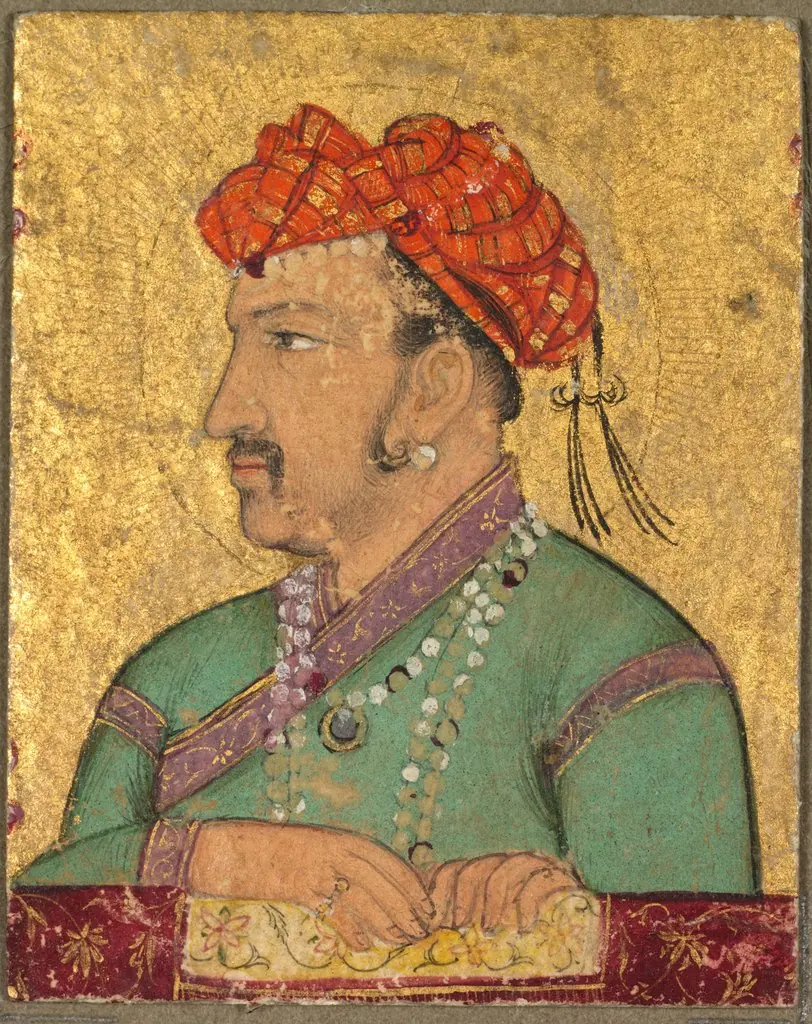
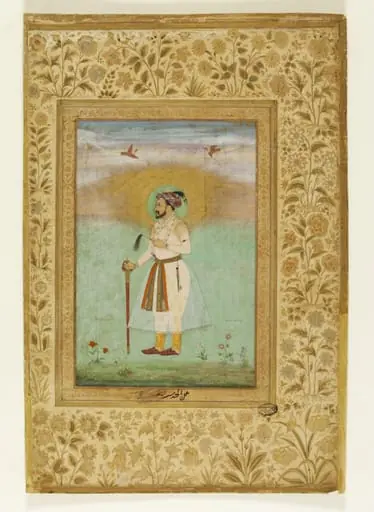
Portrait of Emperor Jahangir
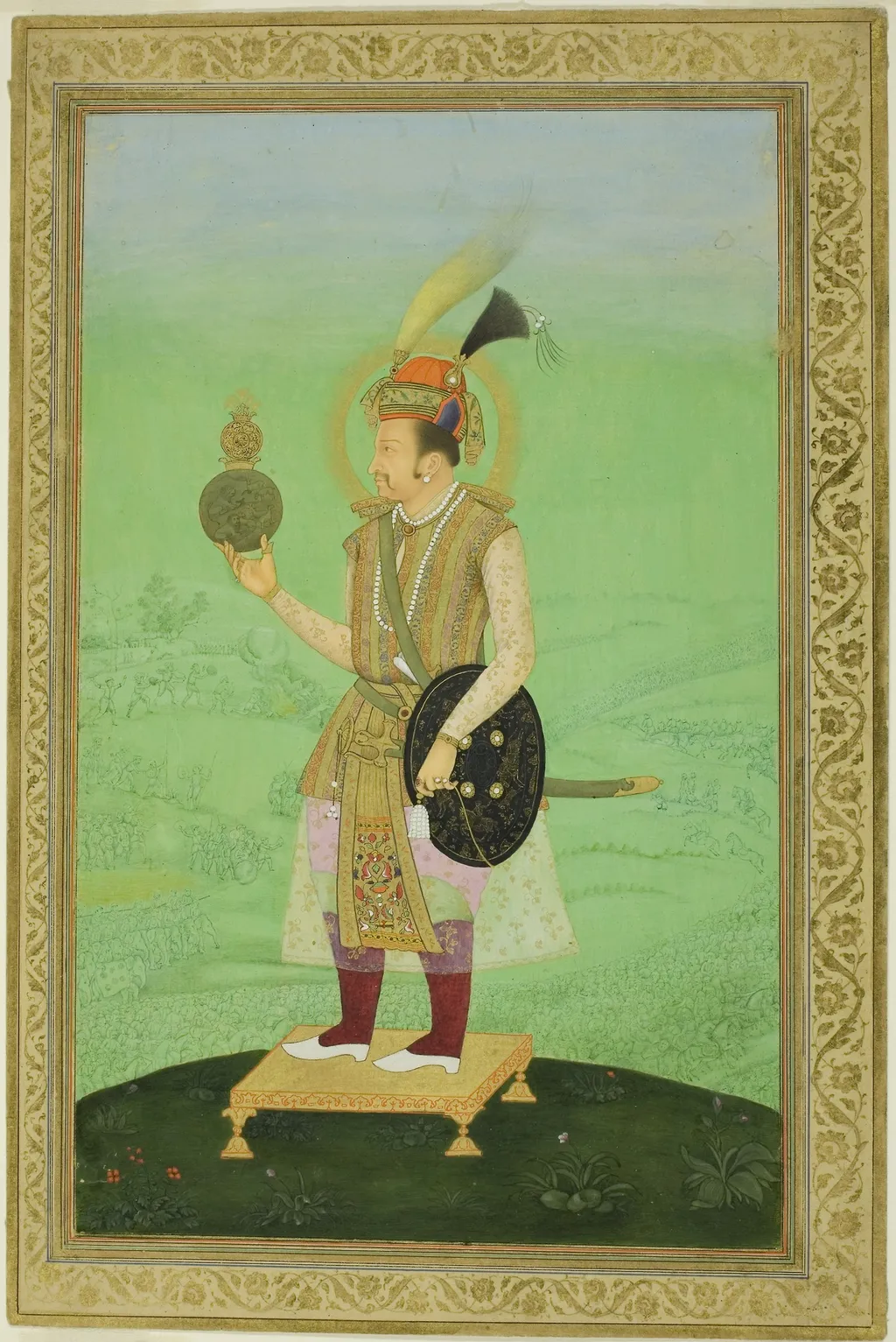
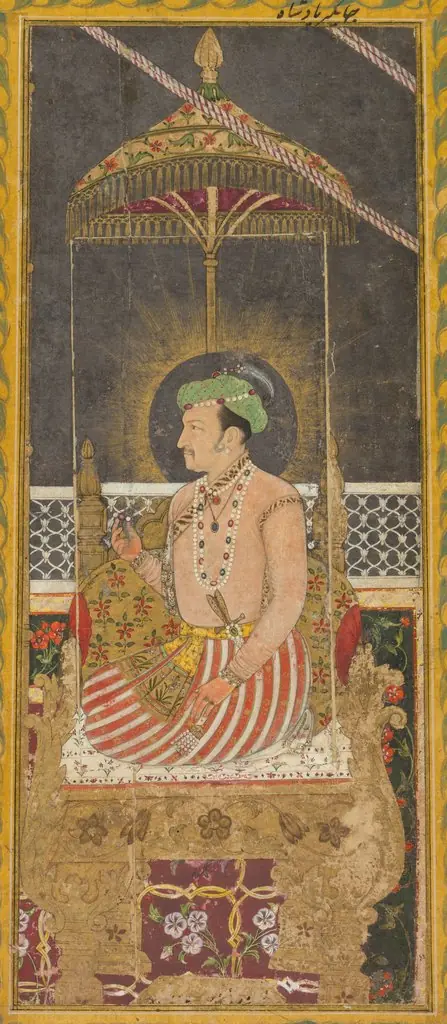
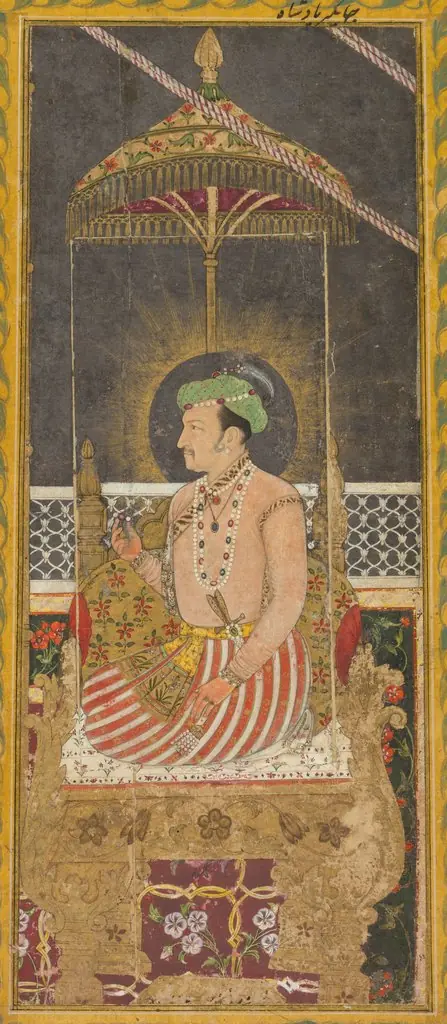
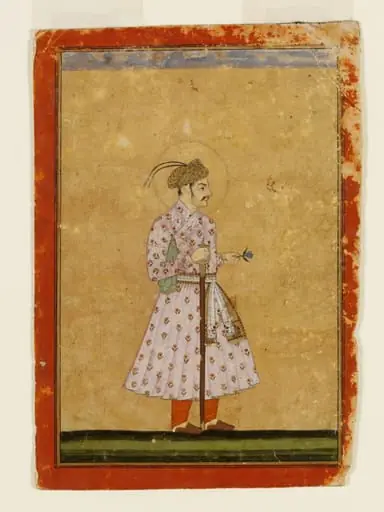
Portrait of Emperor Jahangir is an unspecified painting by the Mughal Painting artist Unknown. It dates from 1800 and is held in the collection of the Art Institute of Chicago. The work is a portrait of the Mughal emperor Jahangir, rendered in oil on canvas.
About this work
Overview
The work is a portrait of the Mughal emperor Jahangir, rendered in oil on canvas.
The work is a portrait of the Mughal emperor Jahangir, rendered in oil on canvas. The figure stands on a modest raised platform, dressed in richly colored attire that includes a tall, feather‑adorned hat, a green jacket embroidered with intricate patterns, and a beaded necklace. He holds a dark spherical object in one hand and a circular shield adorned with gold motifs in the other, set against a muted green landscape with faint foliage and architectural hints.
Subject & Meaning
Jahangir is presented as a sovereign figure, his illuminated complexion and elaborate costume emphasizing royal authority and personal refinement. The objects he bears—often interpreted as a symbolic globe and a shield—suggest both worldly dominion and martial protection, reinforcing the emperor’s role as a ruler who balances governance with the defense of his realm.
Technique & Style
The painter employs a delicate layering of pigments to achieve luminous skin tones and the sheen of jeweled fabrics. Fine brushwork delineates the intricate patterns on the jacket and the feathered headdress, while a soft, atmospheric background recedes, allowing the figure to dominate the composition. The subtle gradations of green create depth without detracting from the central portrait.
History & Provenance
Created during Jahangir’s reign in the early 17th century, the portrait reflects the Mughal court’s patronage of portraiture as a means of documenting imperial identity. The painting entered the collection of the Art Institute of Chicago in the 20th century, acquired through a private donation that expanded the museum’s holdings of South Asian art.
Context
Mughal portraiture of this period combined Persian artistic conventions with indigenous Indian elements, resulting in a distinctive visual language that highlighted the emperor’s personal attributes alongside courtly splendor. Such works were often displayed in royal chambers or diplomatic settings to convey the emperor’s cultivated image to both domestic and foreign audiences.
Legacy
The portrait remains a key example of Mughal court painting, illustrating the sophisticated synthesis of realism and decorative detail that characterized the empire’s visual culture. It continues to inform scholarly understanding of imperial iconography and the artistic exchanges that shaped early modern South Asian art.
Artist & collection

 Domestic Scene
 Giacomo and Cardinal Marco, investing Andrea, Abbot of San Zeno, with his Benefice
 The Nymph of Fontainebleau
 Portrait of a Woman
 Madonna and Child with Saints in the Enclosed Garden
 Venus and Minerva
 Family Group of Four on Sofa
 Wall painting from Room H of the Villa of P. Fannius Synistor at Boscoreale