Artwork
Saint Jerome
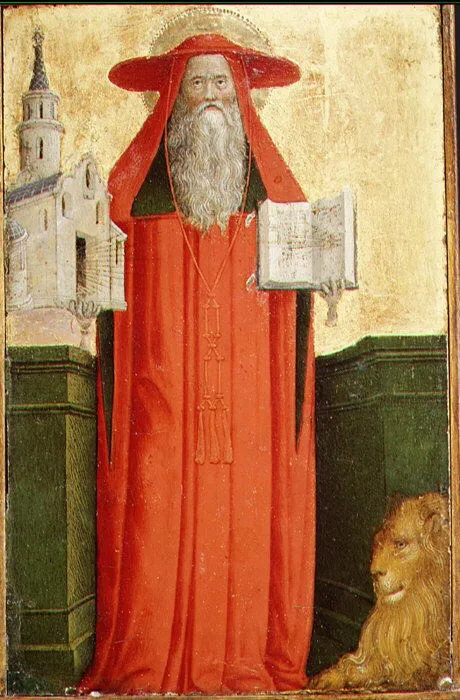
Saint Jerome is a tempera painting. It dates from 1440 and is held in the collection of the Metropolitan Museum of Art.
About this work
Overview
The composition features the saint, identifiable by his long white beard and a lion at his feet, set against a simple architectural backdrop and a gold sky.
This tempera painting depicts Saint Jerome, a prominent figure in Christian history. The composition features the saint, identifiable by his long white beard and a lion at his feet, set against a simple architectural backdrop and a gold sky. His vibrant red attire creates a strong visual contrast with the more subdued background elements, drawing the viewer's attention to the central figure and his attributes.
Subject & Meaning
The painting portrays Saint Jerome, a fourth-century theologian renowned for translating the Bible into Latin. He is traditionally shown with a lion, referencing a popular medieval legend where Jerome compassionately removed a thorn from the creature's paw. This act of kindness led the lion to become his loyal companion, symbolizing the saint's wisdom and his ability to tame wildness through spiritual grace.
Technique & Style
Executed in tempera, the painting exhibits a clear, defined style characteristic of the medium. The artist employs a limited palette, notably using a striking red for Jerome's robes and hat, which stands out against the muted tones of the background building and the flat gold sky. This contrast emphasizes the saint's presence, while the simple, almost stark setting focuses attention on the narrative elements and symbolic figures.
Artist & collection
