Artwork
Children Playing with a Goat
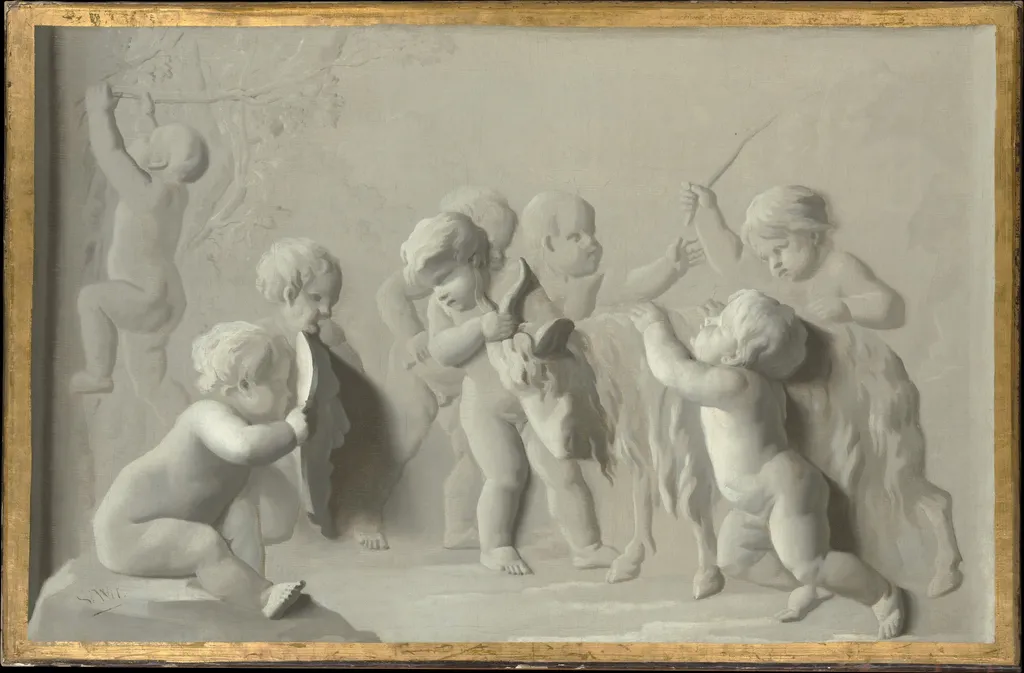
Children Playing with a Goat is an oil painting. It dates from 1800 and is held in the collection of the Metropolitan Museum of Art. This 18th‑century oil on canvas presents a monochrome scene of children interacting with a goat.
About this work
Overview
This 18th‑century oil on canvas presents a monochrome scene of children interacting with a goat. Rendered in the grisaille manner associated with Jacob de Wit, the work imitates the appearance of a sculptural relief, creating the illusion of marble figures set against a plain, light background. The painting belongs to the Metropolitan Museum of Art’s collection.
Subject & Meaning
A group of unclothed youths gathers around a goat, some standing, others seated, and one child crawling on the ground. Their gestures suggest gentle play and petting, evoking themes of innocence and pastoral leisure. The composition mirrors a classical relief, reinforcing the timeless quality of youthful amusement in a rural setting.
Technique & Style
Executed in grisaille, the artist employs subtle gradations of tone to model the bodies, achieving a three‑dimensional effect reminiscent of stone sculpture. Soft shading defines musculature and facial features, while the uniform background eliminates distraction, focusing attention on the figures’ forms and the interplay of light and shadow characteristic of chiaroscuro.
History & Provenance
The painting follows a design after a relief by the 17th‑century sculptor François Duquesnoy, a common practice in decorative painting of the period. Created in the style of Jacob de Wit, whose small-scale monochrome works are termed “witjes,” it entered the Metropolitan Museum of Art’s holdings through acquisition in the early 20th century.
Context
Grisaille paintings like this one were popular in Dutch and Flemish interiors, serving as painted imitations of sculptural reliefs that could be displayed without the expense of actual stone. The work reflects the 18th‑century taste for classical motifs and the educational value placed on scenes of youthful virtue and simple pleasures.
Artist & collection
