Artwork
Portrait of Catherine I
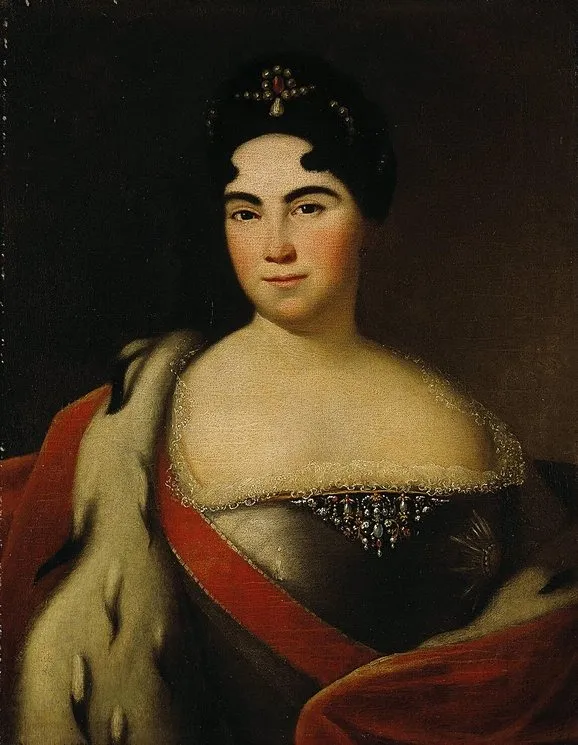
Portrait of Catherine I is an oil painting. It dates from 1713 and is held in the collection of the Hermitage Museum. The work is an oil painting portraying a woman in sumptuous attire.
About this work
Overview
The work is an oil painting portraying a woman in sumptuous attire. She is shown wearing a red robe edged with fur, a glittering necklace, and a decorative crown that frames her pulled‑back hair. Her gaze meets the viewer directly, and a dark, unadorned background isolates her figure, emphasizing the richness of her garments and the solemnity of her expression.
Subject & Meaning
The sitter is Catherine I, the second wife of Peter the Great and Empress of Russia from 1725 to 1727. The prominent necklace she wears is the Order of Saint Andrew, the highest Russian chivalric honor, signalling her imperial status and the legitimacy of her rule. The calm, forward‑looking pose conveys authority tempered by composure, typical of royal portraiture of the period.
Technique & Style
Executed in oil on canvas, the painting employs strong contrasts of light and shadow to model the figure, a technique reminiscent of chiaroscuro.
Executed in oil on canvas, the painting employs strong contrasts of light and shadow to model the figure, a technique reminiscent of chiaroscuro. The dark backdrop functions as a neutral field that heightens the luminosity of the red robe and the reflective surfaces of the jewelry. Fine brushwork renders the texture of fur and fabric, while the smooth treatment of the face suggests a polished, idealized likeness.
History & Provenance
Created in the early 18th century, the portrait entered the Russian imperial collection shortly after Catherine’s reign and remained in the royal holdings through successive dynastic changes. It later passed to state museums during the Soviet era, where it has been conserved and displayed as part of the narrative of Russia’s imperial portrait tradition.
Context
The painting reflects the broader European influence on Russian court culture after Peter the Great’s westernizing reforms. By adopting a style that emphasizes regal opulence and controlled expression, the work aligns Catherine I with contemporary monarchs of Europe, while the inclusion of the Order of Saint Andrew underscores the uniquely Russian symbols of authority that were being integrated into that visual language.
Artist & collection
