Artwork
Portrait of Theobald Wolfe Tone (1763-1798)
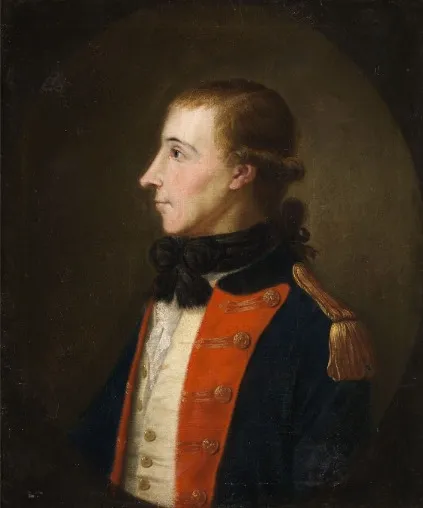
Portrait of Theobald Wolfe Tone (1763-1798) is an oil painting by Unknown. It is held in the collection of the National Gallery of Ireland.
About this work
Overview
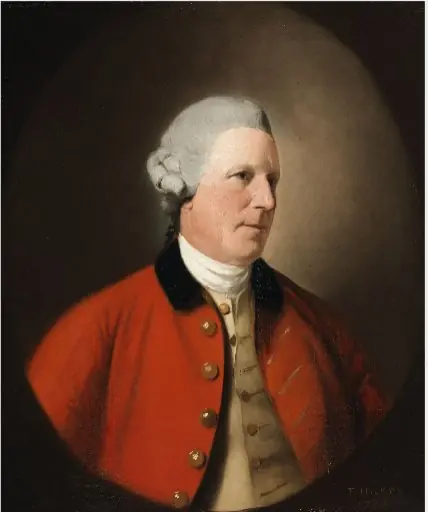
This oil painting presents a formal portrait of Theobald Wolfe Tone, an Irish revolutionary figure. Rendered with careful attention to detail, the subject is depicted in full-length, standing against a neutral brown backdrop. The composition emphasizes his presence through controlled lighting and precise rendering of fabric and texture, conveying a sense of dignity and resolve.
Subject & Meaning
The dark blue coat, red and white accents, and gold tassel align with contemporary officer dress, subtly signaling his leadership and political ambition.
Theobald Wolfe Tone, a key architect of Irish republicanism, is portrayed in attire suggesting military rank, reflecting his role in the United Irishmen movement. The dark blue coat, red and white accents, and gold tassel align with contemporary officer dress, subtly signaling his leadership and political ambition. His gaze, direct and composed, invites contemplation of his ideals and the turbulent era he helped shape.
Technique & Style
The artist employs chiaroscuro to model the figure with subtle gradations of light and shadow, enhancing the three-dimensionality of the face and costume. Brushwork is restrained yet precise, particularly in the rendering of the cravat and metallic tassel. The muted background isolates the subject, focusing attention on his expression and attire without distraction, characteristic of late 18th-century portraiture.
History & Provenance
The portrait was likely painted during Tone’s lifetime, possibly in the 1790s, when he was active in Ireland and France. Its early ownership remains undocumented, but it entered institutional collections in the 19th century, likely through familial or political networks. The painting’s survival reflects Tone’s enduring significance in Irish historical memory.
Context
Painted amid rising revolutionary fervor in Ireland and Europe, this portrait captures a moment when political identity was increasingly expressed through personal appearance. Tone’s uniform-like attire echoes the influence of Enlightenment ideals and military reform movements. Such portraits served not only as likenesses but as political statements, affirming the subject’s role in shaping national destiny.
Legacy
The portrait remains one of the most recognized images of Wolfe Tone, frequently reproduced in historical texts and public memorials. Its restrained elegance and symbolic details have contributed to his enduring representation as a principled revolutionary. Though not widely known outside Ireland, it anchors visual memory of the 1798 rebellion and its leaders.
Artist & collection

 Domestic Scene
 Giacomo and Cardinal Marco, investing Andrea, Abbot of San Zeno, with his Benefice
 The Nymph of Fontainebleau
 Portrait of a Woman
 Madonna and Child with Saints in the Enclosed Garden
 Venus and Minerva
 Family Group of Four on Sofa
 Wall painting from Room H of the Villa of P. Fannius Synistor at Boscoreale
 Portrait of prince Augustus Ferdinand von Hohenzollern (1730–1813)
 Portrait of an unknown Man
 Portrait of Michael Cormak (1771-1799)
 Portrait of Louis François Joseph de Bourbon, Prince of Conti in hunting costume
 General Sir William Maxwell
 Don Juan Lorenzo Gutiérrez Altamirano de Velasco y Flores
 Charles-René Magon, rear admiral
 Portrait of General Sir Charles Grey, later 1st Earl Grey
 Francis Rawdon, 1st Marquess of Hasting and 2nd Earl of Moira
 Governor George Clinton
 Joseph Howell, Jr.
 Sir Armine Wodehouse, 5th Baronet