Artwork
Painted Banner (Thangka) of Milarepa on Mount Kailasha
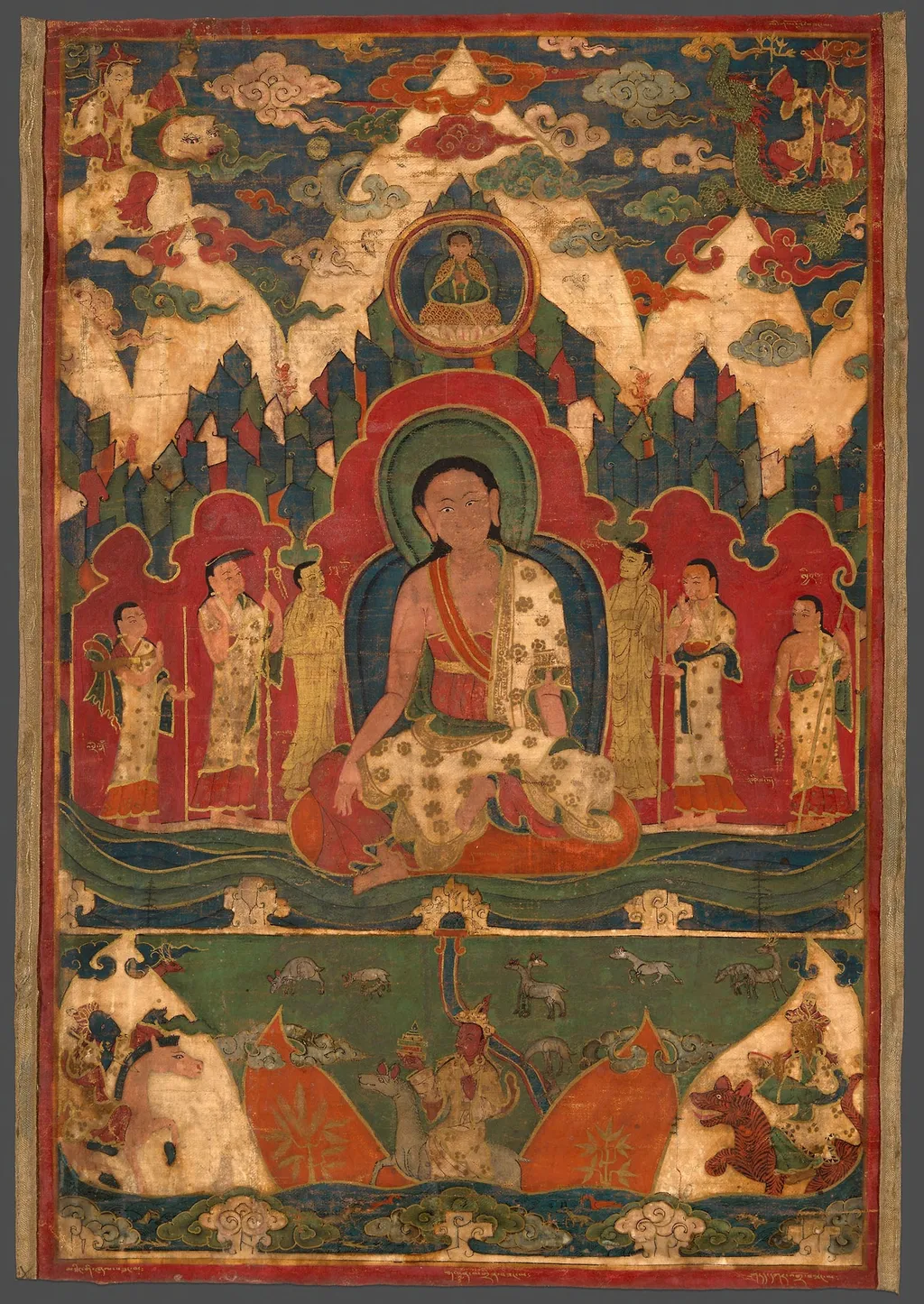
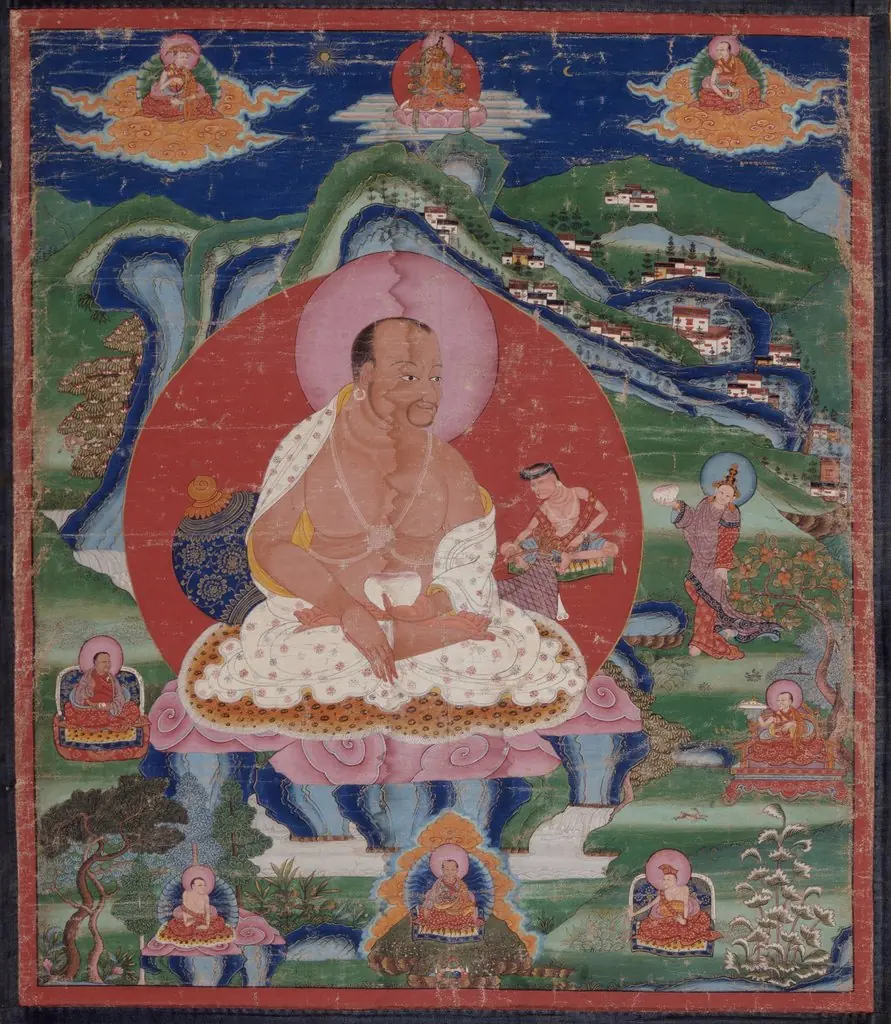
Painted Banner (Thangka) of Milarepa on Mount Kailasha is an unspecified painting by Unknown. It dates from 1500 and is held in the collection of the Art Institute of Chicago.
About this work
Overview
Around him stand and sit numerous disciples and attendants, all clad in traditional robes, while wildlife such as deer and tigers populate the lower register.
The thangka depicts the Tibetan yogi Milarepa seated in meditation on a vivid red cushion, his white robe edged with a red sash, and a luminous halo encircling his head. Around him stand and sit numerous disciples and attendants, all clad in traditional robes, while wildlife such as deer and tigers populate the lower register. The backdrop blends saturated reds, blues, and greens, suggesting clouds and distant mountains that evoke the sacred Mount Kailash.
Subject & Meaning
Milarepa, a central figure in Tibetan Buddhism, is shown in a contemplative pose that emphasizes his attainment of enlightenment. The surrounding figures likely represent his followers and spiritual companions, illustrating the transmission of his teachings. The inclusion of animals—deer symbolizing gentleness and tigers denoting power—reflects the harmony between spiritual insight and the natural world, a recurring theme in Milarepa’s hagiographies.
Technique & Style
Executed as a painted banner, the work follows the thangka tradition of using mineral pigments on cotton or silk, applied in fine layers to achieve luminous color fields. The composition relies on a flat, decorative approach, with bold outlines and stylized forms that prioritize symbolic clarity over naturalistic perspective. The halo, intricate patterns on the robes, and the vivid chromatic contrasts are characteristic of Tibetan devotional painting.
History & Provenance
The banner originates from the Tibetan plateau, likely produced in the 17th or 18th century for ritual display in a monastery dedicated to Milarepa. Its provenance traces through private collections before entering a museum setting in the early 2000s, where it was conserved and catalogued as part of a broader acquisition of Himalayan religious art.
Context
Mount Kailash, revered as the abode of the divine in Tibetan cosmology, serves as the mythic setting for Milarepa’s spiritual ascent. The thangka would have been unfurled during festivals or teaching sessions, providing visual focus for devotees. Its iconography aligns with the broader corpus of Milarepa imagery that underscores his role as a wandering hermit who attained realization through rigorous practice.
Artist & collection

 Domestic Scene
 Giacomo and Cardinal Marco, investing Andrea, Abbot of San Zeno, with his Benefice
 The Nymph of Fontainebleau
 Portrait of a Woman
 Madonna and Child with Saints in the Enclosed Garden
 Venus and Minerva
 Family Group of Four on Sofa
 Wall painting from Room H of the Villa of P. Fannius Synistor at Boscoreale
 Previous Birth Stories of the Buddha
 Buddha Shakyamuni and Narrative Scenes
 The Life of Milarepa (1040-1123)
 The Jina Buddha of Infinite Light (Amitabha) in His Pure Land Paradise (Sukhavati)
 Untitled
 White Mahakala
 Sonam Tsemo (1142-1182) and His Lineage
 Padma Dorje (1128-88) as a Mahasiddha (Great Adept) and Lamas